Dogenzaka Manmosu (Shibuya): Guide to the Ticket Machine, Noodle Selection, and Dining Experience for Rich Tonkotsu Gyokai Tsukemen
Just a 3-minute walk from Keio Inokashira Line Shibuya Station Avenue Exit, along Dogenzaka, lies Dogenzaka Manmosu, an 11-seat counter-style specialty shop for rich tonkotsu gyokai tsukemen. This guide, based on our actual visit on Friday, May 29, 2026, covers everything from buying your ticket first and joining the queue, to answering questions about noodle type, amount, 'atsumori' (warm noodles), and spiciness while waiting. We'll explain how to choose the signature 'haigamen' (wheat germ noodles), how to enjoy the thick soup like soba, and how to finish with 'warisupu' (diluted soup). This comprehensive guide ensures international travelers can visit with confidence.


🦣Dogenzaka Manmosu at a Glance
| Item | Details |
|---|---|
| Difficulty | ★2 Standard (Easy to choose with a ticket machine featuring photos, but instructions are in Japanese only. Rated ★2 instead of ★1 because noodle type and quantity are verbally confirmed in Japanese while queuing.) |
| English Support | Ticket machine and in-store menu are Japanese only (ticket machine has photos). For noodles, just tell the staff 'haigamen' (wheat germ noodles) or your choice. |
| Payment | Cash only (Cards, e-money, and QR code payments are not accepted) |
| Waiting Time | Fast turnover, the line moves quickly. During our visit, we arrived at 19:39, waited outside with 5 people, and were seated at 19:55 (approx. 16 minutes). |
| Recommended For | Those who want rich tonkotsu gyokai tsukemen in Shibuya / International travelers trying tsukemen for the first time / Those who want to enjoy thick noodles or fragrant haigamen (wheat germ noodles). |
| Note | Very difficult to enter with large suitcases (lockers near the station are recommended) / Primarily counter seating, not suitable for long stays. |
| First Order Recommendation | Noko Tsukemen (Rich Tsukemen) ¥1,100 + the main 'futomen haigamen' (thick wheat germ noodles). Normal portion (200g); if you want a hearty meal, an oomori (large portion, +¥100) is also an option. |
The latest operating hours, map, payment information, and traveler-friendliness difficulty can also be found on the shop's page. It's always a good idea to check for any changes in holiday closures or business hours before your visit.
If you visit, we'd love to hear your review!
🦣What Kind of Shop is Dogenzaka Manmosu?
Dogenzaka Manmosu is a popular tsukemen shop, primarily with counter seating, perfect for those who want to enjoy rich tonkotsu gyokai tsukemen in Shibuya. While the ticket machine with photos makes ordering easy even for first-time visitors, staff will verbally ask about noodle type and quantity while you queue, so deciding on 'haigamen (wheat germ noodles) and futsu-mori (normal portion)' beforehand will ensure a smooth experience. It's ideal for those wanting a substantial tsukemen meal during their Shibuya sightseeing, international travelers trying tsukemen for the first time, and anyone looking to enjoy a rich seafood pork bone broth with unique noodles.
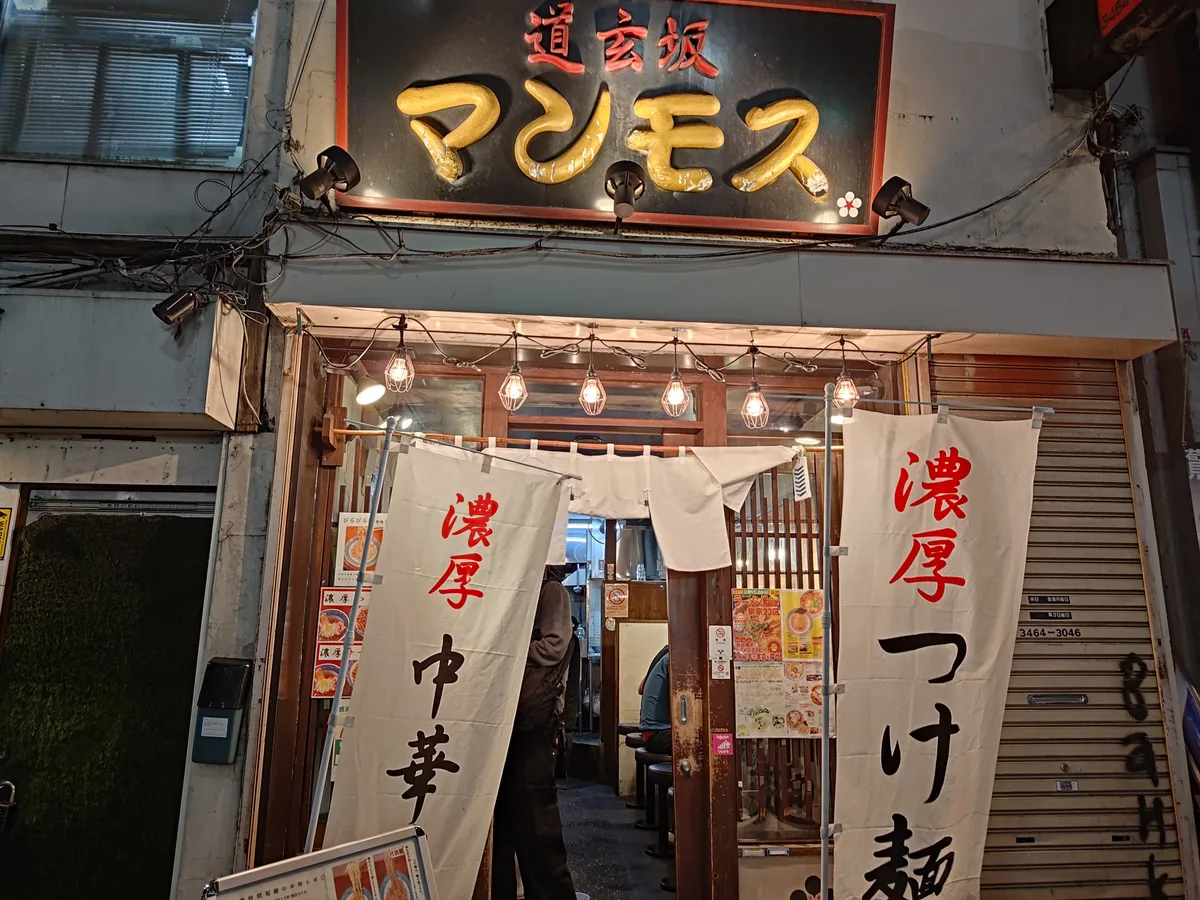
As indicated by the 'Noko' (rich/thick) on its sign, the main attraction here is a satisfying bowl featuring a thick tonkotsu gyokai (pork bone and seafood) dipping soup that generously coats the thick noodles. It's a highly regarded spot in the Shibuya-Shinsen area for 'rich tsukemen.' You can choose from three types of noodles, and while you're queuing after ordering, staff will confirm your noodle type and portion size.
Rich tonkotsu gyokai tsukemen in Tokyo can sometimes feel similar from shop to shop. However, Dogenzaka Manmosu stands out not only for the richness of its soup but also for its noodle options, particularly the fragrant and chewy 'haigamen' (wheat germ noodles) which is its main noodle. I felt that this is a type of tsukemen where you can enjoy the noodles as much as the impactful dipping soup.
The shop's name is often written as 'Dogenzaka Manmosu' in English, and some travelers might search for 'Mammoth.' For those looking for rich tsukemen in Shibuya, it's one of the easily accessible options from the station.

Ren
'Dogenzaka' is the name of the area uphill from Shibuya Station, and Manmosu is located along that slope. Shibuya is one of Tokyo's top sightseeing and shopping districts, so its location makes it easy to incorporate into your plans — after seeing the Scramble Crossing or Hachiko, after shopping, or before/after an evening drink. It's a specialty shop, but don't be intimidated! The staff will ask about your noodles and portion size while you're queuing, so if you have your answers ready, even first-timers can enjoy a smooth dining experience.
🎯Who This Shop is For / Who Should Be Aware
Recommended for these people
- Those who want to eat rich tsukemen in Shibuya
- International travelers who want to try tsukemen for the first time
- Those who like seafood pork bone-based soup
- Those who want to enjoy thick noodles or fragrant haigamen (wheat germ noodles)
- Those who want to casually eat ramen alone
- Those who want to know how to eat and order beforehand
People who should be aware
- People with large suitcases (the shop is narrow and luggage management is difficult)
- People without cash (payment is cash only)
- People who are uneasy with simple Japanese communication (noodle type and quantity are asked verbally)
- People who want to stay for a long time (primarily counter seating with fast turnover)
- People who want light ramen (rich tsukemen is the main dish)
📝What to Know Before Ordering
Ordering at Manmosu follows these steps: 'Buy your ticket first → Queue along the slope → Answer questions from staff while waiting.' The 'verbal confirmation while waiting' is what international travelers might find most confusing. However, the questions aren't difficult, and you'll be fine if you decide on the following points beforehand:
- 【Noodle Type】Haigamen (wheat germ noodles) / Mocchiri-men (chewy noodles) / Birabira-men (flat noodles) (If in doubt, choose the main noodle: 'Haigamen')
- 【Noodle Quantity】Futsu (normal, 200g) / Oomori (large) / Tokumori (extra-large) (both large and extra-large are extra charge)
- 【Optional】Atsumori (=warm noodles), if ordering spicy tsukemen, 5 levels of spiciness
Payment is cash only, so be sure to have ¥1,000 bills and coins ready. In the following sections, we will explain the ticket machine, queuing method, noodle selection, actual dining experience, and how to eat, in detail.
🎫Ticket Machine and How to Queue
The ticket machine is located next to the shop entrance. Although the text is only in Japanese, each button has a photo of the dish, which helps international visitors choose based on images. The reason we rated the difficulty ★2 instead of ★1, despite the photo-equipped vending machine, is because the text is in Japanese only, and additionally, staff verbally confirm noodle type and quantity in Japanese while you are queuing. The questions are simple, so there's no need to overthink it.
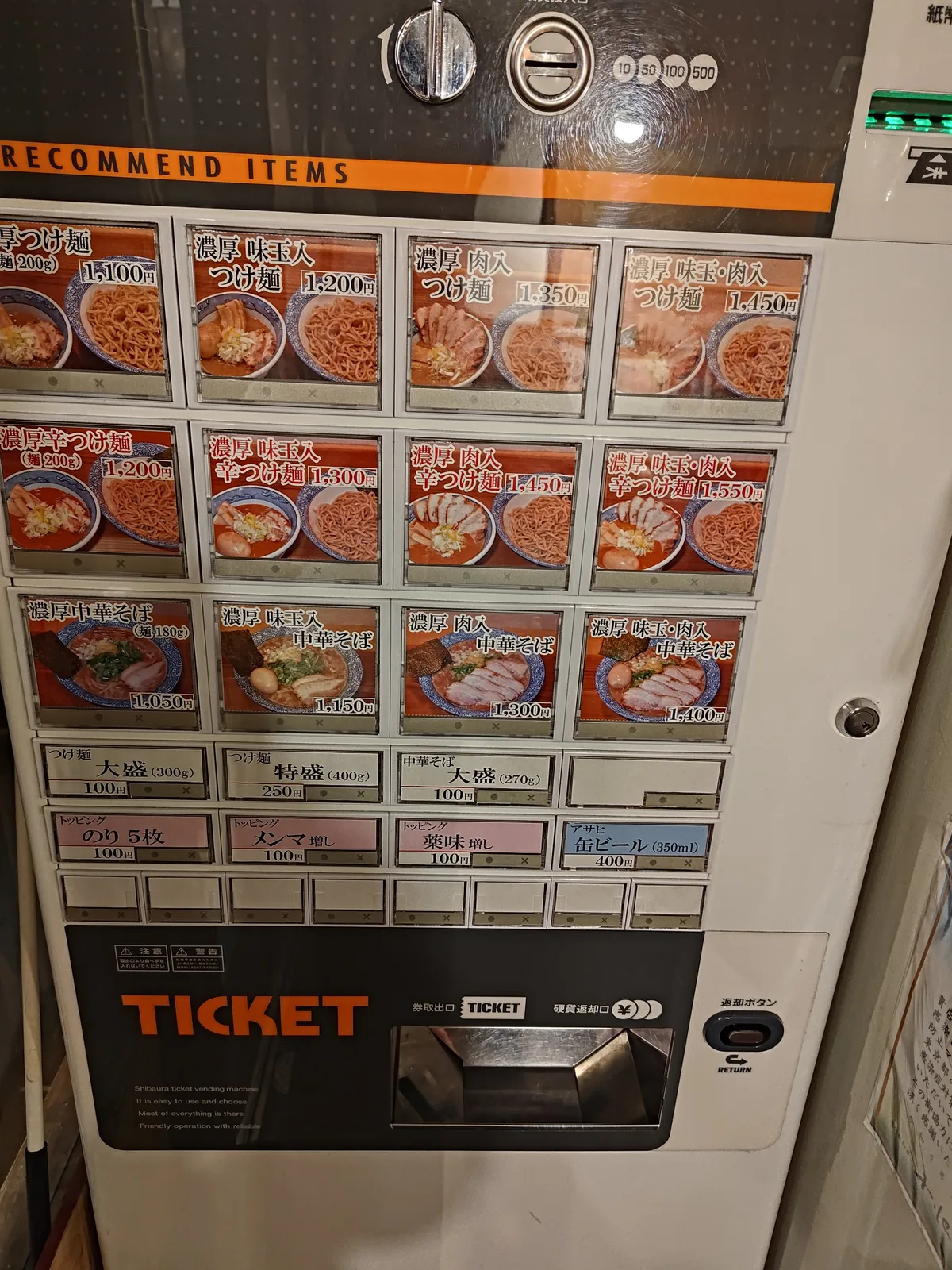
Menu (As of our visit on May 29, 2026)
| Menu Item | Price | Notes |
|---|---|---|
| ★Noko Tsukemen (Rich Tsukemen) (Noodles 200g) | ¥1,100 | ★Recommended for first-timers. The shop's signature rich tonkotsu gyokai tsukemen. You can choose your noodle type. |
| Noko Ajitama Tsukemen (Rich Tsukemen with Flavored Egg) | ¥1,200 | Includes ajitama (seasoned egg) topping |
| Noko Nikuiri Tsukemen (Rich Tsukemen with Extra Meat) | ¥1,350 | Extra chashu (roast pork slices) (This is what we tried for this article) |
| Noko Ajitama Nikuiri Tsukemen (Rich Tsukemen with Flavored Egg and Extra Meat) | ¥1,450 | All-inclusive: ajitama + extra chashu |
| Noko Kara Tsukemen (Rich Spicy Tsukemen) | ¥1,200 | Choose from 5 levels of spiciness (specify while queuing) |
| Noko Chuka Soba (Rich Chinese Soba / Ramen) | ¥1,050 | Warm ramen, not tsukemen |
| Tsukemen Oomori (Large Portion) | +¥100 | Noodles increased to 300g (extra charge) |
| Tsukemen Tokumori (Extra-Large Portion) | +¥250 | Noodles increased to 400g (extra charge) |
| Nori 5 slices / Menma / Yakumi (condiments) | ¥100 each | Toppings |
Prices may vary
The prices listed above were displayed on the ticket machine at the time of our visit on May 29, 2026. Prices may be revised, so please check the ticket machine at the shop for the latest pricing. There are also other combinations not listed in the table above, such as spicy tsukemen with ajitama or extra meat, and chuka soba.
How to Queue — Buy Your Ticket First, Then Line Up Along the Slope
Manmosu operates on a 'buy first' system: 'purchase your ticket first, then join the end of the line.' The front of the shop is the head of the queue, and the line extends uphill along Dogenzaka. There are signboards indicating where to line up, so you won't get lost.
- Purchase your meal ticket first at the ticket machine next to the shop entrance (cash only).
- Join the end of the line, which extends from the front of the shop (the head of the queue) uphill along the slope. There are signboards.
- While queuing, a staff member will come to collect your ticket and confirm the 'number of people' and 'noodle type.' If you want atsumori (warm noodles) or spicy tsukemen, you'll also state your preferred spiciness level at this time.
- Once a seat is available, you will be guided to it, and your dish will be served shortly after sitting down (in our case, about 3 minutes after being seated. The coordination is excellent, and service is quick).
Waiting time guide — The line moves quickly even if it looks long
During our visit for this article (Friday, May 29, 2026), we arrived at 19:39, waited outside with 5 people, were seated at 19:55, and our dish was served at 19:58. It took about 16 minutes from arrival to seating, and only about 3 minutes until the food was served, indicating excellent coordination in asking about noodle type and quantity while queuing. There are also reports of waiting for about 15 minutes with 9 people outside at around 12:30 PM on a Saturday, so even if the line looks long, the turnover is good, and it moves relatively quickly. While the queue extends during lunch and dinner peaks, waiting times are generally predictable.

Sophia
If it's your first time, being 'spoken to while queuing' might make you a little nervous, but they only ask two simple questions: 'How many people?' and 'Which noodles would you like?' If you're unsure about the noodles, just ask 'Osusume wa?' (What do you recommend?) and they'll suggest the haigamen (wheat germ noodles). Showing your ticket and using gestures with numbers will also convey your order perfectly, so don't worry!
🌾How to Choose Noodle Type, Quantity, and Spiciness
At Manmosu, you can choose from three types of noodles for your tsukemen. Staff will ask 'Men wa dore ni shimasu ka?' (Which noodles would you like?) while you're queuing, so it's smoother if you decide before entering the shop.
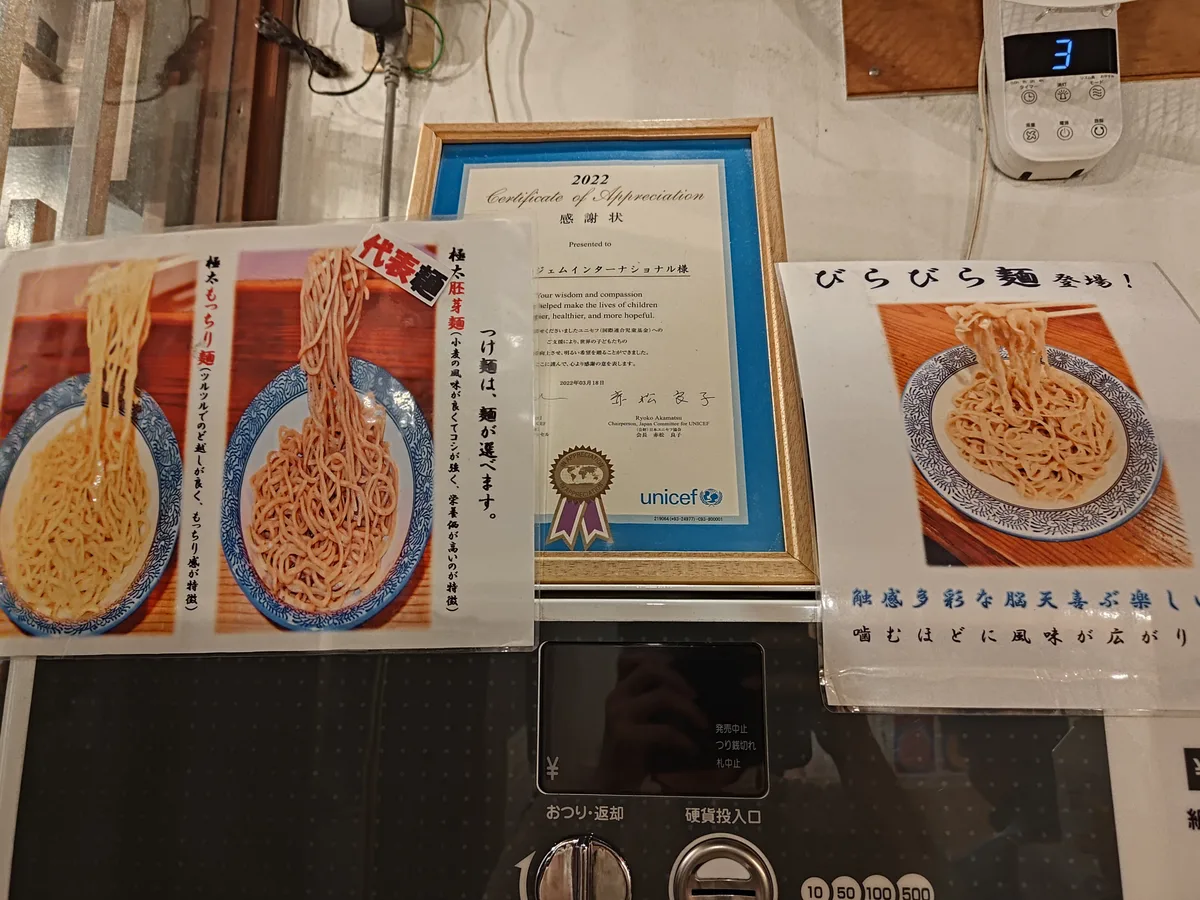
- 【Futomen Haigamen (Thick Wheat Germ Noodles)】Our main, signature noodles. Made by kneading wheat germ from domestic wheat, characterized by the fragrant aroma, sweetness, umami, strong chewiness, and bite of wheat. Also recommended by staff.
- 【Futomen Mocchiri-men (Thick Chewy Noodles)】Characterized by a smooth, easy-to-swallow texture. Choose these if you prioritize a pleasant mouthfeel.
- 【Birabira-men (Flat Noodles)】Wide, flat noodles. Offers a variety of textures where flavor spreads with each bite, recommended for those who want to try something unique.
- 【Atsumori (Warm Noodles)】An option to have your noodles served warm instead of chilled in cold water. Available if requested in advance. Good for those who dislike cold noodles or during colder seasons.

Dr. Hiro
'Haigamen' are unique noodles, and the in-store display even mentions the nutrients found in wheat germ. However, this article does not guarantee health benefits, so from a traveler's perspective, it's best to first understand them as 'distinctive noodles with a fragrant wheat aroma that stand up well to the rich dipping soup.' They have a stronger flavor and more presence when chewed than regular noodles, so if it's your first visit, it will be a bowl that really lets you experience what Dogenzaka Manmosu is all about.
The normal noodle portion is 200g. You can increase the portion to Oomori (large, 300g, +¥100) or Tokumori (extra-large, 400g, +¥250), but both come with an extra charge. Due to the shape of the bowl, the quantity doesn't look as overwhelming as it sounds, so the 200g normal portion is an easy volume for a lunch or dinner during sightseeing. Those accustomed to tsukemen or who want a hearty meal might consider the large portion.
If you like spicy food, there's the 'Noko Kara Tsukemen' (Rich Spicy Tsukemen), with 5 levels of spiciness. However, the spiciness levels are designed for those accustomed to super spicy ramen in Japan, so even if you have a high tolerance for spice, it's recommended to start with level 1 if it's your first time. There's no need to push yourself to choose a higher spiciness level during your trip; if you're not confident with spicy food, the regular tsukemen is a safer bet. Note that spicy tsukemen takes a bit longer to prepare as the noodles are cooked after the order is placed.
🍜Dining Report — Noko Nikuiri Tsukemen + Haigamen
For this article, we ordered the 'Noko Nikuiri Tsukemen' (Rich Tsukemen with Extra Meat), with the staff-recommended futomen haigamen (thick wheat germ noodles). Shortly after being seated, the bowl of thick dipping soup and the glossy, thick noodles were brought to our table.
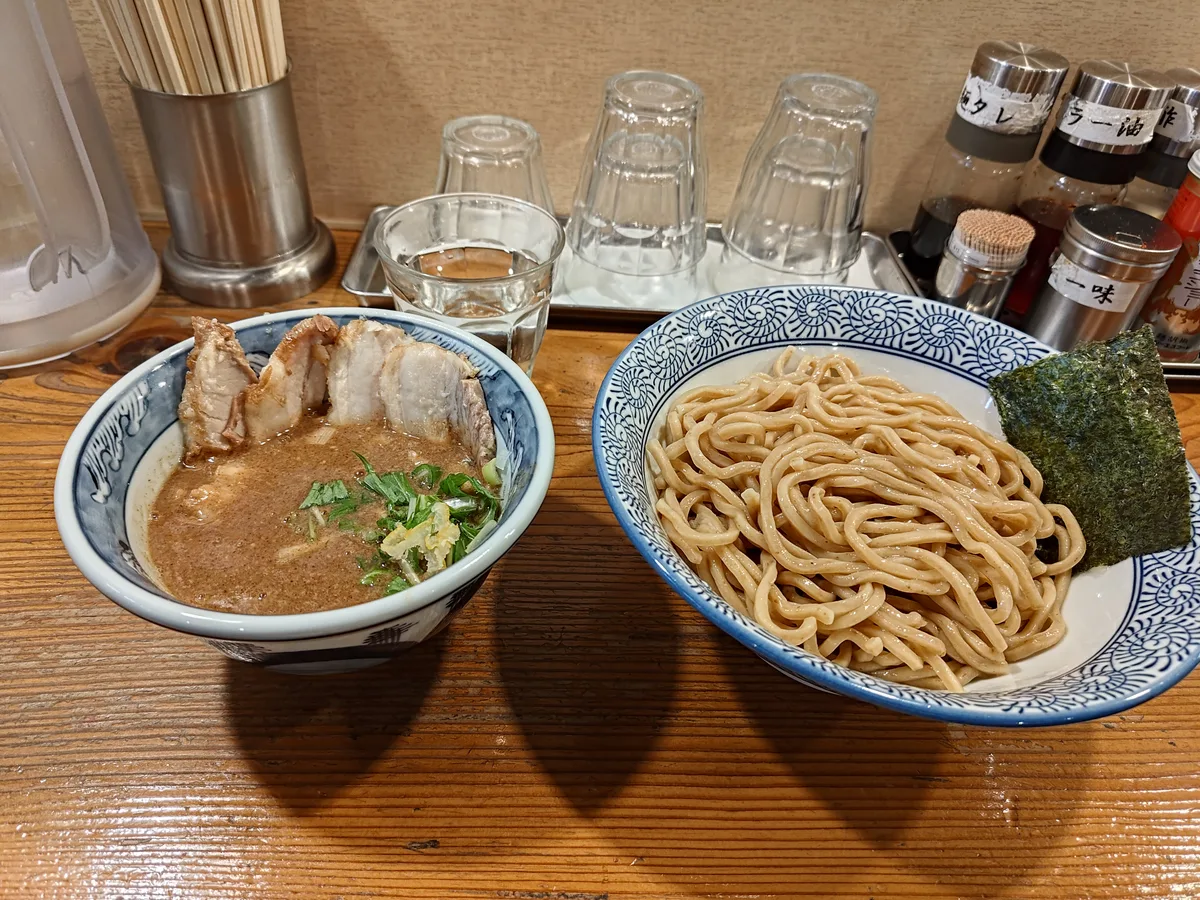
Soup (Dipping Broth) — Rich Tonkotsu Gyokai with a Strong Thickness, Yet Easy to Slurp Down
The dipping soup is incredibly rich with a distinct thickness, coating the noodles generously. While the richness of the tonkotsu (pork bone) is powerful, the robust umami of the gyokai (seafood) is well-balanced, preventing it from being too heavy and making it surprisingly easy to slurp down. The consistency was just right, offering a balanced flavor that kept us engaged until the last bite.
Noodles (Futomen Haigamen) — Strong Chewiness and Wheat Fragrance, Excellent Match for the Rich Soup
The futomen haigamen (thick wheat germ noodles) we chose had superb chewiness and a satisfying bite. Their strong wheat fragrance, sweetness, and umami expanded with every chew. The thick dipping soup adhered wonderfully, creating an exquisite unity between noodles and soup. The appeal of this shop lies in how the noodles themselves can be enjoyed as the star, without being overshadowed by the impactful dipping soup.
Chashu — Braised Until Melt-in-Your-Mouth Tender
The chashu (roast pork slices) were simmered until incredibly tender, melting in the mouth. They had a substantial presence that held up well against the rich dipping soup, making the choice for 'extra meat' truly satisfying.
Nori — Refined Flavor, Dip in the Soup
The single sheet of nori (seaweed) served with the noodles has a refined flavor. You can enjoy it as is, or lightly dip it in the tsukemen soup for a change in taste.
🥢How to Eat Tsukemen and Warisupu
There's a 'How to Eat Tsukemen' guide posted inside the shop. Manmosu's dipping soup has a strong thickness, so knowing the proper way to eat it will ensure you enjoy it deliciously to the very end.
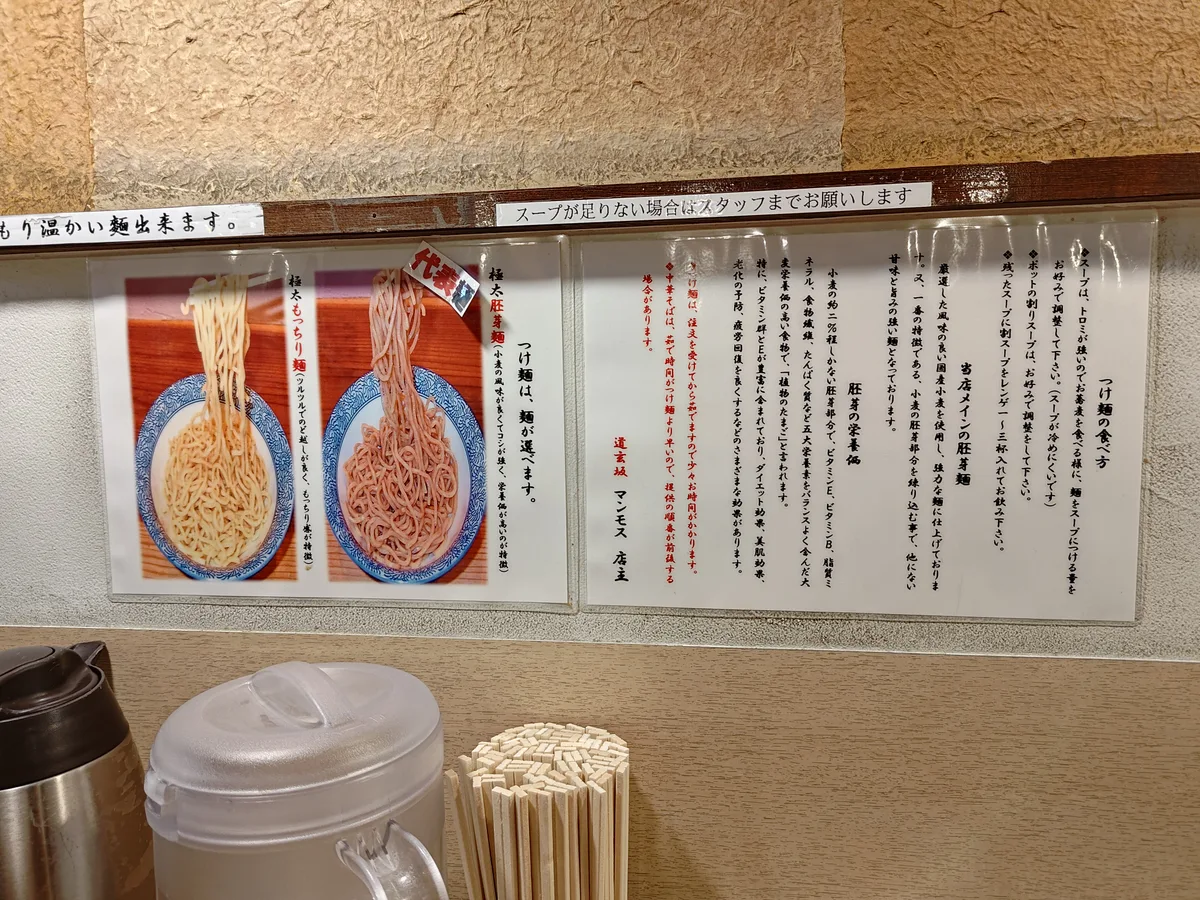
- Since the soup is very thick, adjust the amount of noodles you dip into it, much like eating soba (the trick is to dip lightly, not immerse completely).
- If you want to change the flavor, use the kashi (sauce), chili oil, or ichimi (cayenne pepper) available on the table (thanks to the soup's thickness, the noodles are already well-flavored, so it's perfectly delicious to eat without adding anything).
- After eating, add 2-3 spoonfuls of the 'warisupu' (diluted soup) from the pot into the remaining dipping soup to thin it, then drink it all. The soup stays warm, so you can enjoy it hot until the end.
The trick is to add warisupu gradually
The trick to using the finishing warisupu is to add it little by little, not all at once, to adjust it to your preferred consistency. Because the soup is thick and clings well to the noodles, you might find very little dipping soup left when you finish eating, but adding warisupu from the pot allows you to enjoy every last drop. There is also information that you can get a refill of the dipping soup itself, but we did not try it this time, so it's not certain and may vary depending on the noodle quantity ordered. If you're curious, feel free to ask the staff.

Zack
The key strategy is 'don't dip too much.' This soup is so thick and clings so well to the noodles that if you dunk them in completely like ramen broth, it'll become too rich all at once. If you eat it like soba, lightly dipping the noodles in the sauce, you can maintain the perfect richness until the very end.
🧳Notes on Luggage, Seating, and Payment
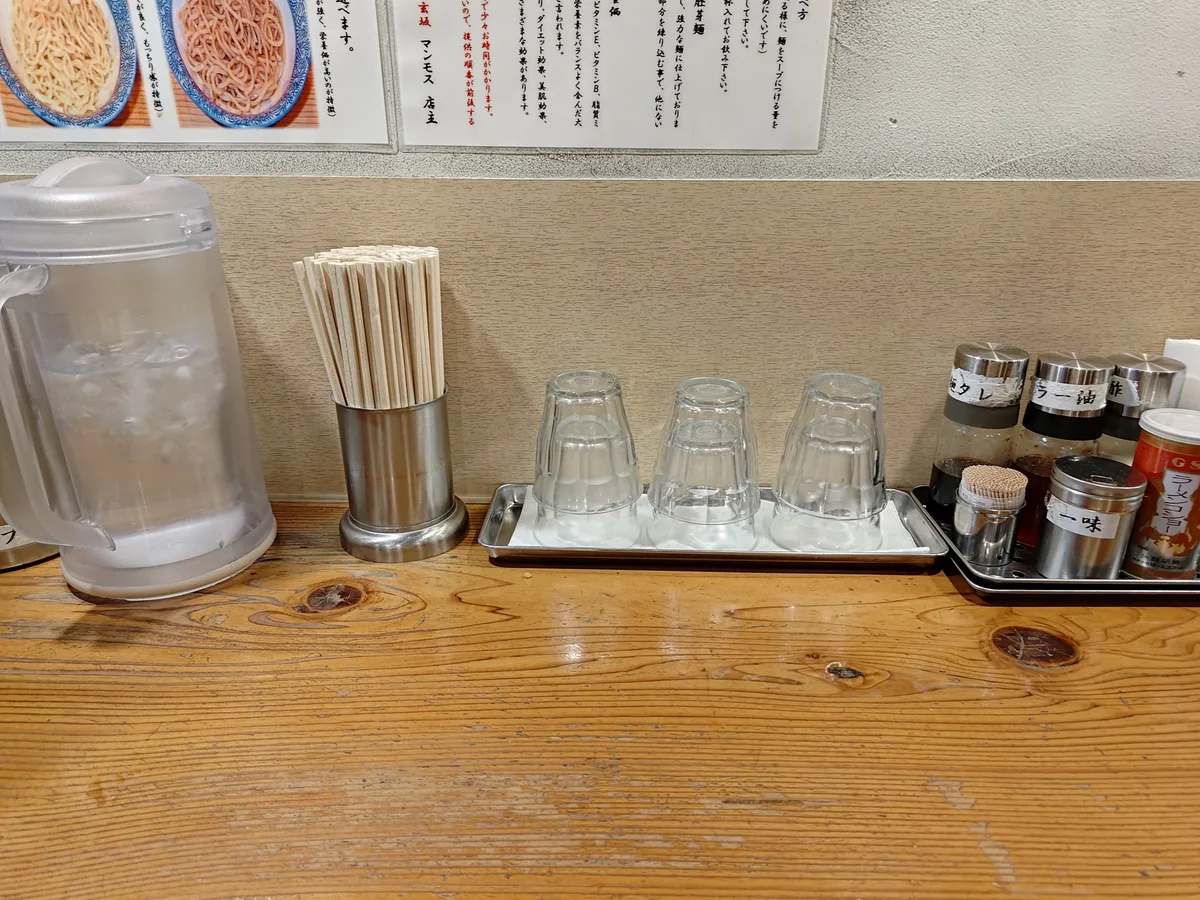
The interior is compact, with only 11 counter seats. It has a stylish atmosphere with Western music playing and is kept very clean. Water is self-service from a pot on the counter.
Travel light — large suitcases are very difficult
Since the shop primarily features counter seating and the aisles are not wide, entering with large suitcases is very difficult. It's recommended to store your luggage in a coin locker near Shibuya Station and come light. For small backpacks or shoulder bags, there's a small recess under the counter near your knees, so please manage them at your feet or lap to avoid inconveniencing others. Also, because the counters are back-to-back, there are no coat hangers or luggage hooks behind you.
Payment is cash only; credit cards, e-money (like Suica), and QR code payments (like PayPay) are not accepted. When you finish eating, since there's no upper shelf on the counter to place dishes, it's fine to leave your bowls as they are. Saying 'Gochisousama deshita' (Thank you for the meal) as you leave is the natural flow, and there are no difficult customs. The turnover is fast, so it's best suited for eating quickly and then making way for the next customer rather than lingering.
🗼If Combining with Shibuya Sightseeing
The shortest route is a 3-minute walk from Keio Inokashira Line Shibuya Station's Avenue Exit (uphill along Dogenzaka). However, Shibuya has extremely heavy foot traffic, and you'll be walking quite a bit uphill, so honestly, it's safer to allow about 10-15 minutes from the station (especially from the JR side, the crowds can make it take longer than expected). We recommend wearing comfortable shoes and heading there with ample time after sightseeing or shopping. When there's a queue, it starts in front of the shop and extends uphill along the slope, so you'll be spending your waiting time on the slope as well.
- 【Keio Inokashira Line】Shibuya Station Avenue Exit: Approx. 3-minute walk (shortest route)
- 【JR, Tokyo Metro, Tokyu Lines】Shibuya Station: Approx. 5-9 minute walk (allow 10-15 minutes during crowded times)
- 【Car/Taxi】Drop-off possible along Dogenzaka, but no dedicated parking. Use nearby coin parking.
All major Shibuya spots are within walking distance, so you can easily integrate it into your sightseeing and shopping itinerary. The walking times below are map estimates; it's safer to expect slightly longer due to crowds.
- 【SHIBUYA109】An iconic commercial facility symbolizing Shibuya fashion, located at the entrance of Dogenzaka (approx. 3-minute walk).
- 【Shibuya Scramble Crossing / Hachiko Statue】Shibuya's iconic intersection and meeting spot (approx. 5-minute walk).
- 【Shibuya Scramble Square (SHIBUYA SKY)】A rooftop observation facility offering panoramic views of Shibuya (approx. 7-minute walk).
- 【Shinsen Station / Ura-Shibuya Area】The next station on the Keio Inokashira Line. Gateway to a calmer area (within walking distance).
Shop Information
| Item | Details |
|---|---|
| Shop Name | Dogenzaka Manmosu |
| Genre | Rich Tonkotsu Gyokai Tsukemen (Choose from Haigamen / Mocchiri-men / Birabira-men noodles) |
| Difficulty | ★2 Standard |
| Ordering Method | Ticket machine with photos next to the entrance (buy-first system), staff confirm noodle type while you queue |
| Seating | 11 counter seats only (no table seating) |
| Price Range | ¥1,050~ (Noko Tsukemen ¥1,100~) |
| Payment Method | Cash only (credit cards, e-money, QR code payments all not accepted) |
| Nearest Station | Keio Inokashira Line Shibuya Station Avenue Exit: 3-minute walk / Shinsen Station: within walking distance |
| Address | 2-10-1 Dogenzaka, Shibuya-ku, Tokyo |
| Operating Hours | 11:30 AM – 10:00 PM (Please check before visiting) |
❓Frequently Asked Questions (FAQ)
QIs Dogenzaka Manmosu easy to visit even for first-time tsukemen eaters?▼
Yes. The ticket machine with photos makes it easy to choose, and staff will confirm your noodle type and quantity while you queue. If you read the 'How to Choose Noodles' and 'How to Eat Tsukemen' sections in this article, you can enjoy tsukemen for the first time without any confusion.
QDoes the ticket machine have English support?▼
The text is only in Japanese, but each button has a photo of the dish, so you can choose based on images. For noodle type, you can just tell the staff 'haigamen' (wheat germ noodles) or your choice while queuing. Pointing will also be sufficient.
QCan I pay with something other than cash?▼
Payment is cash only. Credit cards, e-money (like Suica), and QR code payments (like PayPay) are not accepted. Please have ¥1,000 bills and coins ready.
QWhich noodle type should I choose?▼
For first-timers, we recommend our main 'Futomen Haigamen' (Thick Wheat Germ Noodles). Their wheat fragrance and chewiness pair perfectly with the rich dipping soup. If you prefer a smooth texture, choose 'Mocchiri-men' (Chewy Noodles); if you want to try something unique, you can also select the wide 'Birabira-men' (Flat Noodles).
QCan I enter with a large suitcase?▼
Since the shop primarily features counter seating and the aisles are not wide, it is very difficult to enter with large suitcases. We recommend storing your luggage in a coin locker near Shibuya Station and coming light. Small bags can be managed at your feet.
QHow should I eat tsukemen?▼
Since the dipping soup is very thick, dip your noodles lightly into it, similar to how you eat soba. To finish, gradually add 'warisupu' (diluted soup) from the pot to the remaining dipping soup, adjust to your preferred consistency, and drink it all. There is also a guide on how to eat it posted inside the shop.
QIs it easy to enter alone?▼
Yes. It's primarily a counter-seating shop, catering mostly to solo diners. The turnover is also fast, making it suitable for travelers who want to eat quickly by themselves.
QAre the spicy menu items okay for beginners?▼
Spicy tsukemen offers 5 levels of spiciness, but it's designed for those accustomed to super spicy ramen in Japan. If you're not confident, stick with the regular tsukemen; if you want to try it, start with the lowest level, 1-karami (level 1 spiciness). There's no need to force yourself to choose a higher spiciness level.
Summary
Dogenzaka Manmosu is an excellent spot in Shibuya for those craving rich tonkotsu gyokai tsukemen. While the ticket machine with photos makes it accessible even for tsukemen beginners, it's reassuring to know how to choose your noodles beforehand, as staff will ask about the type and quantity while you queue. We especially recommend selecting the signature haigamen (wheat germ noodles) to enjoy the fragrant noodles alongside the rich dipping soup.
It's not suitable for large luggage or cashless payments, so please visit light and with cash ready. For anyone wanting a substantial tsukemen meal during their Shibuya sightseeing, this shop is definitely a strong contender.
Share your experience with fellow travelers
If you've actually visited Dogenzaka Manmosu, please share your experience in a review report, including waiting times, ease of using the ticket machine, noodle selection, interaction with staff, luggage storage, and English support availability. Your experience will help future travelers enjoying tsukemen in Shibuya.
If you visit, we'd love to hear your review!
Visited & Verified by Our Team
This article is brought to you after the Ramen Gateway editorial team actually visited the shop on Friday, May 29, 2026, and ordered/ate the Noko Nikuiri Tsukemen (Rich Tsukemen with Extra Meat) with Futomen Haigamen (Thick Wheat Germ Noodles) (arrived 19:39, seated 19:55, dish served 19:58). All photos were taken during this visit. Information on queuing, the shop's atmosphere, ordering process, dining report, and how to eat are all based on our actual experience at the time of the visit. Operating hours, regular holidays, and prices may change, so we recommend checking the latest information before your visit.
"We don't let AI eat ramen. We use AI to draw the coolest map so adventurers worldwide can find the real treasure hidden in Japan's back alleys."
Made in Japan — with local knowledge & AI assistance