Ramen Jiro "Kabuji" (Shinjuku-Kabukicho): The Complete Guide to Jiro Calls and Timing
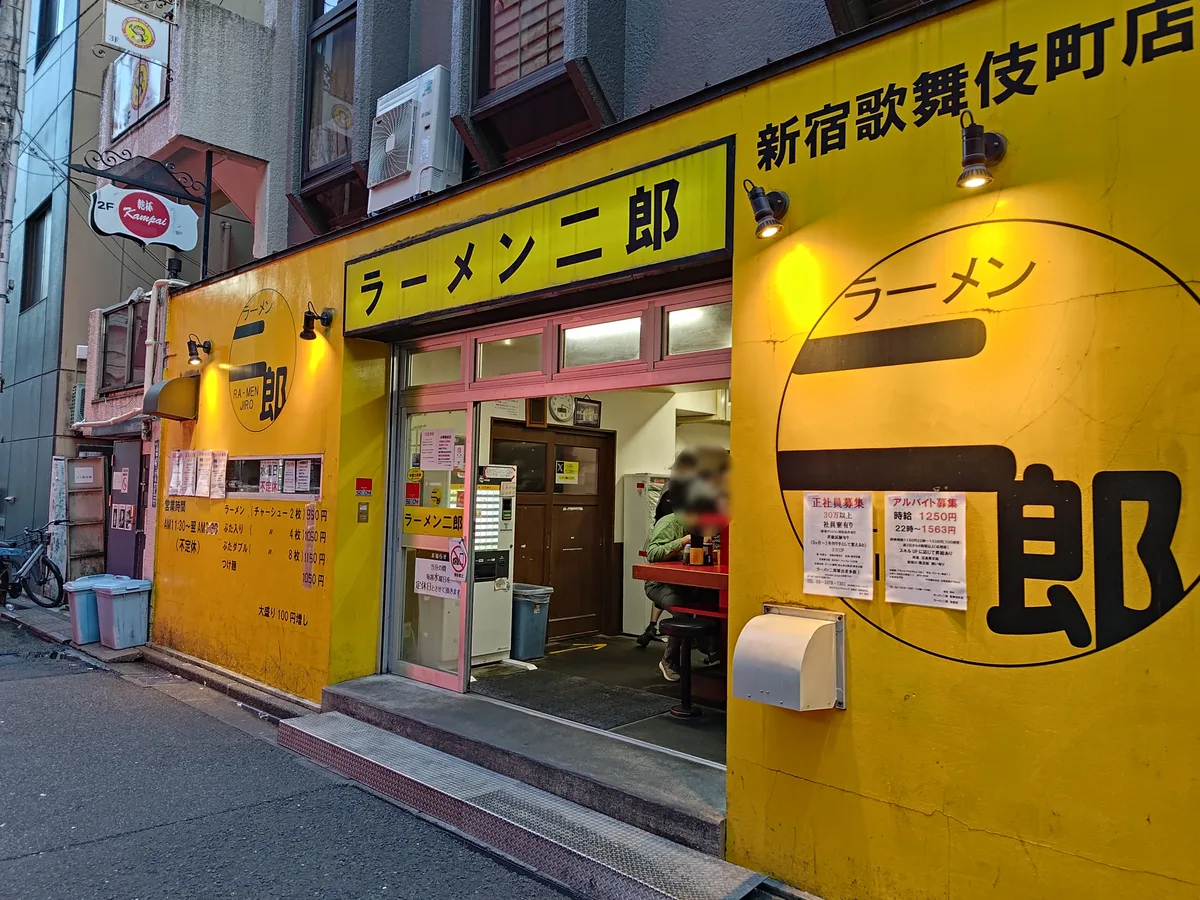
Just a 1-minute walk from Seibu-Shinjuku Station North Exit, Ramen Jiro Shinjuku-Kabukicho, affectionately known as Kabuji (a nickname combining Kabukicho + Jiro), is the fourth oldest chokkei (direct-lineage) shop of the Ramen Jiro chain. Its late-night hours from 11:30 AM to 2:30 AM (Mon, Tue, Thu-Sun, closed Wed) are a unique advantage among chokkei shops, making it ideal for combining with Kabukicho sightseeing or as a late-night ramen after drinks. With its semi-emulsified pork-bone shoyu broth, homemade flat thick wavy noodles, unique call (shouted topping order ritual) culture (Ninniku (raw grated garlic), Yasai (boiled bean sprouts on top), Abura (solid back fat for richness), Karame (extra soy tare for stronger salty taste), Mashi (more, about 1.5×), Sukuname (less, about half)), the chokkei system of ticket-folding (a wordless system to request firmer or softer noodles by folding the meal ticket) to specify noodle hardness, lot system (a Jiro-specific eating rhythm where the same batch of customers finish together) manners, and specific rules (no phone calls, no photography except ramen, no drunken entry), this article provides a complete guide based on our visit on May 15, 2026, where we ordered a Small Ramen (¥950) with the call 'Ninniku Sukuname, Yasai, Abura'.


🐷Ramen Jiro Shinjuku-Kabukicho at a Glance
| Item | Content |
|---|---|
| Difficulty | ★4 Professional (🧙Wizard: free customization via the call; 🥋Dojo: unique rules like no phone calls, no photography except ramen, no drunken entry) |
| English Support | None (ticket machine is Japanese only, no photos; menu is Japanese only; staff guidance is primarily in Japanese) |
| Payment | Cash only (credit cards, e-money, QR code payments all not accepted) |
| Waiting Time | On our visit: arrived at 18:18, no wait outside; 6 people waiting along the wall inside, ramen served at 18:38. Upon leaving (just before 19:00), there were 7-8 people waiting outside, suggesting peak time begins around 19:00 on weekdays. On Sundays before opening at 11:00, over 30 people typically line up (mostly for tsukemen). |
| Recommended For | Ramen travelers who want to experience Jiro at least once / Those looking for a late-night ramen after sightseeing or drinks in Kabukicho/Shinjuku / Those wanting to delve into Tokyo's local culture not optimized for tourists |
| Notes | No phone calls or loud talking, no photography except ramen, no drunken entry, lot system (eat at a good pace after your bowl arrives), Ninniku is not included with a 'Futsu' (default/normal amount) call. |
| First-time Order | Small Ramen ¥950 (for first-timers, when asked about noodle quantity by staff at the ticket machine or while waiting, 'Sukuname' (less, about half) or 'Hanbun' (half portion of noodles) is recommended) / The safest first-time call is 'Ninniku Sukuname, Yasai, Abura'. |
Four Conditions Making Kabuji Approachable for Tourists Among Chokkei Jiro Shops
Ramen Jiro (ラーメン二郎) refers to a group of around 40 ramen shops, primarily in Tokyo, that are chokkei (direct-lineage) — meaning they are independently operated spin-offs from the original Mita Jiro founded by Takumi Yamada, rather than a franchise chain. These shops are deeply embedded in Japanese ramen culture due to their unique Jiro call (shouted topping order ritual) culture, lot system (a Jiro-specific eating rhythm where the same batch of customers finish together), and distinct personalities. The Kabukicho shop, affectionately known as Kabuji (a nickname combining Kabukicho + Jiro), is a rare find among them, meeting four conditions that make it highly approachable for tourists: (1) an excellent location in the heart of Kabukicho, just a 1-minute walk from Seibu-Shinjuku Station North Exit; (2) late-night hours from 11:30 AM to 2:30 AM (Mon, Tue, Thu-Sun, closed Wed), covering times unavailable at other chokkei shops; (3) noodle portions that are generally considered slightly smaller than other chokkei shops, making it easier for first-time Jiro visitors to finish their meal; and (4) staff known for being friendlier than average Jiro shops. For travelers wanting to experience Jiro as part of their sightseeing, this shop serves as an excellent introduction to Tokyo's chokkei Jiro. This article is a report from our actual visit on May 15, 2026 (Thursday), providing a complete guide to the call, ticket-folding, and lot system so first-time visitors to Japan can tackle it with confidence.
🐷What is 'Kabuji'? — The 4th Oldest Chokkei Jiro, Open Late in Kabukicho
Ramen Jiro Shinjuku-Kabukicho is a long-established chokkei Ramen Jiro shop located at Nisshin Building 1F, 2-37-5 Kabukicho, Tokyo. It holds the distinction of being the fourth oldest chokkei shop in the Ramen Jiro lineage and has been affectionately known among ramen enthusiasts as Kabuji (a nickname combining Kabukicho + Jiro). The Kabukicho, Ikebukuro, and Shinbashi (now closed) shops belong to the NS-kei lineage (operated by NS Planning) and have a history of reopening after periods of closure due to fire.
The signature dish is the Small Ramen for ¥950. It features a semi-emulsified pork-bone shoyu broth, hitting a middle ground between heavily emulsified (rich and milky white) and non-emulsified (clear and sharp). The rich umami of pork slowly melts into the soup, and when Ninniku (raw grated garlic) is mixed in via the call (shouted topping order ritual), the punchiness intensifies, making it a benchmark bowl that Jiro fans describe as 'average = this is what Jiro is all about.' The noodles are homemade, flat, thick, and wavy, with a slightly firm, chewy 'washi-washi' texture. The aroma of Aushon (a wheat flour brand often used in Jiro noodles, known for its bold wheat aroma) that spreads when chewed is quintessential Jiro. The noodle portion is generally considered slightly less than at other Jiro shops, making it an approachable amount even for those accustomed to Jiro who might want to try a Large Ramen.
Now, to the core of this article. Kabuji is a shop where tourists need 'advance preparation' to experience chokkei Ramen Jiro for the first time. The ticket machine is Japanese-only with no photos, the Jiro call (shouted topping order ritual) uses unique terms (Ninniku, Yasai, Abura, Karame, Mashi, Sukuname), and noodle hardness is specified by how you fold your meal ticket. Inside, signs display various shop-specific rules, such as 'Ninniku is not included with a 'Futsu' call,' 'no phone calls,' 'no photography except ramen,' and 'no drunken entry.' While it offers the convenience of a great Kabukicho location and late-night hours, stepping inside immediately immerses you in a local ramen culture not optimized for tourists. This article will explain 'everything you need to conquer it,' step by step, based on our actual visit on May 15, 2026.

Ren
Many travelers have probably heard of 'Ramen Jiro,' but it's not a chain store. It's a collection of independently operated shops that spun off from the original Mita Honten, run by founder Takumi Yamada. Each shop owner trained at Mita Honten before going independent and opening their own store, leading to subtle differences in soup concentration, noodle thickness, topping amounts, and call (shouted topping order ritual) nuances from shop to shop. The Kabukicho shop is the fourth oldest chokkei (direct-lineage) Jiro and an indispensable establishment when discussing Tokyo's chokkei Jiro culture. Alongside the Ikebukuro shop, which is also part of the NS-kei lineage, its location in Kabukicho with late-night hours and being a 1-minute walk from Seibu-Shinjuku Station makes it one of the most accessible for Jiro beginners to combine with sightseeing.
🎯Overall Strategy — Four Key Elements for First-Time Jiro Visitors
To successfully navigate Kabuji on your first visit to Japan, it's reassuring to understand four key systems before entering. We'll delve into each in detail in individual sections later, but first, let's grasp the overall picture.
- 【The Call】When the staff calls out 'Dōzo' (go ahead, give your call) just before your bowl is served, verbally request your desired free toppings (Ninniku, Yasai, Abura, Karame) along with their quantity. Silence means default service (without toppings), but note that Ninniku is not included with a 'Futsu' call.
- 【Ticket-folding】After purchasing your meal ticket, this is a chokkei (direct-lineage) wordless system where you indicate noodle hardness by the direction you fold the ticket when placing it on the upper counter. For a first visit, simply placing it unfolded for regular noodle doneness is perfectly fine.
- 【Lot System】After your bowl arrives, it's customary at chokkei shops to eat at a good pace. To ensure customers in the same lot (batch served simultaneously) finish around the same time, minimize photography and conversation, and eat your noodles before they get soggy.
- 【Shop-specific Rules】No phone calls, no loud talking (normal conversation levels are fine), no photography except ramen (ask staff before photographing the ticket machine), no drunken entry, and after finishing, place your bowl and cup on the upper counter, quickly wipe your seat with the provided cloth, and then leave.

Zack
Kabuji might be 'a shop not optimized for tourist convenience,' but the elements to master aren't actually that many. You just need to remember four things: the Jiro call, ticket-folding, the lot system rhythm, and exit manners. Each section of this article explains them one by one with photos, so if you quickly skim through it before entering, even first-time visitors to Japan will find it much easier to have a smooth experience. Conversely, if you ignore these completely, you might be silent during the call, not know how to hand over your ticket, or leave your bowl unattended when leaving, which can inconvenience the shop and other customers. Preparing in advance is definitely worth it for your first Jiro experience in Japan.
🚶Access — 1-Minute Walk from Seibu-Shinjuku Station North Exit, 4-Minute Walk from Shinjuku Station East Exit
Kabuji boasts an excellent location, just a 1-minute walk from Seibu-Shinjuku Station North Exit. From JR Shinjuku Station East Exit, while maps indicate a 4-minute walk (approx. 280m), the reality of navigating through the bustling Kabukicho central area (around Ichibangai Arch) means it feels more like 6-8 minutes. Along the way, you'll pass tourist attractions like the Godzilla Head (on the rooftop of Shinjuku Toho Building) and the Kabukicho Ichibangai arch, so it's recommended to incorporate the walk as part of your sightseeing.
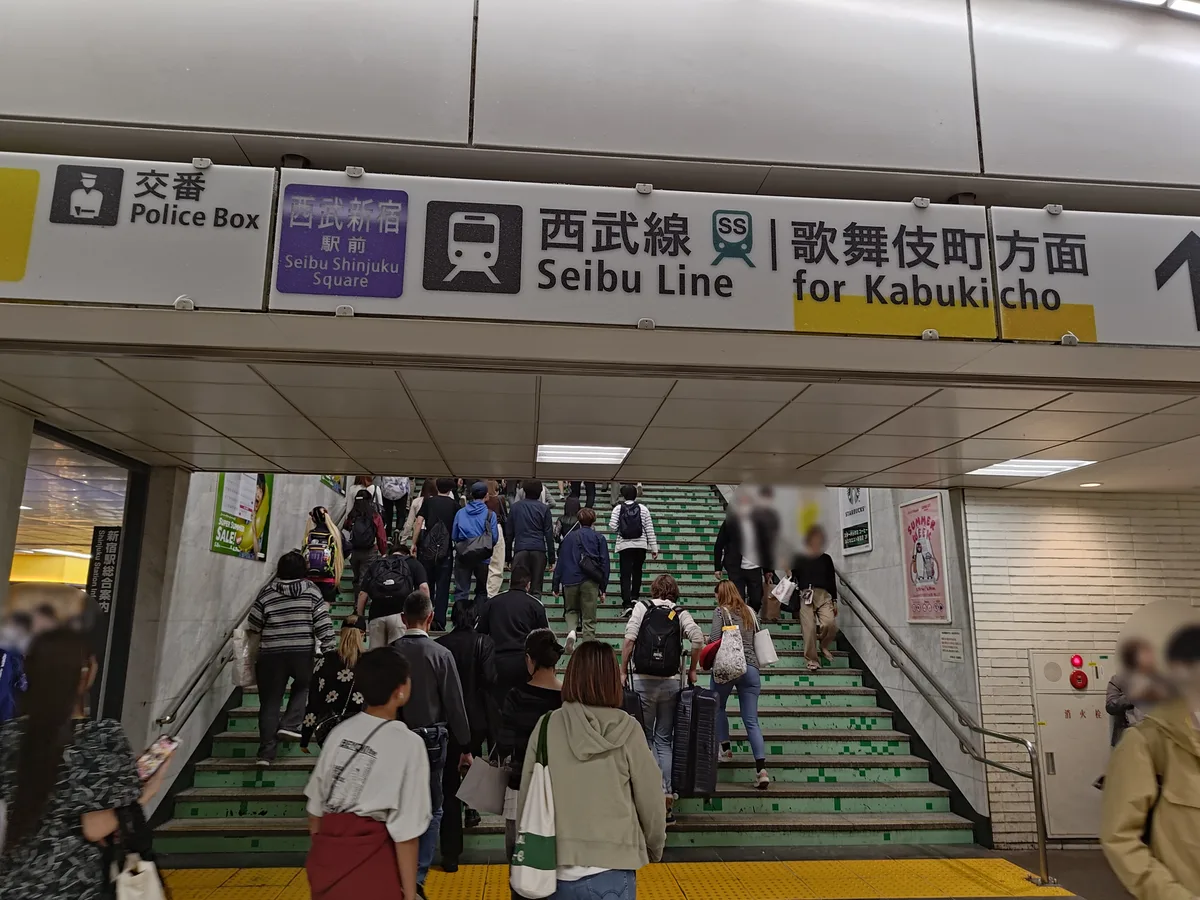
- 【Seibu Shinjuku Line】Seibu-Shinjuku Station North Exit (Kabukicho Exit): Approx. 1-minute walk, 90m (shortest route, easy to find)
- 【JR / Tokyo Metro / Toei Lines】Shinjuku Station East Exit: Effectively 6-8 minutes walk (maps show approx. 4 minutes, 280m, but navigating through Kabukicho's crowds makes it feel longer). Head east on Yasukuni-dori towards Kabukicho.
- 【Tokyo Metro Marunouchi Line】Shinjuku-sanchome Station: Approx. 7-minute walk via Yasukuni-dori.
- 【Car/Taxi】Can be dropped off in front of 2-37-5 Kabukicho, but no dedicated parking nearby.
The Smart Way to Walk from JR Shinjuku Station: Combine with Sightseeing
During our visit, approaching from the JR side, the pedestrian traffic on Yasukuni-dori, combined with touts and crowds in central Kabukicho, definitely made the walk longer than the '4 minutes' indicated on maps. You'll pass iconic tourist spots like the Godzilla Head (the life-sized Godzilla on the rooftop of Shinjuku Toho Building) and the Kabukicho Ichibangai arch. So, rather than simply 'walking for ramen,' it feels just right if you think of it as 'walking to Kabuji as part of Kabukicho sightseeing.' If you want to arrive as quickly as possible, Seibu-Shinjuku Station North Exit (1-minute walk) is the only choice.
Pros and Cons of Kabukicho's Location
Kabuji's location offers exceptionally favorable conditions for a Jiro shop. There are almost no other chokkei (direct-lineage) Jiro shops that combine a central tourist area, a 1-minute walk from the station, and late-night hours, making it ideal for visits combined with Shinjuku sightseeing, Kabukicho nightlife, or accommodation near Shinjuku Station. However, touts, hawkers, and drunk patrons, typical of Kabukicho at night, can be seen around the shop, so solo female visitors in the late-night hours might want to exercise caution. During our visit, arriving on a weekday at 18:18 and being served at 18:38, the area was bustling, but we didn't feel any safety concerns.
🕔Opening Hours and Crowds — Open Until 2:30 AM, Weekdays Around 18:00 and Late Night are Best Bets
Kabuji's operating hours are Monday, Tuesday, Thursday, Friday, Saturday, and Sunday from 11:30 AM to 2:30 AM, with Wednesday as its regular closing day. Being open until 2:30 AM is rare among chokkei (direct-lineage) Ramen Jiro shops, making it a unique advantage for those looking for a late-night ramen after drinks in Shinjuku. However, be careful not to overlook the 'Wednesday closed' pitfall, as many first-time visitors to Japan frequently arrive only to find it shut.
The peak crowding is typically before opening on Sundays (before 11:00 AM), when regulars often form queues of over 30 people, mostly aiming for tsukemen (dipping noodles). Weekday lunch peak (12:00-13:00) is also a time when outside waits tend to lengthen. On the other hand, late lunch/early evening on weekdays from around 15:00-17:00, early dinner around 18:00 on weekdays, and late-night hours (after 23:00) are often good times to visit without an outside wait. Our visit for this article was on a weekday at 18:18 with no outside wait, and 6 people waiting along the wall inside. However, upon leaving (just before 19:00), the outside queue had grown to 7-8 people, giving the impression that weekdays transition to peak time around 19:00.
- 【Sundays before opening】Over 30 people queuing from before 11:00 AM (mostly regulars for tsukemen, the most crowded time)
- 【Weekday Lunch】12:00-13:00 is peak, typically around 10 people waiting outside
- 【Weekday Afternoon】After 15:00 until around 17:00, no outside wait, a calm period with only a few customers inside
- 【Weekday Early Dinner】Around 18:00, often no queue (record of no wait with 4 people just before 18:00 on a Monday / our visit at 18:18 also had no outside wait)
- 【Weekdays around 19:00】Just before the weekday dinner peak. Felt like 7-8 people waiting outside when we left (just before 19:00)
- 【Late Night】After 23:00 until closing at 2:30 AM, mostly customers finishing their night out with ramen; relatively easy to enter on weekdays
- 【Wednesday】Closed (Important Note)
Actual Visit Timeline — Arrived at 18:18, 6 People Waiting Inside, Ramen Served at 18:38
To record our visit chronologically: We arrived at the shop on Thursday, May 15, 2026, at 18:18. There was no outside queue, so we entered directly under the noren (shop curtain) at the entrance. After purchasing a meal ticket at the machine next to the entrance, we joined the waiting line along the wall inside (6 people waiting upon arrival). Our ramen was served at 18:38, and the total time until we left was about 30-40 minutes. Upon leaving (just before 19:00), the outside queue had grown to 7-8 people, giving the impression that weekdays transition to peak time around 19:00.
🎫How to Use the Ticket Machine — Japanese Only, No Photos, Study the Main Menu Locations
Kabuji's ticket machine is a button-type (physical buttons, not a touch panel) located next to the shop entrance. For international travelers, this is often the most worrying aspect — it's Japanese-only, has no photos, and no English menu. For Jiro beginners, the sheer amount of information can be overwhelming, and it's easy to get lost if you're not prepared. However, if you memorize the location of the main menu items in advance, the operation itself takes only a few seconds.
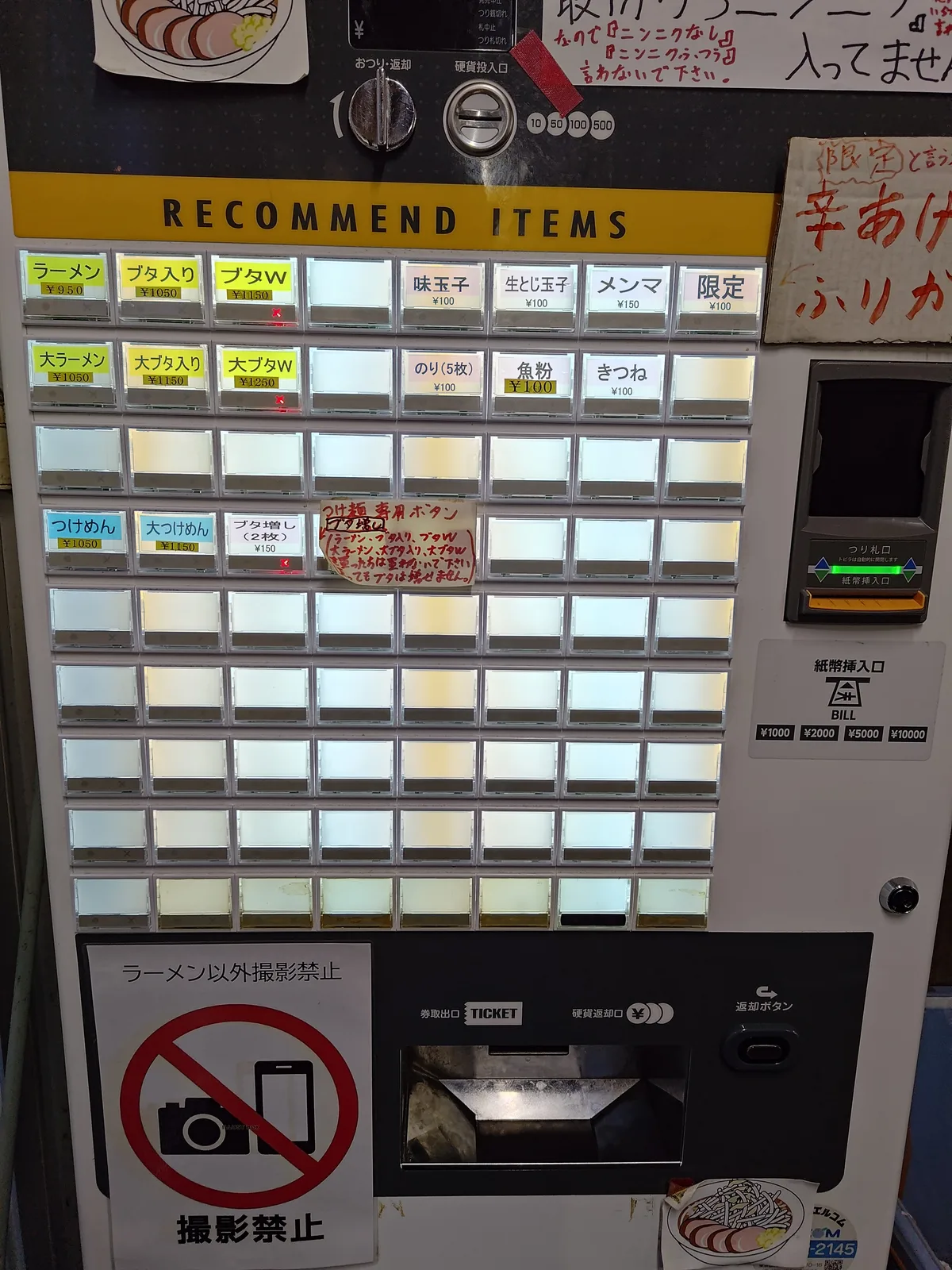
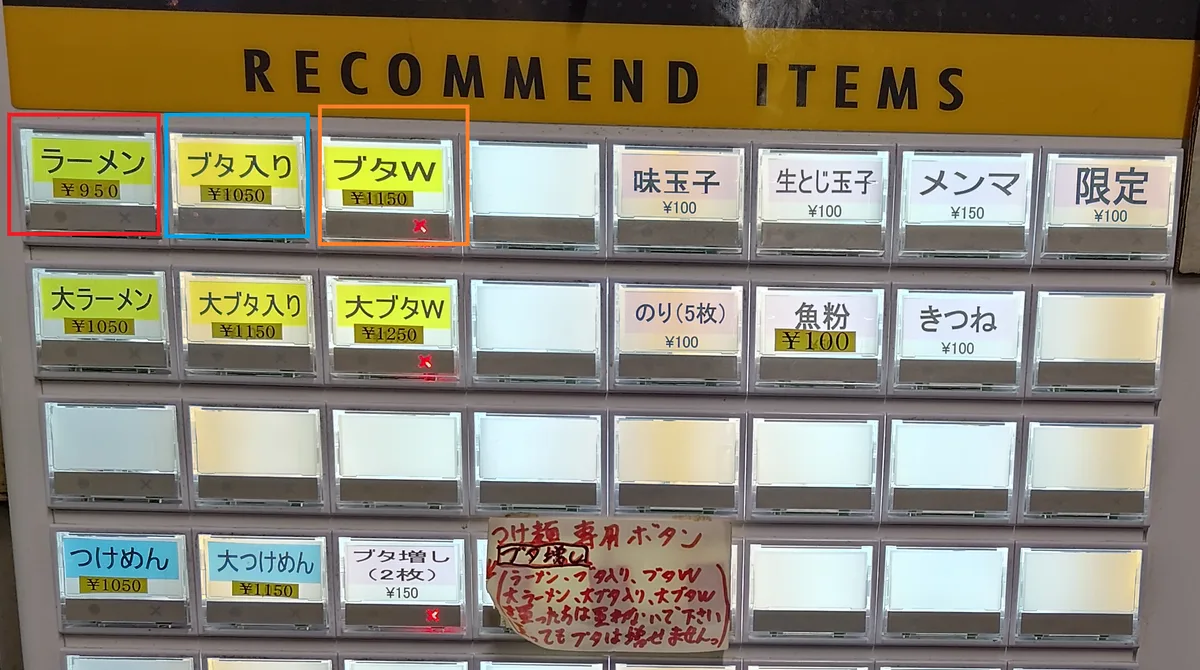
🎯Meaning of the Three Colored Boxes in the Photo — First-Time Selection Guide
| Box Color | Menu | Positioning |
|---|---|---|
| 🟥 Red Box | Ramen (Small) ¥950 | ★Recommended for first-time visitors to Japan. This was chosen for our visit. A classic bowl that offers the most direct Jiro experience. |
| 🟦 Blue Box | Buta-iri Ramen (extra pork) ¥1,050 | For those who want more chashu (pork belly). Features an increased portion of thick-cut, lean pork, making the pork the main highlight of the Jiro experience. |
| 🟧 Orange Box | Buta W / Buta-double (double pork) ¥1,150 | For experienced Jiro fans who want to enjoy a large quantity of chashu. A heavy volume with even more thick-cut, lean pork than the Buta-iri, for true pork enthusiasts. |
The operation flow is simple.
- Stand in front of the ticket machine and identify the button for the signature 'Ramen' (Small Ramen ¥950) or 'Large Ramen' (¥1,050, increased noodle portion).
- Insert coins or bills (cash only; credit cards, e-money, and QR payments are not accepted).
- Press the button for your desired main menu item.
- If needed, also press buttons for any desired toppings (e.g., raw egg, fish powder, nori, menma).
- Collect your meal ticket and change, then line up in a single file along the yellow line drawn on the floor along the wall inside the shop (space for 7-8 people).
【Strategy】Ask Staff Before Photographing the Ticket Machine
Kabuji has a sign inside stating 'No photography except ramen.' This rule includes the ticket machine, the interior of the shop, and other customers. Therefore, if you wish to photograph the ticket machine to review the menu at your leisure later, always ask a staff member beforehand: '写真を撮ってもいいですか? (May I take a photo of the ticket machine?)' The ticket machine photos in this article were also taken with staff permission during our visit.

Sophia
It's easy to feel pressure from regulars behind you if you hesitate at the ticket machine, so it's best to decide what you'll order before you even enter. For your first visit, 'Ramen' (Small Ramen ¥950) is the safest choice. Once you're used to it, trying 'Buta-iri Ramen' (¥1,050, extra pork) is a good recommendation. A 'Large Ramen' (increased noodle portion) is quite a substantial amount even at Kabuji, so for your first time, it's a realistic strategy to start with a Small to gauge your Jiro capacity before moving on to the next step.
【Actual Visit Flow】Queue in a Single File Along the Yellow Line Inside
During our visit for this article (weekday 18:18, no outside wait), the flow was: 'Enter -> Purchase meal ticket at the machine next to the entrance -> Line up in a single file along the yellow line drawn on the wall inside the shop.' This yellow floor line along the wall provides space for 7-8 people. While waiting, a staff member came to us and asked in Japanese, '麺の量はどうしますか? (How much noodles would you like?)', to which we replied with 'Futsu' (default/normal amount), 'Sukuname' (less, about half), or 'Hanbun' (half portion of noodles).
【Alternative Flow During Crowds】User Review-Based Information for Outside Queues
While our visit for this article had no outside queue and followed the flow above, during peak times when the line extends outside, user reviews indicate alternative patterns: (1) It seems customers queue at the end of the outside line, wait their turn, and then buy their meal ticket at the machine when staff prompt them to enter. (2) When it's crowded, there are also cases where customers in the inside queue show their meal ticket towards the kitchen and verbally tell staff their noodle quantity at that moment. Since both scenarios are possible (staff coming to confirm, or you proactively speaking up), it's best to be prepared to quickly answer your order and noodle quantity during crowded times.
📜【Chokkei Unique System】Specifying Noodle Hardness with Ticket-Folding
At chokkei (direct-lineage) Ramen Jiro shops, including Kabuji, there's a unique, wordless system called ticket-folding (a wordless system to request firmer or softer noodles by folding the meal ticket) to indicate your preferred noodle hardness when handing your meal ticket to the staff (by placing it on the upper counter). This is a culture specific to chokkei Jiro and one of the first hurdles for first-time Ramen Jiro visitors.
- 【Unfolded】Place it on the upper counter as is → Regular doneness (default)
- 【Folded Vertically】Fold the meal ticket in half vertically and place it → Katame (firmer noodles)
- 【Folded Horizontally】Fold the meal ticket in half horizontally and place it → Yawame (softer noodles)
- ※Note: Specific folding methods may vary slightly between shops. At Kabuji, the tradition of 'folding direction = hardness preference' remains.
For First-Time Visitors to Japan, Unfolded for Regular Doneness is Recommended
Ticket-folding is a traditional, wordless culture of chokkei (direct-lineage) Jiro, a system used by regulars accustomed to Jiro. For your first visit to Japan, it's safest not to force yourself to try it; simply place your meal ticket unfolded on the upper counter (meaning regular noodle doneness). Even with regular doneness, Kabuji's homemade flat thick wavy noodles offer plenty of chewiness and a satisfying texture. If you get used to it and feel you'd prefer them a bit firmer, try folding vertically for Katame on subsequent visits.
Zack
Ticket-folding is a chokkei (direct-lineage) local rule that 'you don't have to do'; it's not something tourists or first-time visitors to Japan are forced to comply with. In fact, if you fold it incorrectly, you might end up with noodles different from what you expected, so for your first visit, sticking to 'unfolded = Futsu (default/normal amount)' is the way to go. Also, while waiting in line, staff might verbally ask you about your noodle quantity (Futsu / Sukuname / Hanbun). During our visit for this article, we were asked, '麺の量はどうしますか? (How much noodles would you like?)'. We replied with 'Futsu,' but for a first-time visitor to Japan, it's safest to respond in Japanese with 'Sukuname' or 'Hanbun.' Some staff might understand if you say 'I'll have a small portion' in English too.
📢Complete Jiro Call Guide — Five Terms and Quantity Specifications
Kabuji's biggest hurdle and greatest fun is the 'call' (shouted topping order ritual). Just before your ramen is served, a staff member will stand in front of you, extend their hand, and say 'Dōzo' (go ahead, give your call). At that very moment, you verbally tell them your desired free toppings (Ninniku, Yasai, Abura, Karame), combined with a quantity modifier (Futsu, Sukuname, Mashi, Mashi-mashi) – this is Jiro's unique ordering system.
Four Free Topping Terms
| Call | Romaji | Meaning | Amount with Regular Call |
|---|---|---|---|
| Ninniku | ninniku | Raw grated garlic. Mixing it into the soup instantly boosts its punch. | ★Note: Not included with a 'Futsu' call. If you want it, you must say 'Ninniku'. |
| Yasai | yasai | Boiled bean sprouts (may include a small amount of cabbage). Eaten submerged in the soup. | Doesn't feel like a mountain even with a regular call. For a true Jiro experience, 'Mashi' (more, about 1.5×) or 'Mashi-mashi' (double, 2× or more) is recommended. |
| Abura | abura | Solid back fat. Dissolves into the soup, adding sweetness and richness. | A good amount is included even with a regular call. Be mindful of calories with 'Mashi-mashi'. |
| Karame | karame | Extra soy tare (kaeshi). Increases saltiness and soy flavor. | Since kaeshi is also available on the table, it's often smarter to adjust it yourself rather than requesting it in the call. |
Quantity Modifiers
| Modifier | Romaji | Estimated Quantity |
|---|---|---|
| Regular call (no quantity specified) | — | Default amount (note: Ninniku is not included) |
| Sukuname | sukuname | About half the usual amount. Recommended for Ninniku on your first visit to Japan. |
| Mashi | mashi | About 1.5 times the usual amount. |
| Mashi-mashi | mashi-mashi | Double (2×) or more of the usual amount. For those confident they can finish it. |
【MOST IMPORTANT】Remember: 'Ninniku is Not Included with a Futsu Call'
Kabuji has a sign posted inside stating, 'Ninniku will not be included with a 'Futsu' call.' This is a common practice across chokkei (direct-lineage) Jiro shops: if you reply 'Futsu' without specifically saying 'Zenbu' (all four toppings at default amount) (meaning all of Ninniku, Yasai, Abura, Karame), your ramen will be served without Ninniku. If you want Ninniku, you must explicitly say 'Ninniku,' or 'Ninniku Sukuname,' or 'Ninniku Mashi,' including the quantity. This is the point where Jiro beginners are most likely to make a mistake, so for your first visit to Japan, it's safest to remember to add 'Ninniku~' to your call.
【Safe First-Time Call】'Ninniku Sukuname, Yasai, Abura'
This is the call we used during our visit. When you say 'Ninniku Sukuname, Yasai, Abura' in Japanese, you'll receive a heaped teaspoon of Ninniku (which still provides plenty of punch), a standard amount of Yasai, and a generous topping of Abura, creating a well-balanced Jiro experience. For Karame, it's recommended to not request it during the call and instead adjust the flavor yourself with the kaeshi (soy tare) available on the table.

Mei
The timing for your call (shouted topping order ritual) is truly instant! The staff will extend their hand and say 'Dōzo' (go ahead, give your call), and you need to respond immediately at that moment. If you stay silent, the staff will move on to the next customer, and your ramen will be served with no call = default toppings. So, it's recommended to practice your call verbally before entering. If you practice saying 'Ninniku Sukuname Yasai Abura' quickly about five times, you'll be able to say it smoothly when it counts. Also, while traditionally the call is said quickly in Japanese, for foreign tourists, speaking a bit slower is perfectly fine. The staff's job is to understand the call, so they will accommodate you if you pronounce it carefully.
📋Menu — Simple Four Pillars + Toppings
Kabuji's menu is structured around a combination of two ramen sizes (Small and Large) × ingredient configurations (Plain / Buta-iri (extra pork)) × hot/cold options (Ramen / Tsukemen (dipping noodles)), with additional toppings (raw egg, fish powder, nori, menma) available. Prices are based on the display during our visit on May 15, 2026.
| Menu | Price | Notes |
|---|---|---|
| ★Ramen (Small) | ¥950 | ★Recommended for first-time visitors to Japan. The signature Small Ramen. Responds to the Jiro call. When asked about noodle quantity during ordering or while waiting, 'Sukuname' or 'Hanbun' can also be selected. |
| Large Ramen | ¥1,050 | Increased noodle portion (though considered slightly less than other chokkei shops, it's a substantial volume for Jiro). |
| Buta-iri Ramen | ¥1,050 | Increased chashu (pork belly) (from approx. 2 thick-cut, lean slices to approx. 4). |
| Buta W / Buta-double | ¥1,150 | Significantly increased chashu. An even larger portion of thick-cut, lean pork than the Buta-iri, a heavyweight option for experienced Jiro fans. |
| Tsukemen (Small) | ¥1,050 | Cold-rinsed noodles served with a tangy dipping broth. Includes nori (dried seaweed), fish powder, and menma (marinated bamboo shoots). |
| Large Tsukemen | ¥1,150 | Increased noodle version of Tsukemen. |
| Buta-iri Tsukemen | ¥1,150 | Tsukemen + increased chashu. |
| Raw Egg | ¥100 | Topping. Dissolves into the soup for a milder flavor. |
| Fish Powder | ¥100 | Topping. Adds a seafood aroma. |
| Nori | ¥100 | Topping (several sheets of dried seaweed). |
| Menma | ¥150 | Topping (marinated bamboo shoots). |
First-Time Selection — Three Paths
【For a lighter first Jiro experience】'Ramen (Small)' ¥950 + call 'Ninniku Sukuname, Yasai, Abura'. This classic combination allows first-time visitors to Japan to experience the signature soup, homemade noodles, and Jiro call culture. / 【For experienced Jiro fans】'Large Ramen' ¥1,050. While the increased noodle portion is considered slightly less than at other chokkei shops, it's not recommended for first-time travelers. The call 'Zenbu Mashi' (all four toppings at 1.5×) should only be chosen by those who have experience finishing a large Jiro bowl; for your first visit to Japan, it's safer to stick to something like 'Ninniku Sukuname, Yasai, Abura'. / 【If you prioritize meat】'Buta-iri Ramen' ¥1,050 + call 'Ninniku Sukuname, Yasai, Abura'. This option allows you to enjoy an increased portion of lean chashu, savoring Kabuji's unique characteristics from its pork.
🏠Shop Atmosphere and Unique Rules — A Local Space Not Optimized for Tourists
Kabuji's interior is a compact space with only 14 counter seats, offering a rich local atmosphere. It's not dirty, but it doesn't give a sterile clean impression either, with AM radio playing as background music. While the atmosphere might feel a bit daunting for international visitors, the staff are friendlier than at most Jiro shops and respond courteously when confirming orders and noodle quantities.
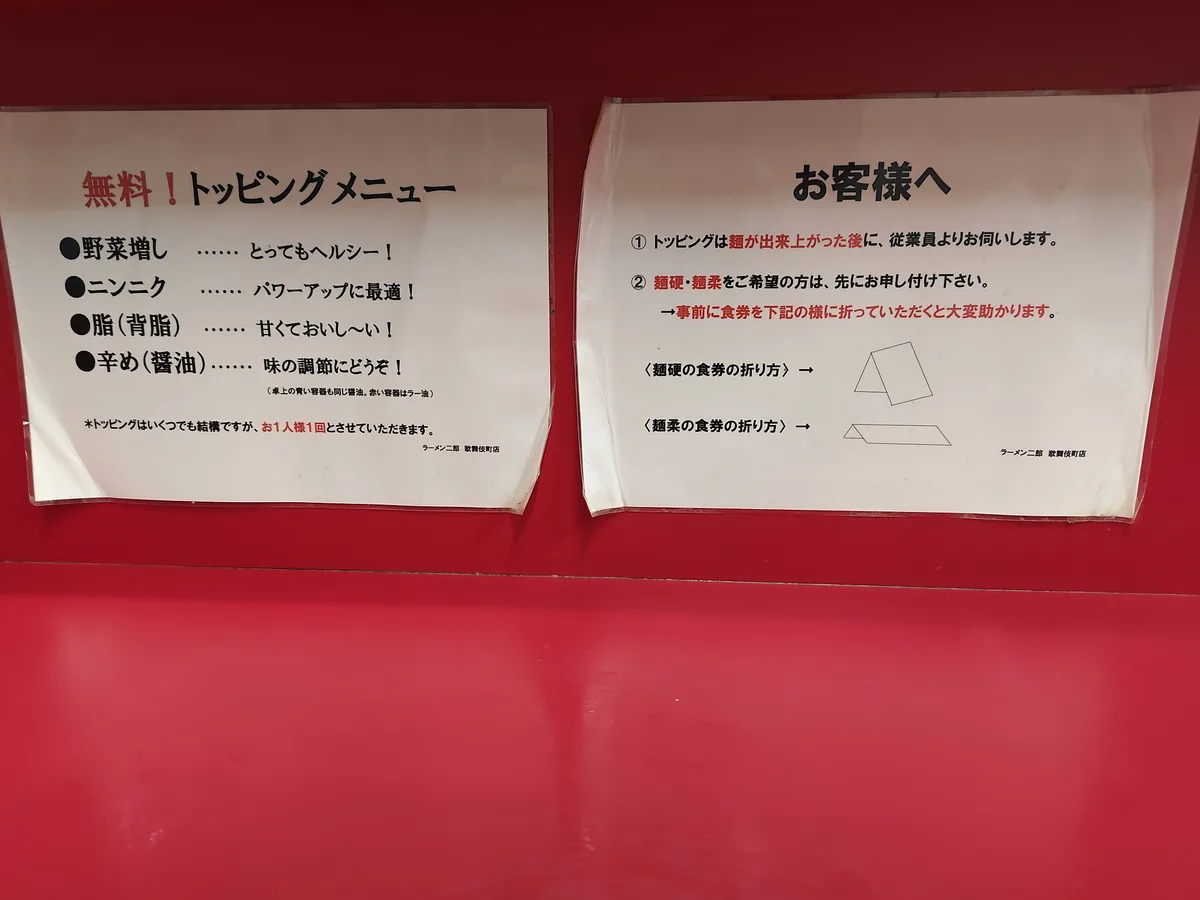
List of Shop-Specific Rules
- 【Ninniku Warning】Ninniku is not included with a 'Futsu' call (a common practice across chokkei (direct-lineage) Jiro shops). If you want it, you must call out 'Ninniku'.
- 【Photography Restrictions】No photography except ramen (ticket machine, shop interior, and other customers are not allowed; only ramen is OK). If you want to photograph the ticket machine, ask a staff member.
- 【Mobile Phones】No phone calls. Loud talking is also prohibited, but normal conversation levels are fine, as some groups of 2-3 people converse while eating. There's no issue with regular conversation.
- 【No Drunken Entry】Entry is prohibited for those who are heavily intoxicated (a rule explicitly stated, typical for late-night establishments in Kabukicho).
- 【Departure Etiquette】After finishing, place your ramen bowl and water cup on the upper counter, quickly wipe your seat with the provided cloth, and then leave.
- 【Lot System】After your bowl arrives, eat at a good pace. Minimize photography and conversation to keep pace with other customers in the same lot.
【Experience】Normal Conversation Levels Are Fine
During our visit, there were groups of 2-3 people inside, eating while having normal conversations. There's no need to be overly formal as if it's a 'training ground where all conversation is forbidden'; normal conversation levels while eating are perfectly acceptable. What's not allowed is talking loudly, laughing boisterously, or making phone calls at a volume that would disrupt other customers' concentration. This was our actual feeling after visiting: there's no need to be overly tense as long as you don't disturb the atmosphere.
【Experience】Actual Feel of the Lot System — People Eat Faster Than You Might Expect
Jiro's lot system (a Jiro-specific eating rhythm where the same batch of customers finish together) isn't a strict rule that 'everyone must finish at the same pace,' but rather a cultural custom to maintain the shop's operational efficiency. During our visit, we leisurely savored our meal and witnessed customers on both sides finishing in about 10 minutes and being replaced one after another. Since the clientele generally eats at a noticeably faster pace than at typical ramen shops, it's reassuring to have a 'slight awareness of eating faster.' That said, you won't be specifically warned if you eat slowly. As long as you eat steadily at your own pace without prolonged conversation or fiddling with your smartphone, there's no problem. If you visit with multiple people and finish at different times, it's natural for chokkei (direct-lineage) Jiro to have those who finish first leave the shop and wait outside until everyone is ready to move on to the next plan.
In-Store Facilities and Self-Service
- 【Water / Ladles】A water server is located along the wall behind you; ladles are placed next to it, so help yourself.
- 【Seats】Fixed round stools. There are small shelves under the counter for small bags (suitcases are not permitted).
- 【On the Counter】Chopsticks, tare (kaeshi - soy sauce base), and pepper only. A simple setup.
- 【Trash Cans】Located in two spots: at the back of the shop and near the entrance. Dispose of tissues and other small trash in the nearest one when leaving.
- 【Meal Ticket】Once seated, place your meal ticket on the upper counter (if folding, this is where you indicate noodle hardness).
🍜Eating Report — Ramen ¥950, Call: 'Ninniku Sukuname, Yasai, Abura'
For this article, we ordered 'Ramen (Small)' for ¥950, with 'Futsu' noodle quantity, and the call 'Ninniku Sukuname, Yasai, Abura.' It took 5-10 minutes after being seated for our ramen to be served, and the impact of the steaming bowl placed before you is uniquely Jiro.
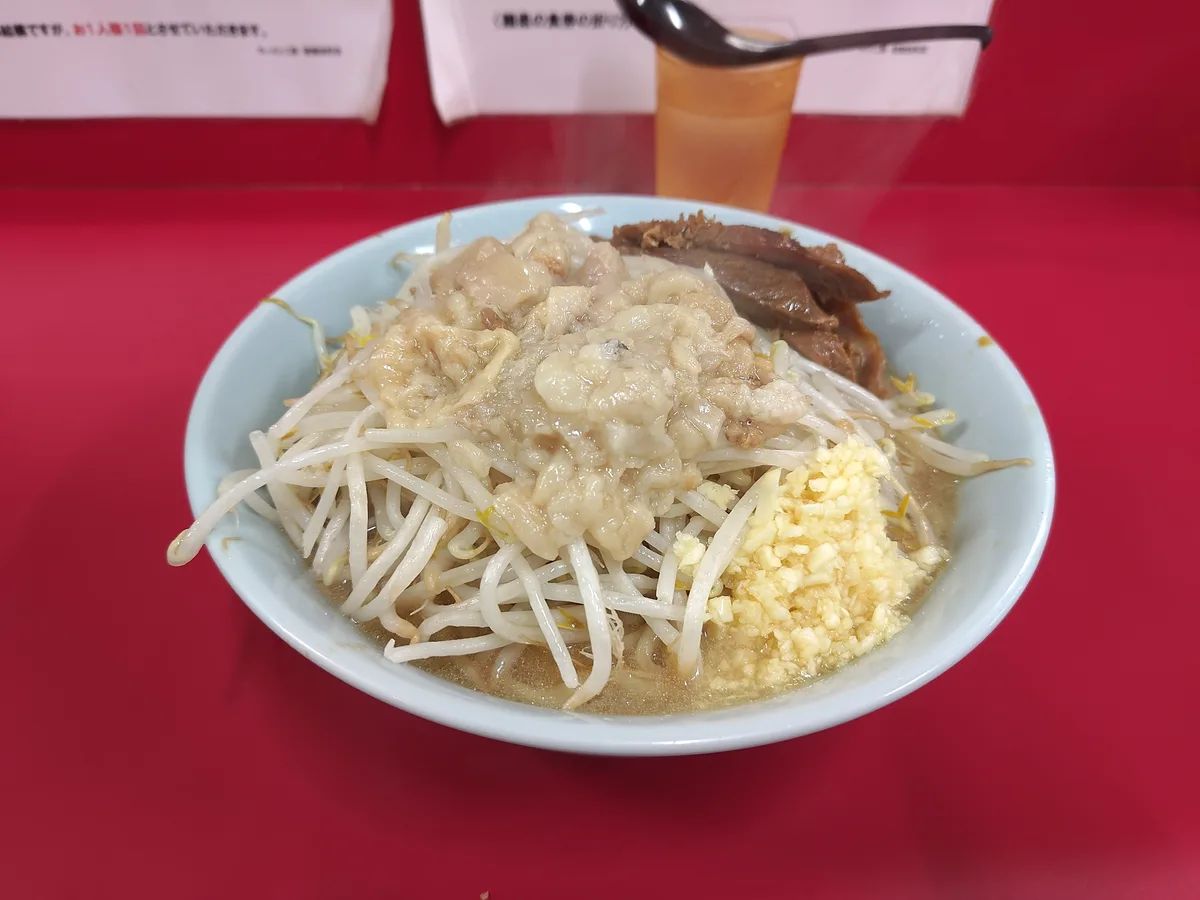
Soup — The Jiro Benchmark: Semi-Emulsified to Emulsified Rich and Punchy Tonkotsu
From the first sip, the rich umami of tonkotsu (pork bone) explodes, a full-throttle, punchy tonkotsu soup that is quintessentially Jiro. While each chokkei (direct-lineage) Jiro shop has its own soup personality, Kabuji's is relatively emulsified, hitting a middle ground that's not as heavy as a fully emulsified (rich and milky white) type, nor as clear and sharp as a non-emulsified type. In a sense, it's a benchmark flavor, 'average = this is what Jiro is all about,' making it ideal as the first bowl for travelers comparing multiple chokkei shops. It's fun to initially leave the 'Ninniku Sukuname' requested during the call as is, and then gradually mix it into the soup, watching the Ninniku's punch accelerate and transform the flavor.
Noodles — Homemade Flat Thick Wavy, Chewy Yet Easy to Eat
The noodles are homemade, flat, thick, and wavy. Compared to average ramen, they are slightly thicker and chewier, but among chokkei (direct-lineage) Jiro shops, they are considered relatively easy to slurp down, with a springy texture that makes you want to keep eating. The aroma of Aushon (a wheat flour brand often used in Jiro noodles, known for its bold wheat aroma) that spreads when chewed is quintessential Jiro. The noodle portion of a Small Ramen is generally considered slightly less than at other chokkei shops, designed to be an amount that even first-time Jiro visitors can easily finish.
Pork (Chashu) — Authentic, Leaner Slices; Opt for 'Buta-iri' if You Want More
Two thick-cut slices of pork arm chashu (pork belly), thoroughly seasoned with tare (soy tare). For a chokkei (direct-lineage) Jiro shop, it's relatively lean and meaty, providing a good balance with Jiro's rich, fatty soup. The firm meat texture offers increasing umami with every bite, an authentic specification. If the amount in a standard ramen feels a bit lacking, you can fully enjoy the pork by choosing 'Buta-iri Ramen' (¥1,050, extra pork) on your next visit.
Yasai (Bean Sprouts) — Flavorless Ingredient, Completed with Soup, Abura, and Kaeshi
Yasai consists solely of boiled bean sprouts (sometimes mixed with a small amount of cabbage). By itself, it has no flavor, so the Jiro style is to build its taste yourself by soaking it in the soup, topping it with Abura, or drizzling a little kaeshi (soy tare) from the table. The plain, flavorless bean sprouts perfectly complement the rich, punchy, and fatty soup. If you don't give the Yasai call, you might not get any bean sprouts at all or only a small amount, so if you want to fully enjoy the Jiro experience, be sure to call out 'Yasai'.
Individual Topping Review
Based on our actual eating experience, we'll explain the quantity and suggested eating methods for each topping, focusing on our call of 'Ninniku Sukuname, Yasai, Abura'.
- 【Ninniku】Even with a 'Sukuname' call, you get a heaped teaspoon of Ninniku, providing a distinct garlic punch. It's recommended to initially leave it as is and gradually mix it into the soup. A regular call or 'Mashi' call will include an even larger amount, so be mindful of your plans for the next day.
- 【Yasai】A regular 'Yasai' call provides a standard amount, not the mountain-like pile typically associated with Jiro. If you want to enjoy Jiro's characteristic 'mountain of bean sprouts,' it's recommended to go for 'Mashi' or even 'Mashi-mashi.' However, the quantity increases significantly, so stick to the regular amount if you're not confident you can finish it all.
- 【Abura】Even with a regular call, a substantial amount of solid back fat is included. Unless you're a big fan of Abura, the regular call is sufficient. 'Mashi-mashi' will significantly increase the calorie count, so being moderate is safer if visiting late at night.
- 【Karame】This is an addition of kaeshi (soy tare), but kaeshi is also readily available on the table. It's smarter not to request it during the call and instead add kaeshi little by little from the table if you find the taste too mild.
🍝About Tsukemen — Not Eaten This Visit, But Kabuji's Hidden Gem
Although we opted for the 'Ramen (Small)' on this visit and did not try the tsukemen, it is another signature dish at Kabuji and is invariably a topic of conversation before and after visits: the 'Tsukemen' (Small ¥1,050, Large ¥1,150). It's a regular menu item always available during normal operating hours, with no seasonal or day-specific restrictions.
Tsukemen features homemade flat thick wavy noodles, rinsed in cold water, dipped into a rich, tangy broth. The dipping broth comes with nori (dried seaweed) and fish powder, along with menma (marinated bamboo shoots) and a small amount of green onions submerged, allowing you to enjoy a combination of 'seafood tang + pork bone umami' that differs from the warm ramen.
Sunday Pre-Opening Queue is Primarily for Tsukemen Regulars
As mentioned in the 'Opening Hours and Crowds' section, Kabuji often sees queues of over 30 people before opening on Sundays (before 11:00 AM), with many of them being regulars specifically for tsukemen (dipping noodles). While there are various theories, it's often said that the cold-rinsed noodles are at their best right after opening, and a culture of leisurely queuing for a meal on holidays is deeply rooted. If you're aiming for tsukemen on a Sunday, you'll need to plan an early morning visit to secure a pole position before 10:30 AM.
Ramen for First-Timers, Tsukemen for Repeat Visits
If you want to savor the trinity of Jiro's call culture, semi-emulsified broth, and homemade noodles, it's recommended for first-time visitors to Japan to go straight for the warm 'Ramen (Small)' ¥950 to experience authentic Jiro. Tsukemen is naturally positioned as an option for repeat visits or for those already familiar with Jiro. Note that the call (shouted topping order ritual) for tsukemen is also available (Ninniku, Yasai, Abura, Karame), with Yasai served on a separate plate and Abura as solid back fat in the dipping broth.
🚪Departure Etiquette — Lifting Your Bowl, Wiping the Counter, 'Gochisousama'
The actions upon leaving after your meal are also part of Kabuji's unique rules. This is traditional etiquette at chokkei (direct-lineage) Jiro shops, and leaving your seat without knowing it might make you feel self-conscious under the gaze of regulars, seen as a 'customer who left their bowl.' During our visit for this article, we departed using the following steps.
- Lift your finished ramen bowl and water cup to the upper counter (the section closer to the kitchen).
- Quickly wipe your seat with the cloth provided on the counter (for the next customer).
- Make eye contact with a staff member, say 'Gochisousama' (a polite phrase said when leaving, meaning 'thank you for the meal'), and then leave.
- Dispose of tissues and other trash in the nearest trash can (two locations: at the back of the shop or near the entrance).
- Collect your belongings (those placed on the shelf under the counter) and leave.
Three Essential Departure Actions — Etiquette for a Smooth Exit
The lot system (a Jiro-specific eating rhythm where the same batch of customers finish together) and departure etiquette at chokkei (direct-lineage) Jiro shops are naturally ingrained customs that help the owner and staff efficiently prepare for the next batch. By remembering just three things – lifting your bowl, wiping the counter, and saying 'Gochisousama' – you can depart smoothly without disrupting the flow of the shop. Even for first-time visitors to Japan, these are not difficult actions and take only a few seconds after your meal.
🗼Nearby Tourist Spots — Combine with Kabukicho and Shinjuku Nightlife
Kabuji's excellent location in central Kabukicho, just a 1-minute walk from Seibu-Shinjuku Station, places it perfectly for combining with Shinjuku sightseeing and nightlife. Leveraging its late-night operating hours until 2:30 AM, you can even plan it as a late-night ramen after sightseeing or drinks.
- 【Kabukicho Ichibangai】A 2-minute walk from Kabuji, this tourist spot features the iconic entrance arch to Kabukicho. It's bustling and lively at night.
- 【Godzilla Head (Shinjuku Toho Building)】A 3-minute walk away, a life-sized Godzilla stands on the rooftop of TOHO Cinemas Shinjuku. An iconic photo spot in Kabukicho.
- 【Shinjuku Golden Gai】A 5-minute walk, a retro bar district with over 200 tiny bars. Popular even among international tourists.
- 【Omoide Yokocho】A 7-minute walk, a Showa-era retro yakitori (grilled chicken skewers) and izakaya (Japanese-style pub) alley on the west side of Shinjuku Station. Perfect for a light drink before or after your Jiro meal.
- 【Shinjuku Station】A 4-minute walk, a massive terminal for JR, Tokyo Metro, Toei Lines, Odakyu, and Keio. Easily integrated as a starting point for sightseeing.
❓Frequently Asked Questions (FAQ)
QIs an English menu available?▼
No, an English menu is not provided. The ticket machine, in-store menu, and staff guidance are all in Japanese only. It's safest to read this article's menu guide and strategy sections in advance, decide what to order, and what to say for your call before entering the shop.
QCan I use credit cards or e-money?▼
No, you cannot. Payment at the ticket machine is cash only. Credit cards, transportation e-money (like Suica), and QR code payments (like PayPay) are all not supported. It's best to prepare some coins or ¥1,000 bills in advance.
QI'm scared of the Jiro call. What happens if I stay silent?▼
If you remain silent the moment the staff says 'Dōzo' (go ahead, give your call), your ramen will be served with no call = default toppings (no Ninniku, small amount of Yasai, standard Abura, no Karame). You can still eat the ramen without making a call, but to experience Jiro's culture, it's recommended to say at least three words: 'Ninniku Sukuname, Yasai, Abura'.
QIs photography really prohibited for anything other than ramen?▼
It's explicitly stated on signs inside the shop: photography of anything other than your ramen (ticket machine, shop interior, other customers) is generally prohibited. The ticket machine photos in this article were taken with staff permission during our visit. If you want to take a commemorative photo, it's safest to limit it to just your ramen bowl.
QCan a solo woman enter?▼
With only 14 counter seats, this shop primarily caters to solo diners. Eating alone and focusing on your meal is the authentic way to enjoy Jiro, more so than coming in groups, as a couple, or with multiple people. During our visit, we saw solo female customers. While some express concerns about Kabukicho's unique touts late at night, once you're inside, it's just a normal ramen shop. If you're concerned, it's recommended to aim for weekdays around 18:00 or early daytime on weekends.
QI'm worried about the portion size. How much is a Small Ramen?▼
While Kabuji's Small Ramen is often considered slightly smaller than at other chokkei (direct-lineage) Jiro shops, including two slices of chashu (pork belly), Yasai (boiled bean sprouts on top), and Abura (solid back fat for richness), it's still quite filling. During our visit for this article, after purchasing our meal ticket and while waiting, staff asked us, '麺の量はどうしますか? (How much noodles would you like?)', offering three options: 'Futsu' (default/normal amount), 'Sukuname' (less, about half), and 'Hanbun' (half portion of noodles). For first-time visitors to Japan, it's safest to choose 'Sukuname' or 'Hanbun,' then progress to 'Futsu' or 'Large Ramen' once you're accustomed to Jiro.
QWhich is recommended for a first-time visitor, Tsukemen or regular Ramen?▼
For first-time visitors to Japan, 'Ramen (Small)' (pork-bone shoyu broth with noodles, chashu, Yasai, and Abura) is the classic choice, offering the most direct Jiro experience. Tsukemen, a style of eating cold-rinsed noodles with a tangy dipping broth, is a bit of a curveball for Jiro. On Sundays, over 30 regulars often queue before opening specifically for tsukemen, making it Kabuji's hidden popular menu item. However, to savor the trinity of Jiro's call culture, soup, and homemade noodles, it's natural for beginners to start with the warm ramen and try tsukemen on a repeat visit.
QAre there any temporary closures besides the Wednesday regular holiday?▼
In addition to Wednesday being a fixed complete regular closing day, temporary closures may occur due to the owner's health, shop circumstances, New Year's holidays, Golden Week, Obon, and other reasons. Temporary closures and changes to business hours are announced on the shop's official X (Official X @kabujiikeji)), so checking before your visit is the most reliable method. Due to the nature of its late-night operations, early closures due to running out of the day's soup or ingredients also rarely occur, so it is safest to avoid visiting right before the 02:30 closing time.
QIs it true that it's open until 2:30 AM?▼
Yes, it's true. It operates continuously from 11:30 AM to 2:30 AM on Monday, Tuesday, Thursday, Friday, Saturday, and Sunday, with Wednesday as the only regular closing day. Late-night operations are rare among chokkei (direct-lineage) Jiro shops, making it a valuable spot for a late-night ramen after drinks in Shinjuku-Kabukicho. However, note that it is completely closed on Wednesdays, so pay attention to the day of your visit.
📍Shop Information
| Item | Details |
|---|---|
| Shop Name | Ramen Jiro Shinjuku-Kabukicho (Nickname: Kabuji) |
| Genre | Jiro-kei (chokkei (direct-lineage)), Tonkotsu Shoyu (pork-bone shoyu broth, semi-emulsified to emulsified), homemade flat thick wavy noodles |
| Difficulty | ★4 Professional (🧙Wizard + 🥋Dojo) |
| Ordering Method | Ticket machine at the entrance (Japanese only, no photos), Jiro call verbally to staff just before your bowl is served |
| Seating | 14 counter seats only (no table seats, fixed round stools, small luggage shelf under the counter) |
| Price Range | ¥950-¥1,150 (Small Ramen ¥950, Buta W ¥1,150) |
| English Menu | None |
| Payment Method | Cash only (cards, e-money, QR code payments all not accepted) |
| Nearest Station | Seibu-Shinjuku Station North Exit 1-minute walk (approx. 90m) / JR Shinjuku Station East Exit 4-minute walk |
| Address | Nisshin Building 1F, 2-37-5 Kabukicho, Shinjuku-ku, Tokyo |
| Opening Hours | Mon, Tue, Thu, Fri, Sat, Sun 11:30 AM - 2:30 AM (Please confirm before visiting) |
| Regular Holiday | Wednesday |
| Lineage | Ramen Jiro Chokkei (direct-lineage, 4th oldest), NS-kei (operated by NS Planning, Ikebukuro, Kabukicho, former Shinbashi) |
🎯Who This Shop Is For / Not For
| Recommended | May Not Be For You |
|---|---|
| Want to experience Ramen Jiro at least once and delve into Tokyo's local ramen culture | Requires an English menu or menu with photos |
| Looking for a late-night ramen after sightseeing or drinks in Kabukicho/Shinjuku | Prefers to pay with credit card, e-money, or QR code |
| Enjoys 'preparing and tackling' strategic elements like the Jiro call, ticket-folding, and lot system | Dislikes eating quietly and focusing in a narrow, counter-only shop |
| Wants to enjoy a rich late-night ramen at a chokkei Jiro open until late | Is a light eater, or dislikes rich tonkotsu shoyu, Ninniku, and Abura |
| Intermediate to advanced ramen travelers who want to experience an approachable chokkei Jiro in a tourist-friendly location | Wishes to enter with a group/couple or large suitcases |
Summary
Ramen Jiro Shinjuku-Kabukicho (known as Kabuji) possesses rare and favorable conditions among chokkei (direct-lineage) Jiro shops: 'located in central Kabukicho, a 1-minute walk from Seibu-Shinjuku Station, and open until 2:30 AM.' This makes it the most approachable entry point for tourists seeking to delve into Tokyo's local ramen culture as an 'introduction to chokkei Jiro.' It's a unique place to experience Jiro's distinctive elements — semi-emulsified to emulsified pork-bone shoyu broth, homemade flat thick wavy noodles, thick-cut lean chashu, and the call culture, ticket-folding, lot system, and shop-specific rules — all within a prime tourist location.
There are only four key tips for success: 'Memorize the Jiro call words (Ninniku, Yasai, Abura, Karame, Mashi, Sukuname) and the rule that 'Ninniku is not included with a Futsu call',' 'For first-time visitors to Japan, keeping the meal ticket unfolded for regular noodle doneness is recommended,' 'Abide by the in-store rules (no phone calls, no photography except ramen, no drunken entry) and departure etiquette (lifting your bowl, wiping the counter, saying Gochisousama),' and 'Prepare cash, specifically ¥1,000 bills.' If you grasp these points, even without an English menu or with a Japanese-only ticket machine, your first visit to Japan will be much smoother and less confusing.
Stepping into a local Jiro culture not optimized for tourists, at a quiet 14-seat counter amidst the touts and bustle of Kabukicho — this experience will be a step beyond the typical tourist circuit into a different aspect of Tokyo's ramen culture.
Visited & Verified by Our Team
This article is brought to you by the Ramen Gateway editorial team, based on our actual visit to the shop on Thursday, May 15, 2026, from 18:18 to 18:38, where we ordered and ate a Small Ramen (¥950) with 'Futsu' noodle quantity and the call 'Ninniku Sukuname, Yasai, Abura.' All photos were also taken during our visit (with permission from the staff for the ticket machine). Queue information (6 people waiting inside upon arrival, 7-8 people waiting outside upon departure), the shop's atmosphere, the eating report, the Jiro call experience, and departure etiquette are all based on our real-life experience during the visit.
If you visit, we'd love to hear your review!
"We don't let AI eat ramen. We use AI to draw the coolest map so adventurers worldwide can find the real treasure hidden in Japan's back alleys."
Made in Japan — with local knowledge & AI assistance