Chiechan Ramen: Experience the Origin of Chan-kei, Open 24 Hours in Kanda
Just a 1-minute walk from Kanda Station West Exit, Chiechan Ramen is the 24-hour origin shop of the Chan-kei ramen lineage. This in-depth report, tailored for travelers, covers its multilingual touch-panel ticket machine, free rice, and traditional Tokyo shoyu ramen.


🍜Chiechan Ramen at a Glance
| Item | Content |
|---|---|
| Difficulty | ★2 Standard (Ticket purchase is easy with the multilingual touch panel. However, guests must decide when to enter the shop themselves.) |
| English Support | Multilingual touch-panel ticket machine supports various languages. Orders can be completed on the English screen. |
| Payment | Cash or QR payment. Prepaid at the ticket machine (ticket system). |
| Waiting Time | Upon our visit at 6:20 PM, there were 5 people in line, and ramen was served in about 11 minutes. The number of people in line varies greatly depending on the time of day. |
| Recommended For | Those who want to try traditional Tokyo shoyu ramen / Travelers who want ramen any time of day or night (24 hours). |
| Important Notes | Leave suitcases in station coin lockers before visiting (the shop is small, so bringing them in is impractical) / The entry process requires guests to look inside and enter if there's an empty seat (staff generally do not provide explicit guidance) / The raw garlic on the table is quite spicy, so it's recommended for enhancing the flavor in the latter half of your meal. |
| First-Time Order | If you want a light taste, Chuka Soba (classic Tokyo-style ramen) ¥900 / If you want to experience the full meaty impact characteristic of Chan-kei (a traditional Tokyo shoyu ramen lineage whose member shops all include 'chan' in their name) ramen, the Chashu-men ¥1,200 (labeled 'If you're unsure, pick this!' on the ticket machine). For free rice, saying "Rice, please" immediately after your ramen is served ensures it arrives. |
Just one stop from Tokyo Station or Akihabara. Drop by any time, 24/7.
Chiechan Ramen boasts a prime location in the heart of Tokyo, just a 1-minute walk from Kanda Station West Exit, one JR stop (2-3 minutes) from Tokyo Station, and a 10-minute walk from Akihabara. Even if you're not staying in Kanda, it's easy to incorporate into your Marunouchi or Akihabara sightseeing plans. What's more, it operates 24 hours a day, year-round (except for New Year holidays), offering a rare convenience. You can visit for breakfast, after sightseeing, as a late-night meal after the last train, or to fill up before a late-night flight, without worrying about the time. As one of the shops recognized as the origin of Chan-kei ramen, it's also a valuable place to experience a piece of Tokyo's ramen history.
🍜Experience the Origin of Chan-kei in Kanda
Chiechan Ramen is a long-established shoyu ramen shop located in Kajicho, Kanda, Tokyo. It is a member of the Chan-Noren Association (an official association of Chan-kei shops) and is recognized by the association as the origin of the lineage known as Chan-kei, a traditional Tokyo shoyu ramen style. The Chan-kei lineage derives its name from the noren (shop curtain) association formed by ramen shops whose names include 'chan' (such as Tacchan, Akichan, Chiechan). These shops carry on the traditional Tokyo shoyu ramen style that dates back to the Showa era – characterized by a clear shoyu broth made from pork extract, known as buta-chintan (pork-based clear broth), a thick layer of lard (pork fat) on the surface, generous amounts of chashu (braised pork), soft, flat-cut noodles, and the offering of free rice. A significant point is that while many overseas visitors assume shoyu ramen is chicken-based, Chan-kei's clear broth is, in fact, packed with concentrated pork umami.
Since the 2000s, as trends shifted towards Jiro-kei, Ie-kei, and rich seafood-based ramens, Tokyo shoyu ramen was often seen as 'old-fashioned.' However, in recent years, there's been a growing re-evaluation of it as the 'ultimate standard of shoyu ramen.' The Chan-kei lineage is at the heart of this movement, embodying the theme of a 'return to tradition.' With attention now starting to focus on this style as a next-generation ramen trend, visiting its origin point holds significant meaning.
It's just a 1-minute walk from the Kanda Station West Exit rotary. Look for the red noren (shop curtain), the 'Chuka Soba Mori Chuka' sign, and the Chan-Noren Association mark. You'll often find a short line of people outside. Despite the line, service is quick; during our visit, it took about 11 minutes from joining a 5-person line to receiving our ramen. Most notably, its 24-hour operation (except for New Year holidays) is a rarity in Tokyo, offering remarkable flexibility to visit at any time.
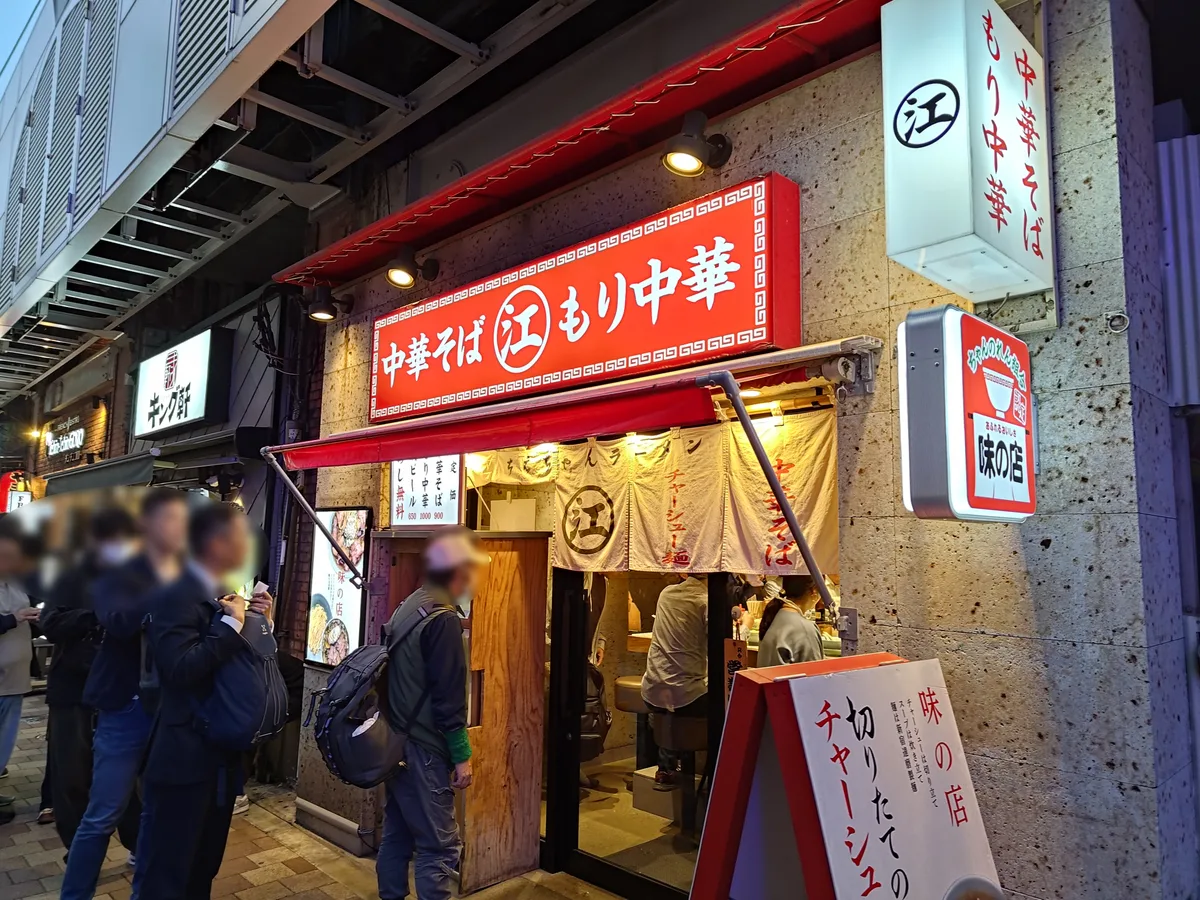
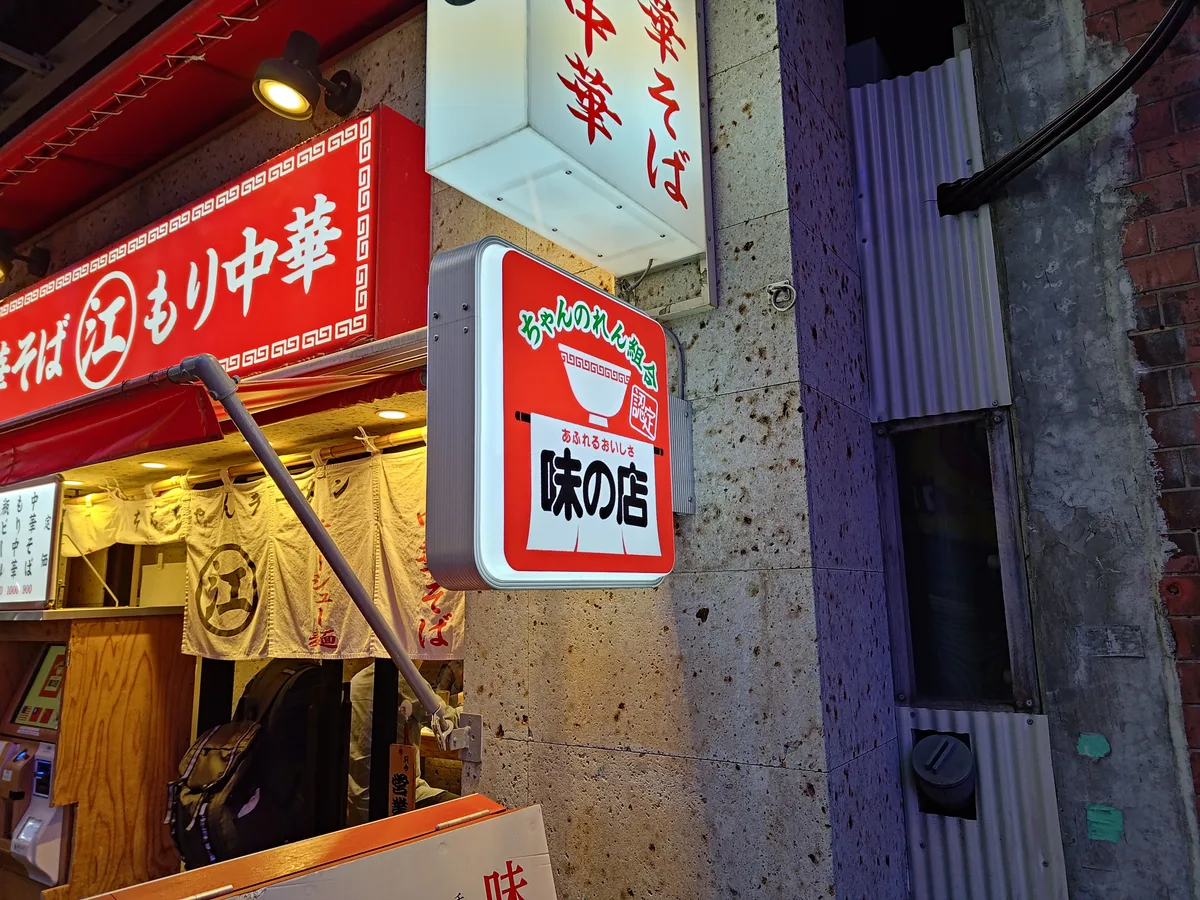

Ren's Note
The Chan-kei lineage preserves the classic style of Tokyo shoyu ramen. While it hasn't seen the flashy evolution of Ie-kei or Jiro-kei, it's the only lineage where you can experience the 'original form of shoyu ramen.' We'll be creating a detailed article explaining the Chan-kei ramen style soon, so getting a feel for it at Chiechan Ramen now will help you understand the entire lineage later.
🚶Access — 1-Minute Walk from Kanda Station West Exit
Exit Kanda Station's West Exit (JR Chuo Line, Keihin-Tohoku Line, Yamanote Line), proceed straight through the rotary, and you'll arrive in just a few dozen meters. It's an overwhelmingly close 93m, a 1-minute walk from the station. It's also about a 2-minute walk from Kanda Station on the Tokyo Metro Ginza Line, making it convenient for a quick stop during transfers.
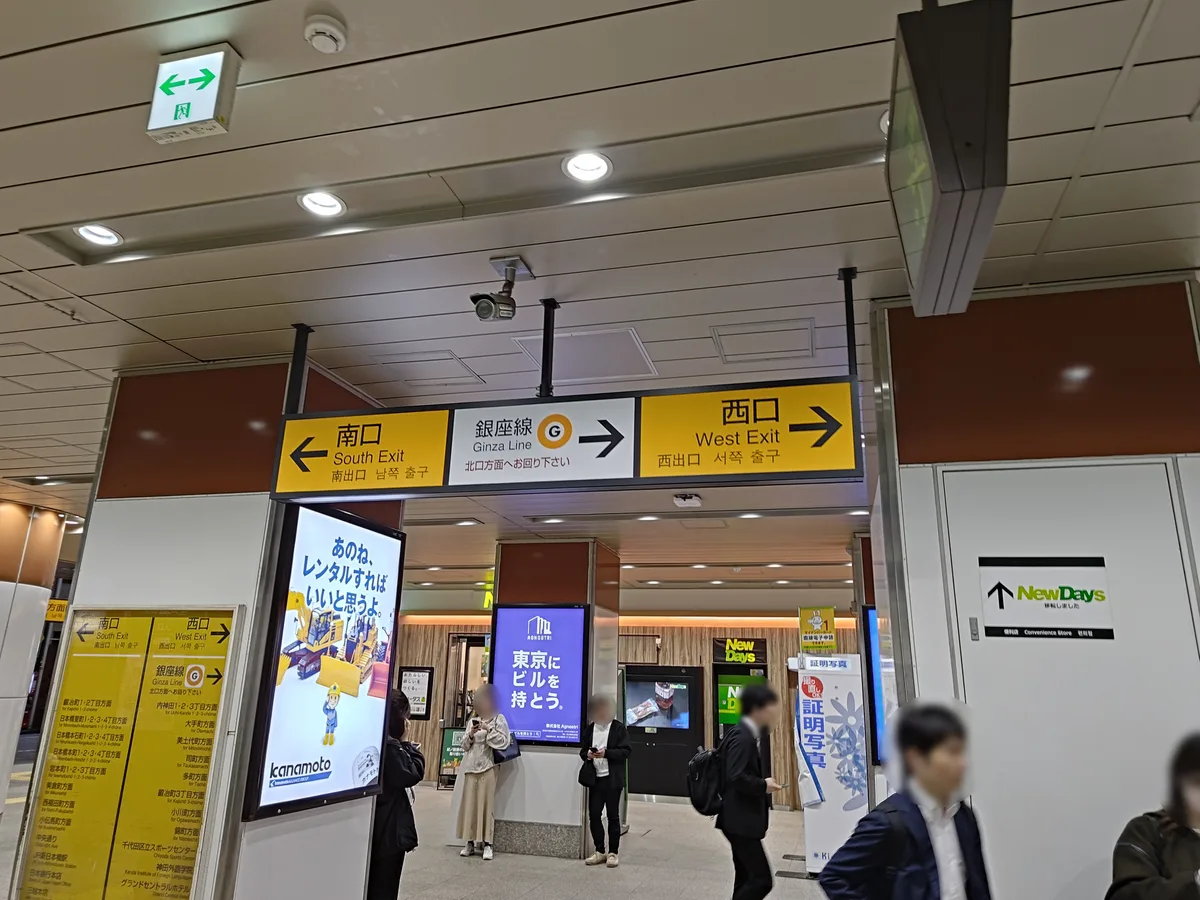
Even 24-hour shops have lines
While Chiechan Ramen is open 24 hours, its Kanda location means it gets particularly crowded during lunch, dinner after work, late-night after the last train, and early morning. The best times to aim for are mid-morning, between 10 AM and 11 AM, or very early morning, between 2 AM and 5 AM. If you absolutely want to avoid a line, these are the times to choose.
IMPORTANT: Always store suitcases before visiting
The shop interior is quite small, making it physically impossible to bring large suitcases inside. It's so narrow that you might not even be able to reach a seat, so please be sure to deposit your luggage in a coin locker beforehand. Kanda Station and its vicinity have numerous coin lockers, and it's also a good idea to visit after checking into your hotel and leaving your luggage there. Small bags like backpacks can be hung on hooks under the counter or on hangers behind the seats.
📝From Waiting to Ordering — How to Use the Touch-Panel Ticket Machine
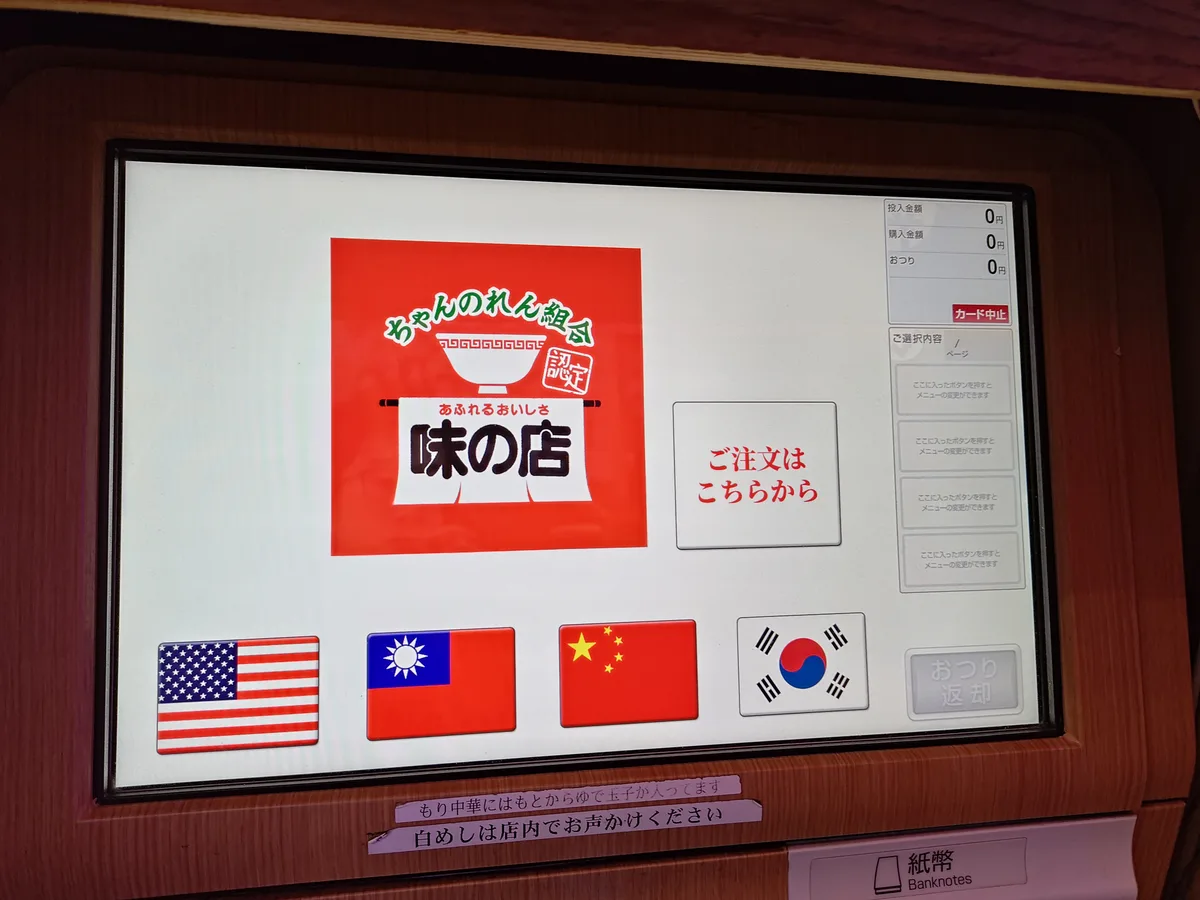
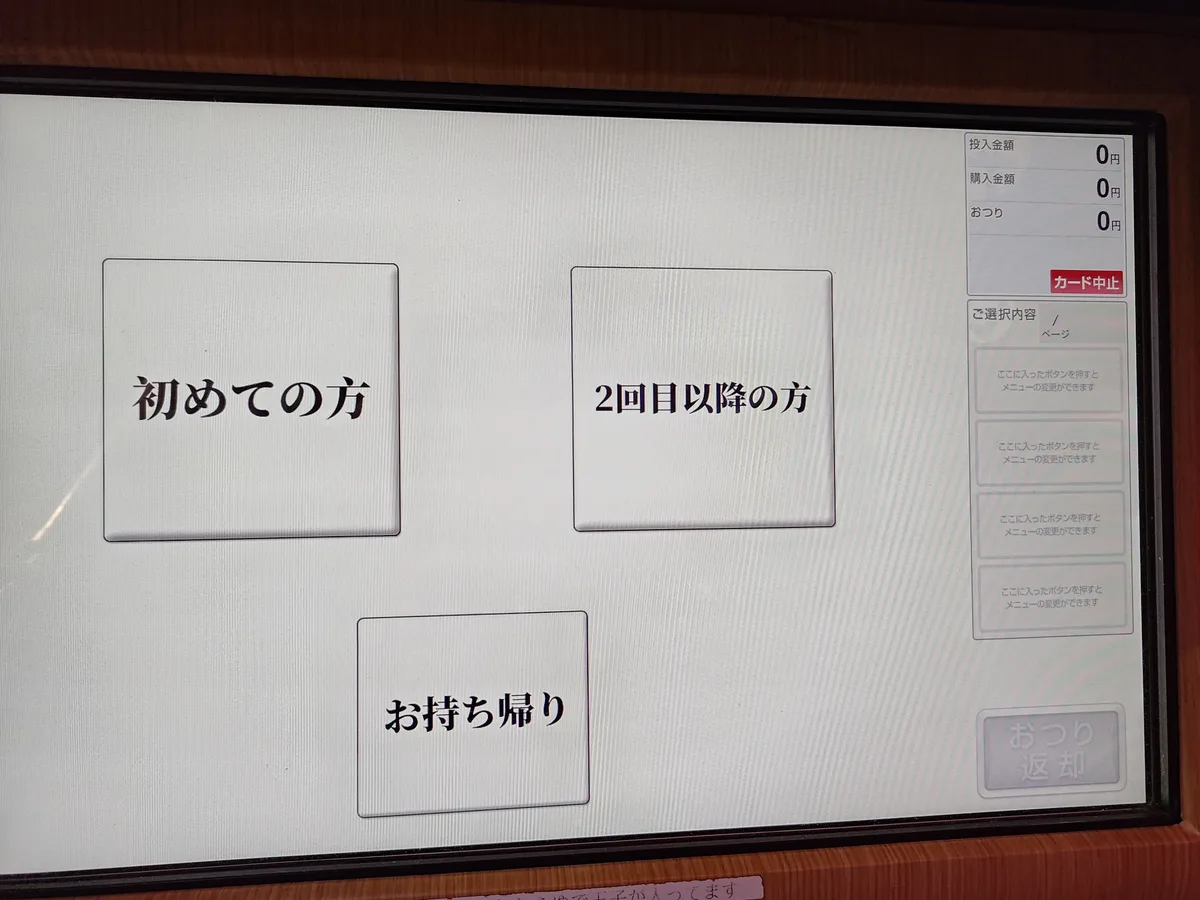
If there's a line outside the shop, the basic procedure is to operate the outdoor touch-panel ticket machine while waiting in line. This ticket machine is multilingual, designed for a three-step process: language selection, visit history, and product selection. It also supports QR code payments, allowing for non-cash transactions. After purchasing your meal ticket, enter the shop and hand it to a staff member to start your order.
- Line up outside the shop (number of people varies by time of day)
- Once the line moves, begin operating the touch-panel ticket machine
- First, select your language (Japanese, English, Chinese, Korean, etc.)
- Select your visit history (first-time visitors choose the left button)
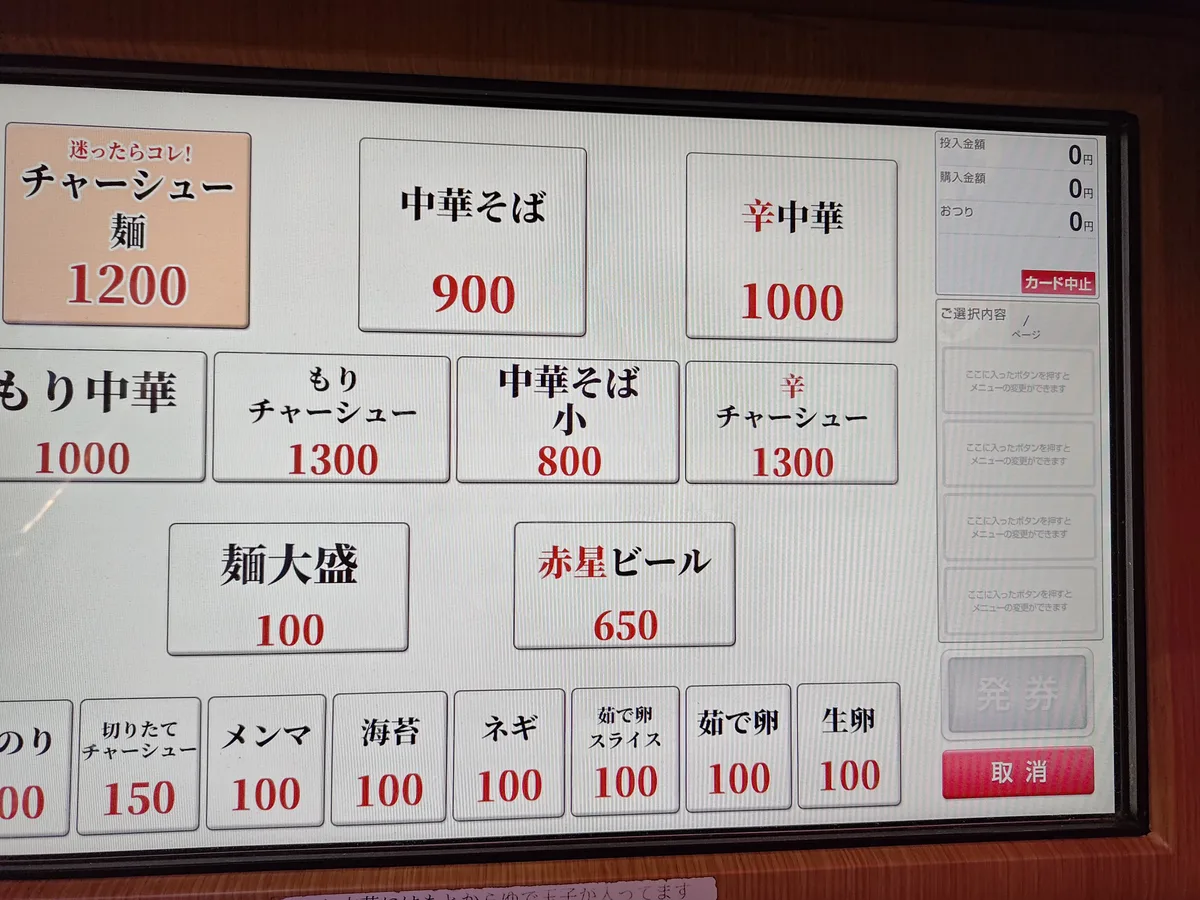
- Choose your desired menu item and confirm the price
- Insert cash or use the QR code in the bottom right for smartphone payment
- Take your meal ticket as it comes out
- Look inside the shop, enter if there's an empty seat; if full, wait outside
- Once seated, hand your meal ticket to a staff member
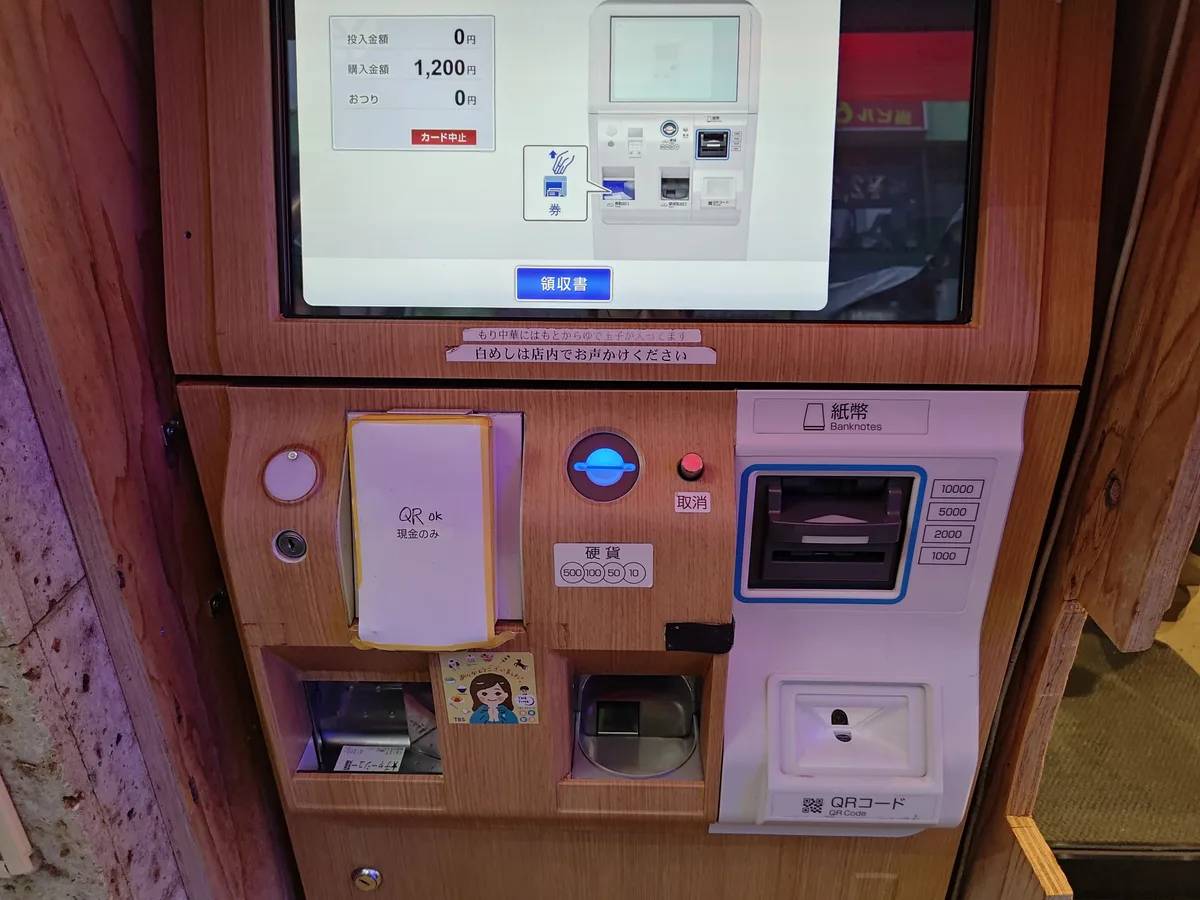
Guest judgment required for entry — The difficulty factor
Chiechan Ramen does not have a clear system for staff to guide you to your seat, like 'Please come in, party of X.' Instead, after buying your ticket, you are expected to look inside yourself, enter if there's an empty seat, and wait outside if it looks full. You might be told 'We're full right now, please wait outside' if you enter mistakenly. If you're unsure, it's safest to enter just as someone leaves the shop. While purchasing tickets with the touch panel is easy, this entry flow is the only part that requires guest judgment.
🍜Menu
The prices on the ticket machine are summarized below. For your first visit, there are two main choices: if you want a light taste, opt for the standard Chuka Soba ¥900 (which still includes a good amount of chashu). If you want to fully experience the substantial volume and meaty impact characteristic of Chan-kei from the start, choose the Chashu-men ¥1,200, marked with 'If you're unsure, pick this!' Whichever you choose, you'll get a solid taste of this shop's unique character.
| Menu Item | Price (Tax Incl.) | Notes |
|---|---|---|
| Chuka Soba (Classic Tokyo-style ramen) | ¥900 | Standard menu. A light shoyu soup Tokyo-style Chuka Soba. |
| Chuka Soba Small | ¥800 | A mini size for those who want a lighter meal. |
| Chashu-men (Ramen with extra braised pork) | ¥1,200 | ★ Shop recommended: 'If you're unsure, pick this!' An enhanced version with more chashu. |
| Spicy Chuka | ¥1,000 | A variation with added spice. |
| Mori Chuka / Tsukemen (Dipping noodles) | ¥1,000 | Tsukemen (dipping noodle) style. |
| Mori Chashu-men | ¥1,300 | Tsukemen with extra chashu. |
| Spicy Chashu-men | ¥1,300 | Spicy + extra chashu. |
| Extra Noodles | +¥100 | Can be added to any menu item. |
| Akaboshi Beer (Sapporo Red Star) | ¥650 | Bottled beer. |
Toppings include freshly sliced chashu (braised pork) ¥150, and menma (bamboo shoots), nori (seaweed), green onions, boiled egg (whole or sliced), and raw egg for ¥100 each. While simple, the complimentary free rice makes for a highly satisfying meal.
How to Order Free Rice
When your ramen is served, a staff member will ask in Japanese, 'Meshi ikaga desu ka?' (How about some rice?). If you want it, simply say 'Onegaishimasu' or "Yes please". However, staff can be busy, so if you ask beforehand, it might be forgotten. The best timing is to say "Rice, please" immediately after your ramen is served. This way, it's sure to arrive. The serving is small, so definitely try it if you have room.
🏠Shop Atmosphere — An Unpretentious Space with 70s Western Rock Music
Upon opening the door, you're greeted by a clean yet compact space. There are 14 counter seats, and while there seem to be table seats further back, their arrangement is somewhat intricate. Throughout your visit, 70s Western rock music, primarily The Beatles, plays in the background, creating a unique atmosphere that feels distinct from a traditional ramen shop, hinting at the owner's love for music. Despite being a long-established shop in a downtown area, it doesn't try to evoke Showa-era retro charm; rather, it feels like an 'active legendary shop,' an unpretentious space where the sounds of modern daily life naturally flow.
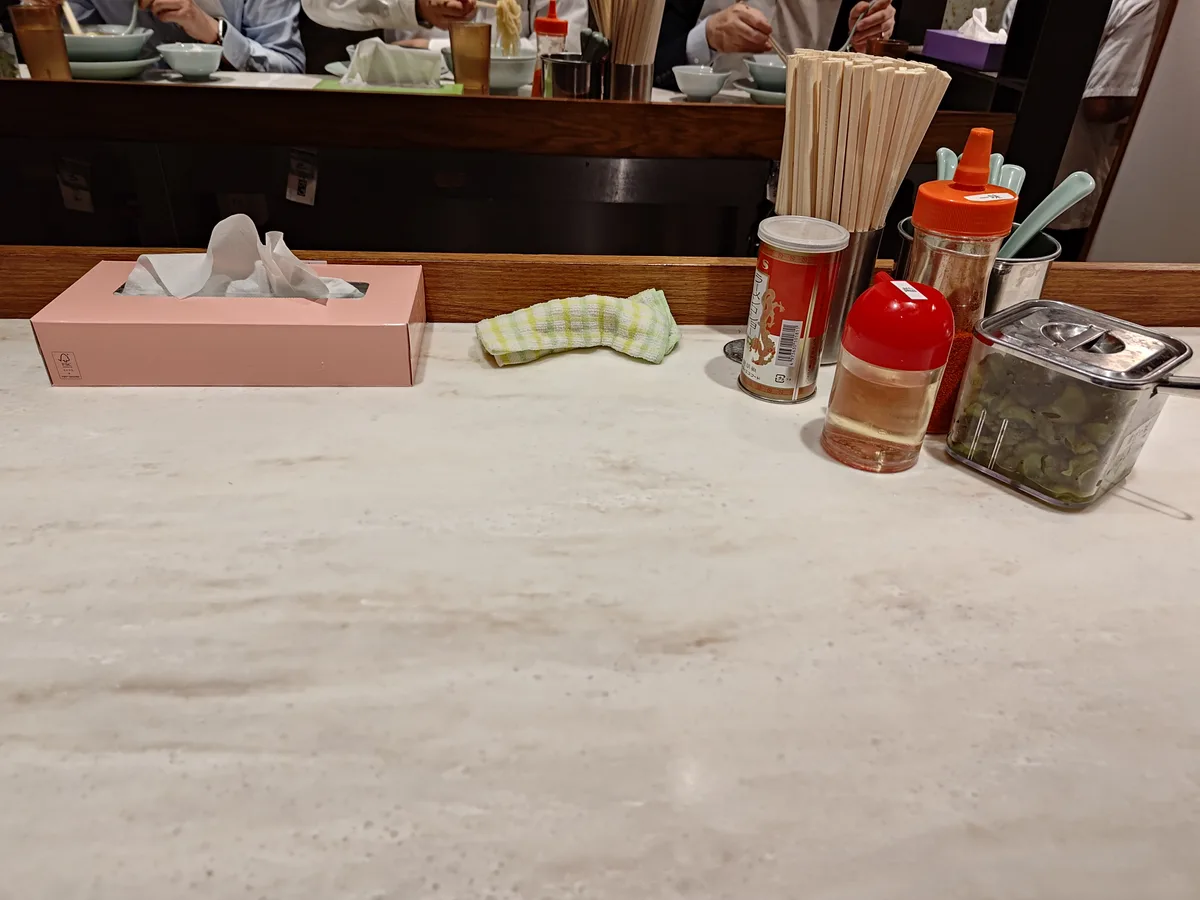
Once seated, the first thing to note is that water is entirely self-service. You'll get it yourself from the water dispenser inside the shop. Paper aprons are also available, so you can dine without worry even if you're wearing a white shirt. Hooks for bags are provided under the counter, and hangers for clothes are located behind the seats, with many thoughtful touches to ensure single diners have a comfortable experience.

Sophia's Note
It's definitely best to store large luggage in a station locker before coming. If you only have a backpack-sized bag, you can hang it on the hooks under the counter, so that's fine.
🔥The Tasting — Chashu-men + Free Rice
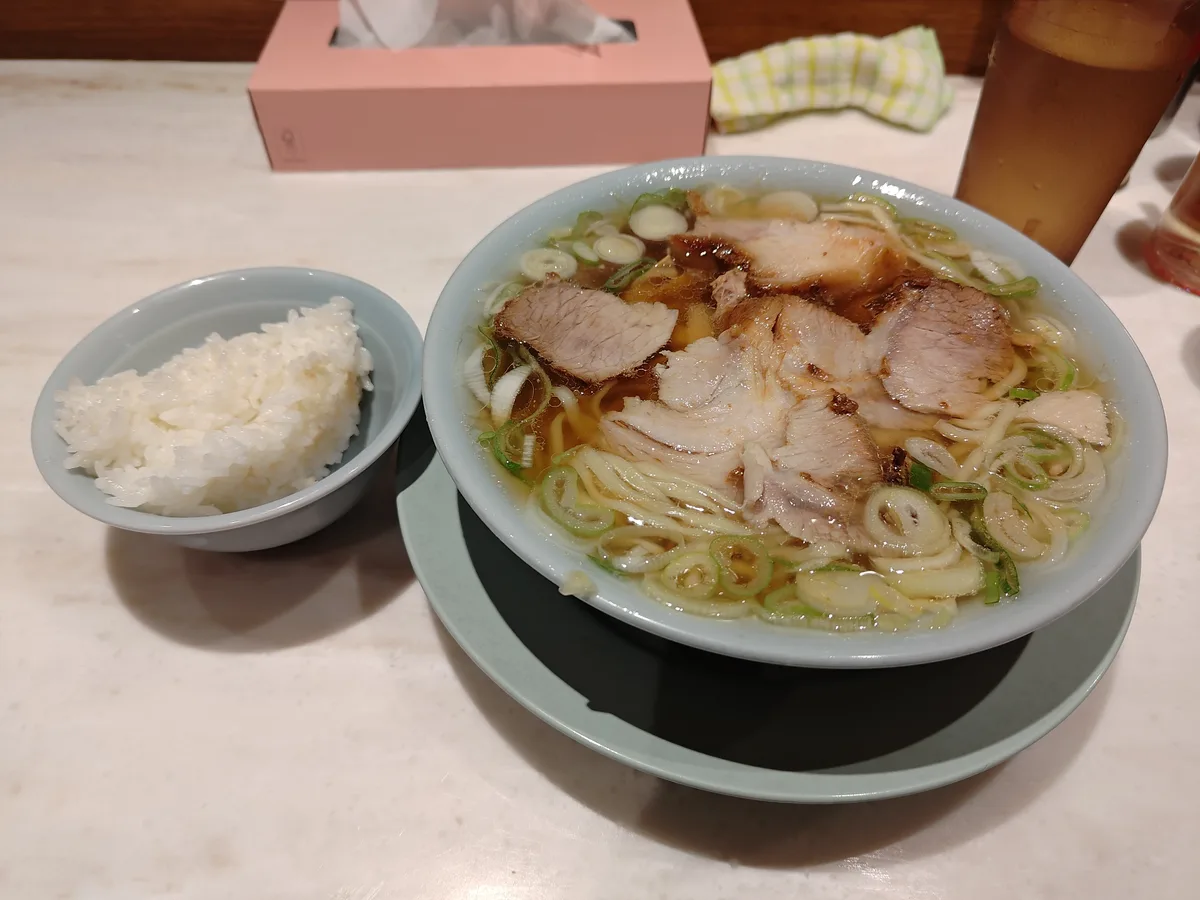
Broth — The Richness of Buta-Chintan Hidden Within Clear Shoyu
The first sip gives an impression of being 'smooth and light.' The shoyu flavor comes to the forefront, creating a first impression of classic, traditional Tokyo shoyu ramen. However, there's a crucial fact to keep in mind here. While many overseas visitors might strongly associate 'shoyu ramen' with a chicken-based broth, the clear shoyu broth of Chan-kei ramen is actually buta-chintan (pork-based clear broth), derived from pork extract. Despite its translucent appearance, you can distinctly taste the deep umami of pork when you drink it – this surprising contrast of 'clear appearance × pork umami' is the Chan-kei lineage's greatest characteristic.
Furthermore, a visibly thick layer of lard (pork fat) floats on the surface of the broth, and as you continue to drink, a rich, weighty flavor spreads throughout your mouth. The fat melting from the generous amount of chashu also adds to this, creating a depth that makes you feel 'it was richer than it looked' as you near the end of your meal.
This structure, which initially suggests a light and refreshing flavor but then delivers a rich punch in the latter half, is a unique brilliance of the Chan-kei lineage. It's a valuable style where you can experience the original way shoyu ramen umami is constructed, completely different from the rich tonkotsu or Jiro-kei styles popular with younger generations.
Noodles — Soft, Flat-Cut, with a Smooth Udon-like Texture
The noodles are a slightly soft, flat-cut type. In contrast to the modern ramen trend of firm, low-hydration noodles, they are characterized by a smooth, udon-like texture. They pair well with the light shoyu broth and slide easily down the throat. While those who prefer a firmer bite might find them lacking, this is also an authentic flavor of Tokyo shoyu ramen, a valuable example where the culture of soft noodles persists.
Chashu — Balancing Meaty Texture and Juiciness
The chashu (braised pork) is a distinctly meaty and juicy type, sliced thickly to allow you to enjoy the alternating balance of lean and fatty parts. It's worth noting that even the standard Chuka Soba already comes with a generous amount of chashu. While the price difference between Chashu-men (¥1,200) and Chuka Soba (¥900) is ¥300, our actual tasting suggested the increase in quantity felt modest. Therefore, it's straightforward to choose: Chuka Soba if you want a lighter taste, and Chashu-men if you want to fully experience the 'meaty impact of Chan-kei' from the start.
Free Rice — Small Serving, Definitely Try if You Have Room
The complimentary free rice is a small serving, a manageable size to order casually. You can enjoy various ways of eating it, such as pouring a little shoyu broth over it or topping it with chashu to make a mini donburi. Adding the table pickles for rice completes a simple yet satisfying meal. There's little worry of getting too full, but if you're a light eater or having ramen for breakfast, it's fine not to order it if you don't have room. Positioning it as 'try if you have room' is just right, making it a fitting side dish for a wide range of travelers.
Flavor Transformation Flow — Pepper → Garlic for an Accelerated Experience
Among the table condiments, pepper and raw garlic are particularly effective. We'll introduce the best order to try them. First, enjoy the original shoyu and lard (pork fat) flavors of the broth for about half of your meal without adding anything. Once it starts to feel a bit heavy, a sprinkle of pepper adds a stimulating kick, giving the soup more dimension. Finally, when about a third of the ramen remains, add the raw garlic – this is potent. The garlic is served nearly raw, with just the skin peeled, making it quite spicy, so adding too much will instantly overpower the soup's delicate balance. It's safest to start with about half a teaspoon. This rhythm of finishing the last few bites with a sharp garlic punch is just right.
Raw garlic is spicy, save for later flavor transformation
The raw garlic provided on the table at Chiechan Ramen is not a grated paste, but rather peeled raw garlic pieces. These are surprisingly spicy, and adding them completely transforms the flavor of the soup. If you add too much early on, the delicate lightness of the shoyu will disappear, so it's recommended to save it for a flavor change in the last third of your meal. Definitely try it for an experience that turns it into a completely different ramen.

Zack's Note
Strategically speaking, this bowl of ramen is designed for 'enjoying flavors in stages.' It's a 3-step process: ① Start as is → ② Add a kick with pepper → ③ Finally, add garlic. You'll definitely regret putting everything in at once. All the table 'weapons' are free, and how you use them can completely change your impression of the bowl, so I really encourage you to try them incrementally.
📍Nearby Tourist Spots
Kanda Station area is primarily an office district, but several historical and cultural spots are within walking distance, making them enjoyable to combine before or after your ramen meal.
- Kanda Myojin Shrine (15-minute walk) — An ancient shrine that served as the guardian of Edo. Also known today as a pilgrimage site for anime and manga fans.
- Akihabara Electric Town (10-minute walk) — One of the world's leading centers for otaku culture. Just a short walk from Kanda.
- Manseibashi Bridge (7-minute walk) — Enjoy retro architecture and cafes at 'mAAch ecute Kanda Manseibashi,' located at the former Manseibashi Station site.
- Nihonbashi (15-minute walk) — The starting point of Japan's road network. The venerable Mitsukoshi Main Store department store is also within walking distance.
- Tokyo Station (20-minute walk / 1 JR stop) — See the red-brick Marunouchi Station Building, and enjoy underground gourmet options right away.
❓Frequently Asked Questions
QIs there an English menu?▼
The touch-panel ticket machine itself is multilingual, allowing for screen operations in English, Chinese, Korean, and other languages. While there isn't a physical English menu, you can view menu items with photos on the screen before purchasing, so there is virtually no language barrier.
QCan I use a credit card?▼
QR code payments (such as PayPay) are available at the ticket machine. Cash is also accepted. However, direct credit card insertion is not supported, so if you wish to pay by card, it's best to prepare a service that allows card payments via a QR code payment app beforehand for a smoother transaction.
QHow long is the wait?▼
During our visit on a Monday at 6:20 PM, there were 5 people in line, and it took about 11 minutes until the ramen was served. Service is relatively quick, and waits are shorter if you arrive just as customers are turning over. It tends to be particularly crowded during lunch peak, evening hours (6-8 PM), and late-night after the last train. The best times to aim for are mid-morning (10-11 AM) or very early morning (2-5 AM).
QIs it really open 24 hours?▼
It is generally open 24 hours, 365 days a year, but it closes during the New Year holidays. Rarely, there may be temporary closures or changes in hours for maintenance, so if you plan to visit late at night, it's best to check announcements at the shop or on social media just before your visit for peace of mind.
QWhat is Chan-kei?▼
It is a collective term for member shops of the Chan-Noren Association (an official association of Chan-kei shops) whose names include 'chan' (such as Chiechan, Tacchan, Akichan). It features the traditional Tokyo shoyu ramen style: a clear shoyu broth made from pork extract (buta-chintan/pork-based clear broth), a thick layer of lard (pork fat), generous amounts of chashu (braised pork), soft flat-cut noodles, and free rice. It's often called the 'ultimate standard of shoyu ramen.' While many overseas visitors strongly associate shoyu ramen with chicken-based broths, a distinctive feature of Chan-kei is its surprisingly pork-based broth. It hasn't undergone flashy evolutions like Ie-kei or Jiro-kei, but its humble nature is currently being re-evaluated as a 'return to tradition.' Chiechan Ramen is recognized as the origin of this lineage, and new shops like Kyoto's Akichan Ramen continue to emerge. A detailed guide to the entire lineage is planned for a separate article.
QWhen should I ask for free rice?▼
A staff member will ask 'Meshi ikaga desu ka?' in Japanese when your ramen is served. However, staff can be busy, so if you ask beforehand, it might be forgotten. The most reliable way is to say "Rice, please" immediately after your ramen is served. At this moment, the interaction will be completed in one go, and your rice will arrive promptly.
🚃Access
Just a 1-minute walk from the West or South Exits of JR Kanda Station (Chuo Line, Keihin-Tohoku Line, Yamanote Line). Exit the station, proceed through the station rotary, and it's located right at the corner. It's also about a 2-minute walk from Kanda Station on the Tokyo Metro Ginza Line. From Tokyo Station, it's just 1 JR stop (2-3 minutes), and about a 10-minute walk from Akihabara Station. It boasts an excellent location with good access from anywhere in central Tokyo.
📋Shop Information
| Item | Details |
|---|---|
| Shop Name | Chiechan Ramen |
| Genre | Tokyo Shoyu Ramen (Chan-kei, Origin) |
| Difficulty | ★2 Standard |
| Ordering System | Touch-panel ticket machine (multilingual support) |
| Seating | 14 counter seats + table seats in the back (details unknown) |
| Price Range | ¥800〜¥1,300 |
| English Menu | English available on touch-panel screen |
| Payment Method | Cash / QR code payment (PayPay, etc.) |
| Nearest Station | JR Kanda Station West Exit / South Exit 1-minute walk / Tokyo Metro Ginza Line Kanda Station 2-minute walk |
| Estimated Waiting Time | During our visit, 5 people in line took about 11 minutes until served / Number of people in line varies by time of day |
| Business Hours | 24 hours (please confirm before visiting) |
| Closed | None (except New Year holidays) |
🎯Who This Shop Is For / Not For
| Recommended For | Might Not Be For You |
|---|---|
| Want to try traditional Tokyo shoyu ramen | In the mood for rich tonkotsu or Jiro-kei |
| Looking for a ramen shop open 24 hours | Prefer modern, firm noodles |
| Want a satisfying meal with ramen + free rice | Traveling with a suitcase |
| Want to enjoy flavor transformations (pepper, garlic) during your meal | Feel confused without explicit staff guidance for entry |
| Want to experience the origin of the Chan-kei lineage | Only want to pay with a physical credit card |
Summary
Chiechan Ramen is a rare establishment in Tokyo, combining the advantages of a prime location—a 1-minute walk from Kanda Station West Exit and 24-hour operation—with the historical significance of being recognized as the origin of the Chan-kei ramen lineage. Thanks to the multilingual touch-panel ticket machine, there's virtually no language barrier for ordering, making ticket purchase itself an ★1 level of ease. However, since staff generally do not provide explicit seating guidance, and guests must decide their entry timing themselves, the overall difficulty is set at ★2. Beyond this small 'effort for entry' awaits traditional Tokyo shoyu ramen that traces its roots back to the Showa era.
The rich flavor of lard (pork fat) hidden within the clear shoyu broth, the smooth udon-like texture of the slightly soft flat-cut noodles, the juicy and distinctly meaty chashu, and the complimentary free rice—while seemingly simple in composition, you can also enjoy the clever design that allows for dramatic flavor transformation by gradually adding pepper and raw garlic from the table. In an era dominated by rich, trendy ramen styles, the Chan-kei lineage quietly preserves the authentic umami of shoyu ramen. There aren't many shops that offer its origin 24 hours a day, at any time. If you're interested in the 'return to tradition' as a next-generation ramen trend, this is the perfect place to start your journey into the lineage.
Visited & Verified by Our Team
This article was written by the Ramen Gateway editorial team after an actual visit to the shop around 6:20 PM on Friday, April 24, 2026, where we ordered and tasted the Chashu-men + free rice. All photos were also taken during that visit.
If you visit, we'd love to hear your review!
"We don't let AI eat ramen. We use AI to draw the coolest map so adventurers worldwide can find the real treasure hidden in Japan's back alleys."
Made in Japan — with local knowledge & AI assistance