Sansanto: Higashi-Jujo's well-regarded gyokai-tonkotsu shop with limited hours, selected for Tabelog Top 100 Ramen Tokyo for nine consecutive years
A complete guide from a serious traveler's perspective to a well-regarded gyokai-tonkotsu ramen shop in Higashi-Jujo, a 2-minute walk from JR Higashi-Jujo Station, open only for 2.5 hours from 18:00 to 20:30. A thorough guide with photos covering queuing strategy, the buy-first ticket machine (kenbaiki), and the contents of the Toku-mashi add-on.


🥷Sansanto at a Glance
| Category | Details |
|---|---|
| Difficulty | ★5 Challenging (A typical ninja shop: limited hours, hidden location, no English, cash only, risk of selling out) |
| English Support | None on ticket machine or inside the shop (Japanese only); staff may have limited English proficiency |
| Payment | Cash only (cards, e-money, QR code payments all not accepted) |
| Wait Time | On a recent visit, 6 people were in line right after 6:06 PM opening, increasing to about 12. Estimate 15-30 minutes for the first seating (including early opening around 5:50 PM), 30-60 minutes for subsequent seatings. |
| Recommended For | Travelers who want to savor gyokai-tonkotsu (a hybrid broth of pork bones + dried bonito/sardine) from a shop on Tabelog's Top 100 Ramen Tokyo for 9 consecutive years, off the main tourist route; those with an adventurous spirit for seeking out hidden gems. |
| Note | Open only 2.5 hours from 6:00 PM to 8:30 PM; closed Mondays & Thursdays + occasional irregular closures; no suitcases (use station lockers); ticket machine & menu are Japanese only; may close early if sold out. |
| First-Time Order | The standard first order is Ramen ¥900 + Toku-mashi ¥450 (an advantageous set with extra chashu, menma, and a seasoned egg), totaling ¥1,350. For repeat customers, San-ten-mori ¥700 (a higher-tier topping set than Toku-mashi, served on a separate plate) is also available. |
Who This Article Is For
This article is written as a guide for travelers who have already experienced the mainstream ramen spots in Asakusa, Shinjuku, and Shibuya, and are seeking the "next level." While Sansanto's appeal (its refined flavors and status as a well-regarded shop) will be detailed later, in short, this is a complete guide for travelers to navigate a shop not designed for tourists. We've proactively explained all potential challenges for visiting—queuing strategy, buy-first ticket machine, cash preparation, and directions—to ensure first-time visitors can queue, order, and enjoy their meal with confidence. While basic information is available on the shop page, here we provide concentrated primary information from our visit on April 28, 2026, combined with common strategies gleaned from past reviews.
🍜A Well-Regarded Shop Hidden in Higashi-Jujo's Alleys, Selected for Tabelog Top 100 for 9 Consecutive Years
Sansanto, located in Higashi-Jujo, Kita Ward, Tokyo, is a well-regarded gyokai-tonkotsu ramen shop. It has been selected for Tabelog's "Tabelog Top 100 Ramen Tokyo" for nine consecutive years since 2017 (as of 2026) and maintains a rating of 3.85, establishing itself as one of Tokyo's leading ramen shops, widely known among Japanese ramen enthusiasts.
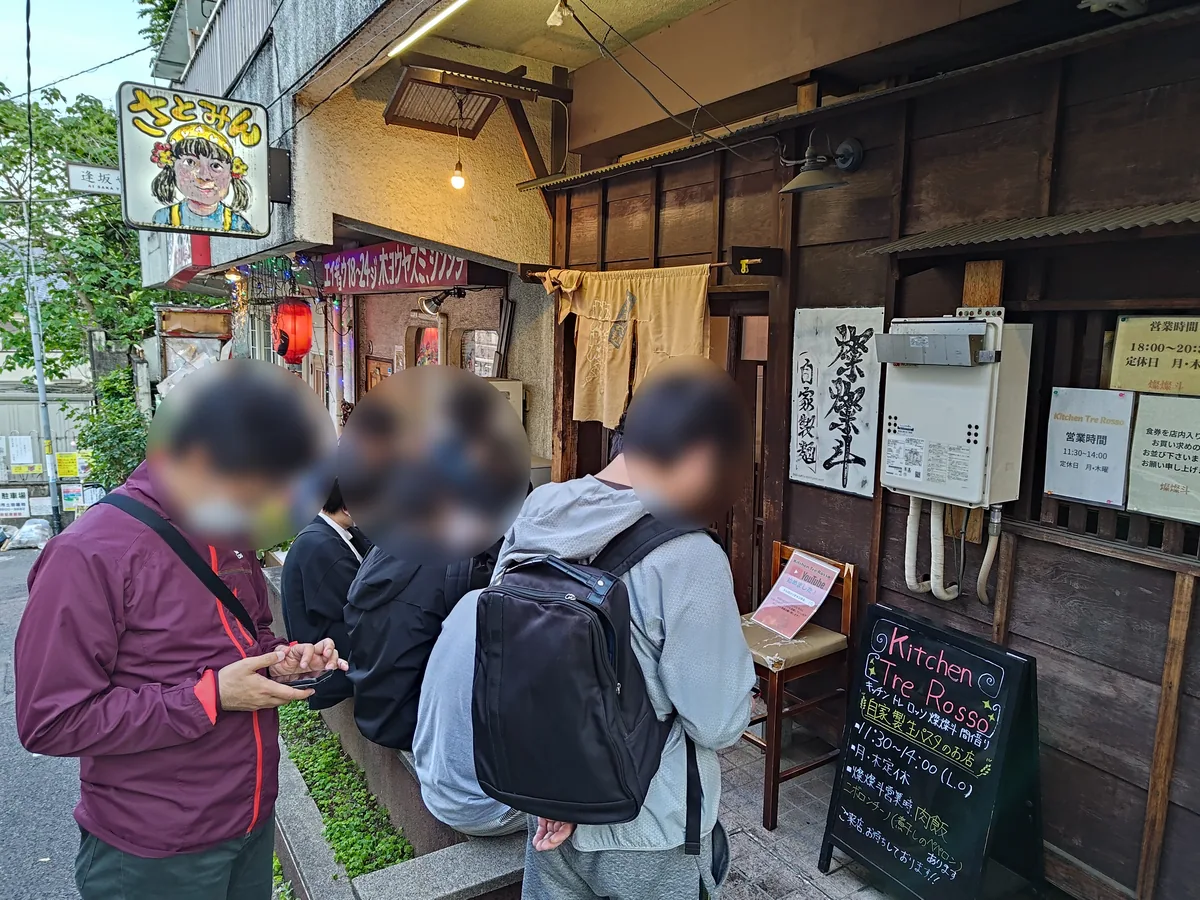
However, the shop's uniqueness extends beyond its excellent taste. Operating hours are a mere 2.5 hours a day, from 18:00 to 20:30. It's open only five days a week (closed Mondays and Thursdays), and sudden closures are not announced in advance. The storefront features only a worn yellow noren (cloth curtain) indicating it's open; there are no English indications on the ticket machine or inside, and payment is cash-only. Signage is minimal, and despite being a two-minute walk from Higashi-Jujo Station, first-time visitors might question if they've found the right place due to its discreet location. This is a quintessential example of what this site classifies as a "challenging-access shop," where simply reaching the door is part of the experience.
Why do we feature this shop, which isn't typically found in guidebooks, on an English-language website for travelers? The reasons are simple: 'if you prepare, you'll likely be well rewarded,' and 'it's a shop for travelers accustomed to tourist-centric ramen to venture into a bowl found in Tokyo's local neighborhoods.' This article is a comprehensive guide to Sansanto, designed to pre-emptively explain all the challenges, ensuring first-time visitors can confidently line up, order, and fully savor their meal.

Ren
“Tabelog Top 100 Ramen Tokyo” is Tabelog’s annual list of the 100 highest-rated ramen shops in Tokyo. Sansanto has been selected for nine consecutive years since the system began in 2017 (as of 2026). Owner-chef Goto operates the shop, offering a well-balanced style centered on katsuobushi-based seafood and tonkotsu, distinct from Tokyo’s prevalent Iekei, Jirokei, and rich-broth trends. It’s a prime example of traditional Tokyo ramen, condensing artisanal skill into a simple composition.
🚶Access — 2-minute walk from Higashi-Jujo Station North Exit (pay attention to the exit and route)
Higashi-Jujo Station on the JR Keihin-Tohoku Line has only two exits, North and South, which are structurally separated. If you exit in the wrong direction, it takes several minutes to pass through the station to the other side. Therefore, to reach Sansanto, always exit from the "North Exit."
The correct route is a bit unique. After exiting the North Exit ticket gate, first proceed to your left. You will then see a staircase; go up it, turn left, and walk down a small slope. Partway down the slope, Sansanto sits discreetly on your right. The distance is just 93m, about a 2-minute walk.
[CRITICAL] Do NOT use the stairs leading down to the station rotary
After exiting the North Exit ticket gate, there are also stairs that descend towards the station rotary. Using these will lead you to the opposite side, and you won't be able to reach Sansanto. The correct route is: "Exit the ticket gate, proceed to your left → Go up the stairs → Turn left → Go down a small slope → Sansanto will be on your right." Once you know it, you won't get lost, but please keep this path in mind for your first visit.
🕔Operating Hours and Queuing Strategy — Securing a First Seating Spot is Key
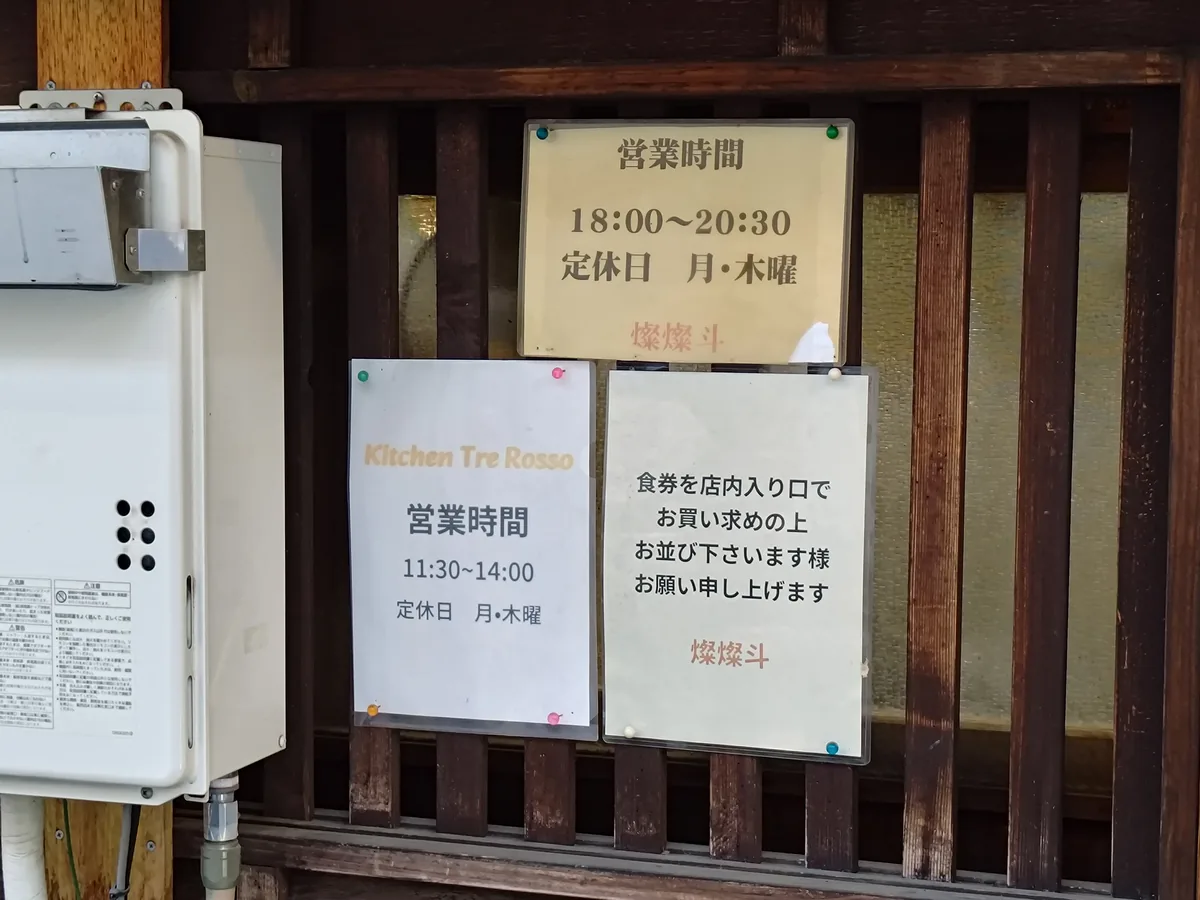
Sansanto's operating hours are only 2.5 hours, from 18:00 to 20:30, five days a week (closed Mondays and Thursdays, with occasional sudden closures for New Year's, etc.). The shop may close earlier than 20:30 if the soup sells out, so arriving in the late 19:00s or later carries a higher risk of not being served.
The key to visiting this shop is securing a spot in the "first seating." The first seating refers to the initial group (for the 7 counter seats) that enters at opening. The first seating offers the most stable soup temperature, the shortest waiting time, and no worry about sell-outs. Conversely, for the second and third seatings, you can expect to wait outside for 30-60 minutes, even on weekdays. On our visit, there were already 6 people in line at 18:06, and the queue subsequently grew to about 12.
- [Weekdays] Arrive between 17:40 and 17:50 for a stable chance at the first seating. Arriving at 18:00 often means a queue of 5-6 people already, putting you in the second seating.
- [Weekends/Holidays] Arrive between 17:15 and 17:30 to secure a spot in the first seating. After 17:30, the first seating may already be full.
- [Early Opening] On busy days, the noren may be hung and the shop may open early, around 17:50 (this is not highly likely).
- [Waiting Outside] There is no dedicated waiting area inside or outside the shop. Staff will call you while you wait in line outside.
- [Rainy Weather] There is some space under the eaves, but an umbrella is essential if it's raining.
Actual Visit Timeline — 6 people in line → Seated in 23 minutes → Ramen served within 1 minute
Documenting our visit chronologically: we arrived at the storefront at 18:06 (6 people in line, effectively equivalent to a second seating), were seated at 18:29 (23 minutes after joining the queue), and our Ramen + Toku-mashi was served within 1 minute of being seated. Even if the queue seems long, the shop has a fast turnover, and once you get inside, service is very quick. The "30-60 minute" estimate for waiting in line refers to the time from joining the queue to entering the shop, not the time from being seated until the ramen is served, which is reassuring.
No Noren = Potential for Sudden Closure
Sansanto rarely provides advance notice of sudden closures. If the worn yellow noren is hanging at the storefront, the shop is open; if not, it is closed or has a sudden closure. If there's no noren past 19:00, it's highly likely they won't open that day. However, there's no need for excessive worry. Akabane, the next station over, is known as a "Sen-bero" (getting tipsy for ¥1,000) spot with many izakaya and ramen shops, and Ikebukuro (about 20 minutes away) also boasts numerous highly-regarded shops in Tokyo. Even if Sansanto is closed, you can still enjoy dinner that night due to its convenient location – it's best to approach your visit with this mindset.
🎫How to Use the Ticket Machine (Kenbaiki) — Buy-First System, Cash Only, All Japanese
Sansanto uses a "buy-first system" (purchase your ticket first, then join the end of the queue). A notice at the storefront officially states, "Please purchase your meal ticket at the shop entrance before joining the queue."
Here's the flow:
- If there's a queue outside the shop, first walk past it and enter the shop (this means passing by those in line, but it is the correct procedure).
- Use the ticket machine immediately to your left upon entering to select your menu and insert cash.
- Take your meal ticket and join the end of the queue outside the shop.
- While you're waiting in line, a staff member will come to check your meal ticket (this is standard operation).
- A staff member will call you when it's your turn.
- Sit at the assigned seat and hand over your meal ticket (you may be able to hand it over in advance).
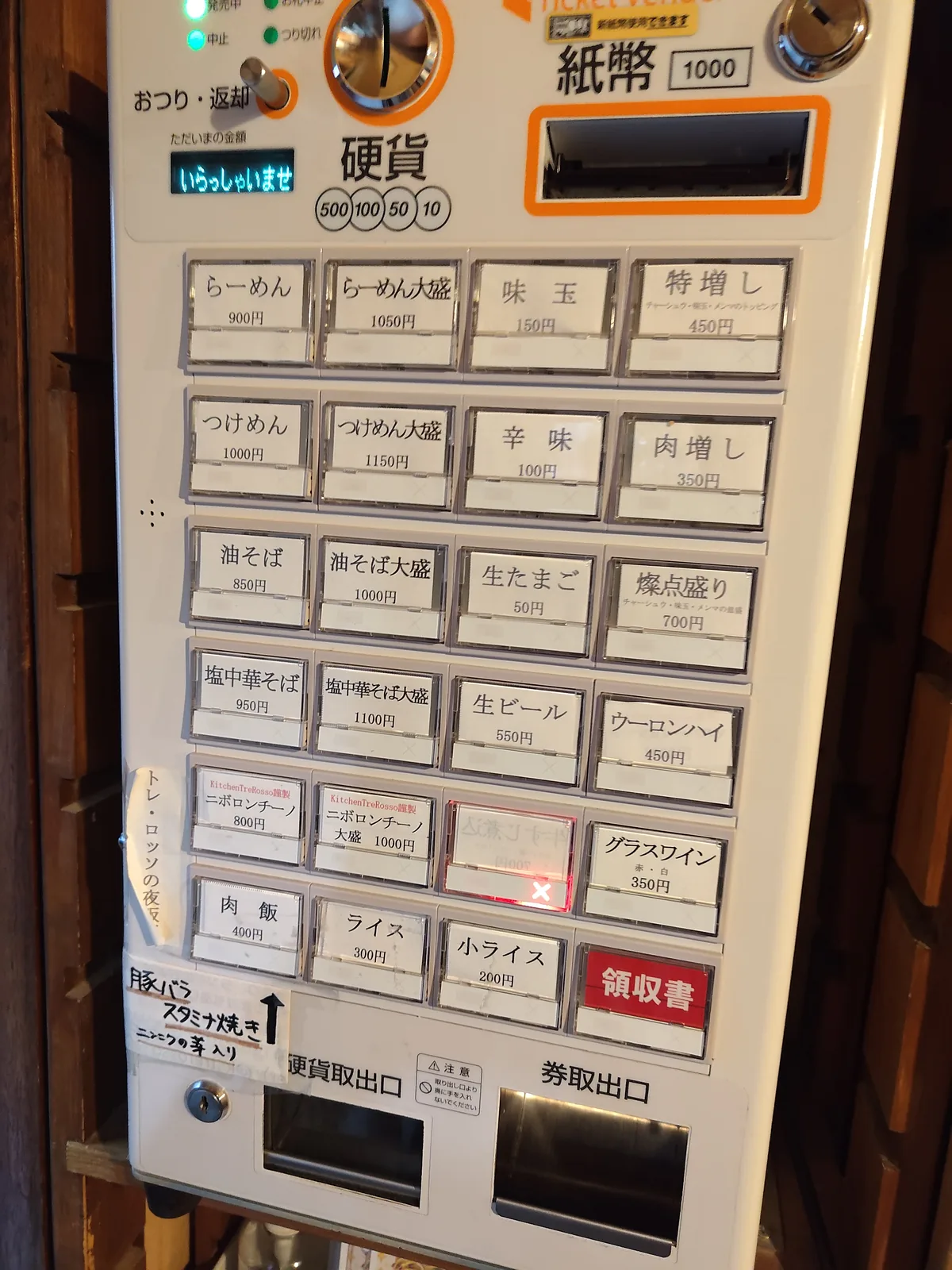
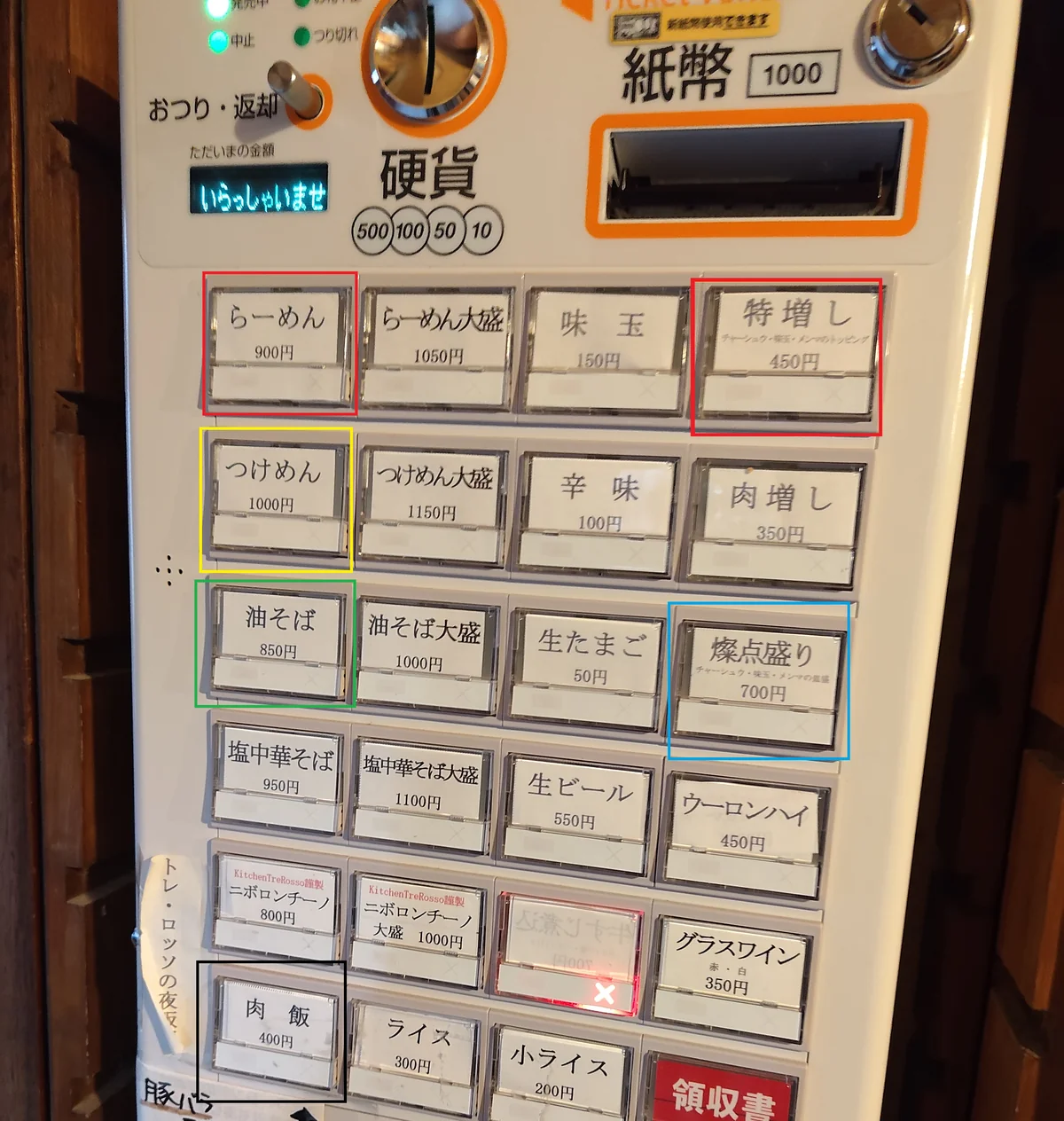
| Color Box | Menu | Price | Description |
|---|---|---|---|
| 🟥 Red Box | Ramen (left) + Toku-mashi (right) | ¥900 + ¥450 | ★The classic set we ordered this time. This combines the signature gyokai-tonkotsu ramen with extra chashu + extra menma + ajitama egg, totaling ¥1,350. |
| 🟨 Yellow Box | Tsukemen | ¥1,000 | A hidden gem where you can best appreciate the quality of the homemade noodles (jikasei-men). Often chosen by repeat visitors for comparison. |
| 🟩 Green Box | Abura-soba | ¥850 | This brothless ramen (mazesoba) type is often cited as the most popular. It's typically served with the soup in a separate bowl, followed by a "wari-soup" (broth for diluting) to finish. |
| 🟦 Blue Box | Santen-mori | ¥700 | A premium upgrade to Toku-mashi. The toppings are served on a separate plate, allowing repeat visitors to savor them thoroughly, distinct from the ramen itself. |
| ⬛ Black Box | Niku-meshi | ¥400 | A signature-level side dish. Flavored with garlic, soy sauce, and acidity, its contents change daily (sometimes Kitchen Tre Rosso's chicken curry, run by a relative, appears as "Today's Niku-meshi"). |
About Ticket Machine Button Layout and Prices
The layout of the ticket machine buttons, menu names, and prices are subject to change without notice at the shop's discretion. This article's colored box guide reflects the status as of our visit on April 28, 2026; please be aware that the layout or prices may differ during your visit.
The Most Confusing Point for First-Time Visitors
Because you will be "cutting into" the queue to enter the shop, first-time visitors tend to hesitate, wondering if it's okay to just walk in. However, this is the official rule for this shop. Those already in line have also done the same—bought their ticket before queuing—so they won't mind if you pass them. Feel free to walk in, as this is the "buy-first" system.
⚠️⚠️ No Reserving Spots in Line
"Daihyo-machi" (one person queuing to reserve spots for others who join later) is strictly prohibited. This is a rule observed not only at Sansanto but generally at popular ramen shops across Japan. Due to the limited space and sequential seating, one person queuing and others joining later is considered cutting in front of other customers and can lead to problems. If visiting as a group, ensure everyone is present before joining the end of the queue.
📋Menu
The main menu items on the ticket machine are as follows. The signature item is simply "Ramen" (¥900), but abura-soba, tsukemen, and shio chuka-soba also form a four-pillar menu that encourages repeat visits for comparison. For a first visit, "Ramen + Toku-mashi" is the classic choice.
| Menu | Price (incl. tax) | Notes |
|---|---|---|
| Ramen (Ramen) | ¥900 | Signature item. The basic form of gyokai-tonkotsu soup. Noodles 200g. |
| Ramen Large (Ramen Large) | ¥1,050 | Noodles 330g. For hearty eaters. |
| Tsukemen (Tsukemen) | ¥1,000 | A hidden gem where you can best appreciate the quality of the homemade noodles (jikasei-men). |
| Tsukemen Large (Tsukemen Large) | ¥1,150 | Large size of the above. |
| Abura-soba (Abura Soba) | ¥850 | Often cited as the most popular. Typically served with soup in a separate bowl + wari-soup (broth for diluting) to finish. |
| Abura Soba Large (Abura Soba Large) | ¥1,000 | Large size of the above. |
| Shio Chuka-soba (Shio Chuka Soba) | ¥950 | Clearer broth with prominent niboshi (dried sardine) flavor. Recommended for comparison with the ramen. |
| Shio Chuka Soba Large (Shio Chuka Soba Large) | ¥1,100 | Large size of the above. |
| ★Toku-mashi (Toku-mashi) | ¥450 | ★ Recommended for first-timers. A set with extra chashu + extra menma + ajitama egg. |
| Santen-mori (Santen-mori) | ¥700 | A premium upgrade to Toku-mashi. For repeat visitors to savor the toppings served on a separate plate. |
| Niku-mashi (Niku-mashi) | ¥350 | Extra chashu only. |
| Ajitama (Ajitama) | ¥150 | Soft-boiled seasoned egg. |
| Karami (Karami) | ¥100 | Spicy seasoning. |
| Nama-tamago (Nama-tamago) | ¥50 | Raw egg. |
| Rice (Rice) | ¥300 | |
| Small Rice (Small Rice) | ¥200 | Small size. |
| Niku-meshi (Niku-meshi) | ¥400 | A signature-level side dish. Flavored with garlic, soy sauce, and acidity, its contents change daily (sometimes Kitchen Tre Rosso's chicken curry, run by a relative, appears as "Today's Niku-meshi"). |
| Draft Beer (Draft Beer) | ¥550 | YEBISU medium mug. Includes a complimentary snack when ordered. |
| Oolong-hi (Oolong-hi) | ¥450 | Shochu mixed with oolong tea. |
| Glass Wine (Glass Wine) | Market price | A suitable item for evening hours. |
For Your First Visit, "Ramen + Toku-mashi" is the Choice
Adding "Toku-mashi" (¥450) to the signature "Ramen" (¥900), totaling ¥1,350, is the standard way to fully experience the shop's appeal at once. Toku-mashi is positioned as a "sampler set," offering better value than ordering the three individual toppings (chashu + menma + ajitama egg) separately. For repeat visitors who wish to savor the ingredients on a separate plate, the premium upgrade "Santen-mori" (¥700) is also available.
🏠Shop Atmosphere — A Local Favorite Microcosm with Showa-era Ballads
Opening the wooden sliding door reveals a clean but extremely compact space. There are only 7 counter seats and no table seating. Japanese Showa-era ballads play inside, creating a retro and warm atmosphere that would not feel out of place in a local izakaya. The clientele is predominantly office workers on their way home, but there are also occasional solo female diners, conveying that despite its challenging-access shop appearance, it is cherished by a wide range of customers.
The shop is often operated by a team of three: owner-chef Goto, his wife, and the owner of "Kitchen Tre Rosso," a relative's shop that operates in the same location during the day. The operation is pleasant and efficient. Contrary to the challenging-access shop appearance, the service is warm and polite. Any anxieties about a first visit quickly disappear once you step inside.
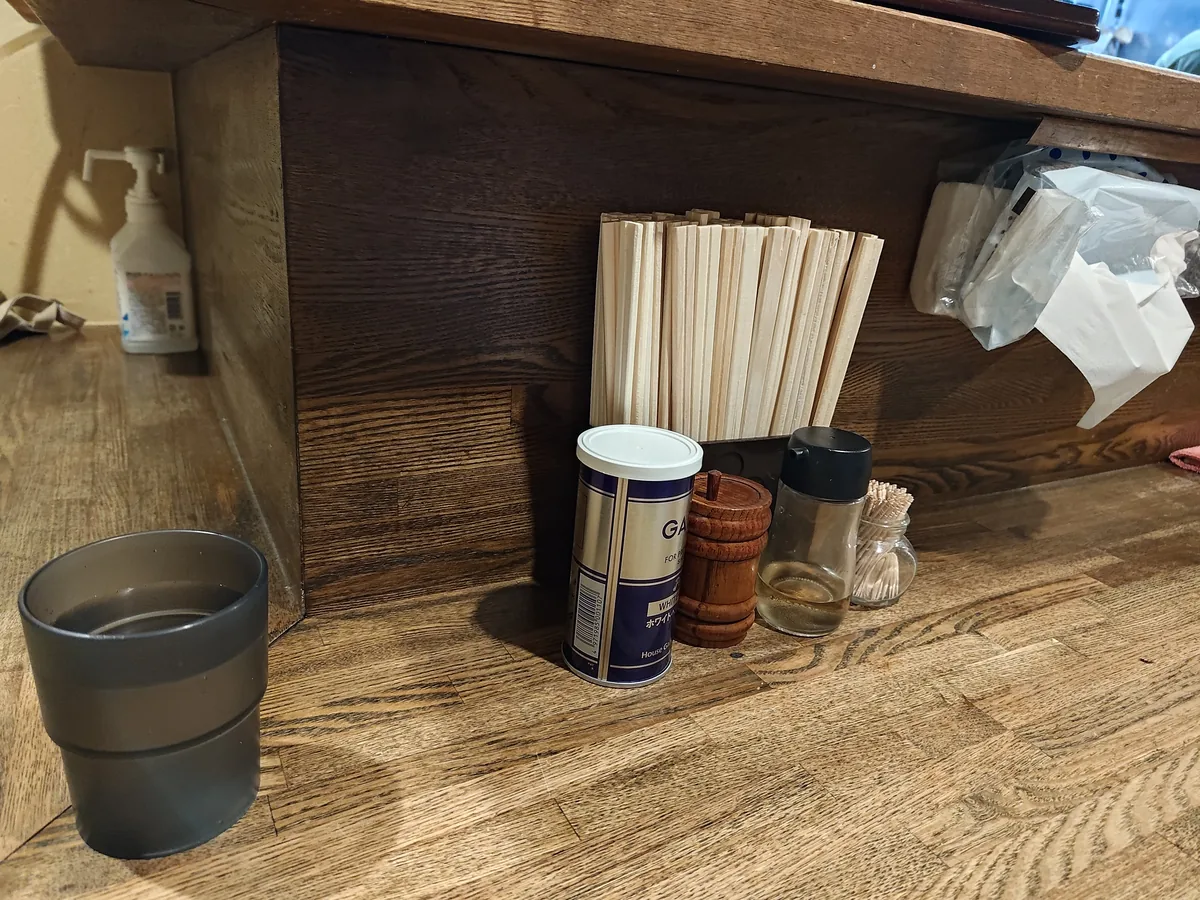
Water is self-service; you draw it yourself from a pot on the upper counter. Small bags like backpacks can be placed on a small shelf at your feet, and there are hangers and a tissue trash can behind the seats. A noodle-making machine is visible in the small room behind, creating a handcrafted feel where you can literally "see" their dedication to homemade noodles (jikasei-men).
Keep Luggage Compact
The shop is very small, with only 7 counter seats, so suitcases cannot physically be brought inside. If you are sightseeing, please store large luggage in a coin locker at Higashi-Jujo Station or at your hotel before visiting. Small items like backpacks can be stored on the shelf at your feet or on the hangers behind the seats.
🔥The Meal — Ramen + Toku-mashi (Total ¥1,350)

Mei
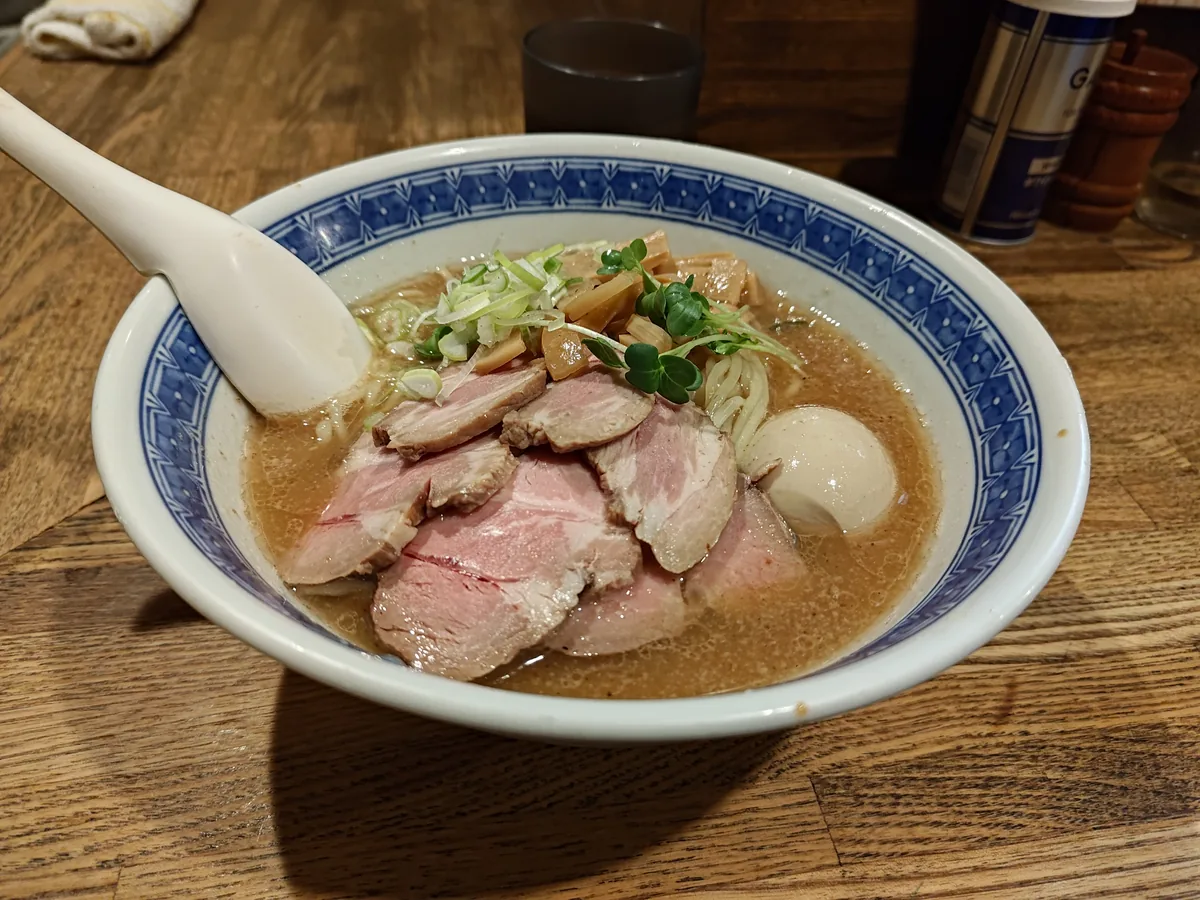
This bowl truly has beautiful colors in the photo. The gentle pinkish hue of the slow-cooked chashu, the orange-tinted yolk of the soft-boiled ajitama egg, the green mitsuba, the glossy homemade noodles (jikasei-men), and the faintly translucent gyokai-tonkotsu broth in the background—despite its simple composition, there's a well-thought-out color contrast that stimulates the appetite. It was a moment of realization, seeing the real thing, that a bowl can be this visually appealing without relying on excessive decoration when each ingredient is of high quality.
Soup — A Refined Gyokai-Tonkotsu, Where Richness and Delicacy Coexist
The first sip leaves an impression of "rich, yet without any harshness." Despite being a double soup of tonkotsu and seafood (katsuobushi-based), there's no animal-derived bitterness or off-flavors; it goes down smoothly. While the richness of tonkotsu is present, the seafood flavors follow, creating a layered umami experience that alternates in the mouth.
Unlike the thick, heavy consistency often found in typical gyokai-tonkotsu tsukemen, this soup is designed to be lighter and smoother for ramen, offering a refreshing quality that allows you to drink every last drop. Vinegar is always available on the table; adding a small amount in the latter half of the soup introduces a tang that sharpens the seafood flavors, acting as a functional taste alteration.
Noodles — Sansanto's True Star: 'A Shop That Wins With Its Noodles'
The noodles are homemade (jikasei-men), slightly thick and flat, made in the small room behind the counter. They offer an exquisite balance of chewy elasticity, wheat aroma, smooth texture, and satisfying bite. What was particularly striking during the meal was their glossy sheen, allowing a bundle of noodles to be lifted cleanly with chopsticks. The refined quality, with a rich wheat aroma upon chewing, is so high that one could believe they were originally crafted for tsukemen but repurposed for ramen; they possess the strength to be a main attraction even without the soup.
Not only do they pair exceptionally well with the soup, but the noodles themselves feel like a "main attraction." With a standard serving of 200g and a large serving of 330g, the volume is substantial, making for a highly satisfying bowl from a fulfilling perspective. Seeing the noodle-making machine in the small room behind creates a unique experience, allowing you to literally "see" their dedication to homemade noodles (jikasei-men) as you savor them.
Chashu — A 'Star Supporting Actor' Cooked at Low Temperature
The chashu included in Toku-mashi is a moist, tender, roasted type, slow-cooked at a low temperature. Thick-cut with a substantial presence, it has a melt-in-your-mouth texture when chewed, with just the right saltiness and a spreading richness of the meat's natural flavors. It functions as an excellent supporting actor, complementing the soup and noodles without overpowering them, thereby elevating the overall quality. While "Niku-mashi" (¥350) for extra chashu only and the premium "Santen-mori" (¥700, served on a separate plate) are available, for a first visit, the classic choice is Toku-mashi to enjoy the overall balance with menma and ajitama egg.
Menma — Thick-Cut, Crunchy, and a Hidden Highlight of Toku-mashi
Unlike the thin, bamboo shoot-tip menma typically found at ramen shops, the menma here comes in large, thick-cut pieces. It offers a unique crunchy-yet-crisp texture and a robust seasoning, releasing more umami with each bite. Surprisingly, many fans mention it as a highlight of Toku-mashi, with some even saying "the menma alone makes a good snack."
Ajitama Egg — Exquisitely Soft-Boiled with a Gel-Like Yolk
The ajitama egg is exquisitely soft-boiled with a luscious, gel-like yolk. The yolk, when mixed into the soup, adds a mild creaminess, acting as a taste alteration element in the latter half of the meal. Served whole, you can adjust where and how much to break it with your chopsticks or spoon, for example, eating half on its own and dissolving the other half into the soup, allowing the flavor to evolve as you eat.

Zack
From a strategic perspective, the true value of this shop lies in its "simple composition × high perfection of all elements." The soup, noodles, chashu, menma, and ajitama egg are all individually capable of being signature items, and they are all condensed into one bowl. That's why, for your first visit, I recommend trying all elements at once with "Ramen + Toku-mashi" without hesitation. When you return, exploring other options like abura-soba, tsukemen, and shio chuka-soba will reveal the shop's depth.
📍Half-Day Model Route Including Sansanto
While Higashi-Jujo Station itself is a traditional shopping street area without major tourist attractions, the convenience of the JR Keihin-Tohoku Line combined with Sansanto's late opening time of 18:00 naturally allows it to be integrated into a half-day itinerary exploring the "hidden side of Northern Tokyo."
Recommended Model Route (Half-Day Evening Course in Kita Ward)
- Around 15:00 — Get off at Oji Station (one stop from Higashi-Jujo on the Keihin-Tohoku Line). Stroll through Asukayama Park (famous for cherry blossoms in spring, autumn leaves in fall, and the former residence of Eiichi Shibusawa, free to visit year-round).
- Around 16:30 — Visit Oji Inari Shrine and the Paper Museum (historical and cultural spots in Kita Ward).
- Around 17:30 — Return to Higashi-Jujo Station via the Keihin-Tohoku Line, exit the North Exit, and join the queue for Sansanto (aim for first seating by arriving between 17:40 and 17:50).
- Around 18:00 — Enjoy your meal at Sansanto (Ramen + Toku-mashi ¥1,350).
- Around 19:00 — Take the Keihin-Tohoku Line one stop to Akabane. Have a light drink in the "Sen-bero" (getting tipsy for ¥1,000) district before heading home.
If you're short on time, even just spending a few tens of minutes before Sansanto opens by exploring the Higashi-Jujo shopping street, directly connected to the station's North Exit, allows you to pass the time while enjoying retro shops that retain a Showa-era charm.
Access to Major Tourist Destinations (for Plan B)
While Sansanto is a little removed from central Tokyo, you can return smoothly to major tourist areas using the JR Keihin-Tohoku Line, which connects with the Yamanote Line. Due to its short operating hours and risk of irregular closures or selling out, it's wise to bookmark one backup option for the same evening in the Akabane, Oji, or Ikebukuro area, just in case Sansanto is closed. Its location ensures no significant disruption to your subsequent travel plans.
| Destination | Route | Travel Time |
|---|---|---|
| Akabane (next station) | 1 stop on Keihin-Tohoku Line | approx. 2 min |
| Akihabara | Direct on Keihin-Tohoku Line | approx. 20 min |
| Ueno | Direct on Keihin-Tohoku Line | approx. 15 min |
| Tokyo Station | Direct on Keihin-Tohoku Line | approx. 25 min |
| Ikebukuro | Transfer to Yamanote Line at Tabata Station | approx. 20 min |
| Shinjuku | Transfer to Yamanote Line at Tabata Station | approx. 25 min |
| Shibuya | Transfer to Yamanote Line at Tabata Station | approx. 30 min |
The location allows for easy creation of alternative plans, such as "If Sansanto happens to be closed, try another ramen shop in Akabane, the next station, then return to a hotel in Ikebukuro," or "If that doesn't work out, switch to Shinjuku via the Yamanote Line for another popular shop." Even if you visit Higashi-Jujo solely for ramen, travel time loss is minimal. Essentially, the transportation network in northern Tokyo effectively reduces the "high barrier to entry" for this shop, acting as a strong support.
❓Frequently Asked Questions
QIs there an English menu?▼
No, there isn't. Both the ticket machine and the interior are entirely in Japanese, and there are no photos. We strongly recommend taking a screenshot of the menu table in this article (with romanized names) in advance, or deciding on your order before your visit to avoid hesitation at the ticket machine.
QCan I use a credit card?▼
No, you cannot. Payment is cash only; credit cards, e-money, and QR code payments are all unavailable. Please prepare cash, with an estimate of around ¥1,350 for "Ramen + Toku-mashi," or about ¥2,000 if you add draft beer or a large serving. There are convenience store ATMs inside and around Higashi-Jujo Station.
QHow long is the queue?▼
On our visit, a Tuesday at 18:06, there were 6 people in line, and about 12 more joined afterward. If you can get into the first seating (the initial group of 7), expect 15-30 minutes; for subsequent seatings, it's typically 30-60 minutes. The key is to secure a first seating spot by arriving between "17:40 and 17:50 on weekdays" or "17:15 and 17:30 on weekends." The noren may sometimes be hung for an early opening around 17:50, so arriving early is often beneficial at this shop.
QI heard there are frequent sudden closures?▼
Yes, Sansanto rarely provides advance notice of sudden closures. In addition to the regular Monday and Thursday closures, the shop may not open on irregular days. If the worn yellow noren is hanging at the storefront, the shop is open; if not, it is closed. However, there's no need for excessive worry. Akabane, the next station over, is a "Sen-bero" spot with many alternative ramen shops, and Ikebukuro (about 20 minutes away) also boasts numerous highly-regarded shops in Tokyo. In the event of an unexpected closure, it's easy to switch to another shop and enjoy dinner, making Plan B straightforward—please refer to the "Half-Day Model Route" section in this article for details.
QDoes the shop sometimes close early due to selling out?▼
Yes, it does. While the official closing time is 20:30, it's not uncommon for the shop to close early, around late 19:00s to 20:00, if the soup sells out. Arriving after 19:00 carries a higher risk, so if you definitely want to eat, we strongly recommend arriving in the early 18:00s.
QAre Abura-soba and Tsukemen also recommended?▼
Among Japanese ramen fans, abura-soba, tsukemen, and shio chuka-soba are also highly regarded, and repeat visitors frequent the shop to compare them. However, for a first visit, the classic approach is to experience the shop's full appeal with the signature "Ramen + Toku-mashi." For subsequent visits, we recommend expanding your choices to abura-soba (where you can best appreciate the homemade noodles), tsukemen, and shio chuka-soba (which has a lighter, niboshi-forward profile).
QWhat is 'Kitchen Tre Rosso' during the day?▼
It is an Italian restaurant that operates in the same location during daytime hours (11:30-14:00, closed Mon & Thu) and is run by Sansanto's relatives. Chicken curry is among its signature dishes. While the interior is the same, it operates as a two-part business: Sansanto as a ramen shop and Kitchen Tre Rosso as an Italian restaurant. The owner of Kitchen Tre Rosso often joins the evening operations of Sansanto, making it a family-run operation with a team of three. The side dish "Niku-meshi" sometimes features Kitchen Tre Rosso's chicken curry as its daily special, showcasing a playful touch unique to this dual-concept operation.
🚃Access
Approximately a 2-minute walk (93m) from Higashi-Jujo Station North Exit on the JR Keihin-Tohoku Line. Exit the ticket gate, proceed to your left, go up the stairs, turn left, and it will be on your right partway down a small slope. Be careful not to use the stairs leading down to the station rotary, as this will take you to the wrong side (refer to the Access section at the beginning for details).
From Tokyo Station, it's about 30 minutes on the Keihin-Tohoku Line. From Ikebukuro and Shinjuku, it's about 25-30 minutes with a transfer from the Yamanote Line to the Keihin-Tohoku Line at Tabata. For travelers staying at Tokyo Station, Shinjuku, or Ikebukuro as their base, it's a sufficiently accessible distance for dinner. Direct visits from Haneda or Narita are not recommended due to multiple transfers; visiting from your accommodation is suggested.
📋Shop Information
| Item | Details |
|---|---|
| Shop Name | Sansanto (Sansanto) |
| Genre | Gyokai-tonkotsu ramen (homemade noodles) |
| Difficulty | ★5 Challenging (a challenging-access shop) |
| Ordering System | Ticket machine (buy-first system) |
| Seating | 7 counter seats only (no table seating) |
| Price Range | ¥850 - ¥1,500 (Ramen + Toku-mashi is ¥1,350) |
| English Menu | None |
| Payment Method | Cash only (no credit cards, e-money, or QR code payments) |
| Nearest Station | Higashi-Jujo Station, JR Keihin-Tohoku Line, North Exit, 2-minute walk (93m) |
| Address | 3-16-15 Nakajujo, Kita-ku, Tokyo |
| Operating Hours | 18:00-20:30 (Tues, Wed, Fri, Sat, Sun) / Closed Mon & Thu (please confirm before visiting) |
| Regular Closures | Mondays & Thursdays (occasional sudden closures for New Year's, etc., no advance notice) |
| Accolades | Selected for Tabelog Top 100 Ramen Tokyo for 9 consecutive years (since 2017, as of 2026) |
🎯Who This Shop Is For (and Who It's Not For)
| Recommended If | May Not Be For You If |
|---|---|
| You want to savor gyokai-tonkotsu from a shop on Tabelog's Top 100 Ramen Tokyo for 9 consecutive years, off the tourist trail. | You are looking for a tourist-friendly shop with an English menu. |
| You want to experience a bowl long supported by Japanese ramen fans, alongside locals. | You want to pay with credit card or e-money. |
| You have an adventurous spirit for the 'go out of your way' experience, away from tourist spots. | You have a lot of luggage or a suitcase. |
| You can allocate time for preparation (lining up strategy, pre-purchase system, cash). | You don't want to be inconvenienced by operating hours or irregular closures. |
| You are an intermediate to advanced ramen traveler who appreciates high perfection within a simple composition. | You're in the mood for rich tonkotsu, Jiro-kei, or Ie-kei ramen. |
Summary
The biggest appeal of Sansanto is the contrast between its challenge level and the perfection of its ramen. Beyond the thorough 'ninja shop' specifications—open only 2.5 hours a day, 5 days a week, no English, cash only, hidden location, and occasional irregular closures (features not designed for tourists)—awaits a bowl that has been long supported by fans, earning it a spot on Tabelog's Top 100 Ramen Tokyo for 9 consecutive years.
There are just three keys to a successful visit: "Arrive between 17:40-17:50 on weekdays (17:15-17:30 on weekends) to aim for the first seating," "Use the buy-first system: enter the shop to purchase your ticket at the machine immediately inside, then join the end of the queue," and "Prepare ¥1,350 in cash for Ramen (¥900) + Toku-mashi (¥450)." As long as you follow these steps, a pleasant experience awaits you, contrary to the shop's challenging-access appearance, with warm and attentive staff.
For intermediate to advanced travelers who have explored Tokyo's tourist-centric ramen, this shop is a gateway to the 'next level.' The experience of savoring a bowl long supported off the main tourist route, one not found in guidebooks, is likely to remain a highlight of your ramen memories from your trip to Tokyo.
Visited & Verified by Our Team
This article was written after the Ramen Gateway editorial team physically visited the shop around 18:06 on Tuesday, April 28, 2026, and ordered and ate the Ramen + Toku-mashi. All photos were taken during that visit. Queue information, shop atmosphere, and the meal report are all based on actual experience during the visit, supplemented with past review information to enhance accuracy.
If you visit, we'd love to hear your review!
"We don't let AI eat ramen. We use AI to draw the coolest map so adventurers worldwide can find the real treasure hidden in Japan's back alleys."
Made in Japan — with local knowledge & AI assistance