How to Smartly Incorporate Ramen into Your Itinerary — Avoiding Crowds and Choosing the Right Time
Time Slots, Crowd Avoidance — Practical Techniques Revealed by Our Shop Data.


⚡Key Points in 30 Seconds
| Question | Answer |
|---|---|
| When are the least crowded times? | Just before opening, around 2 PM (beware of *nakayasumi* – mid-day break), 5:30 PM – 6:00 PM (right after *nakayasumi* ends) |
| When to avoid? | 11:30 AM – 1:00 PM (lunch peak), 2:00 PM – 5:00 PM (about half of shops close for *nakayasumi*) |
| How long is the wait in line? | Number of people ahead ÷ Shop's seating capacity = How many rotations. 1 rotation ≈ approx. 20 minutes (1-batch rule) |
📖What You'll Learn in This Guide
- Ramen Shop Time Patterns — Morning, Lunch, *Nakayasumi* (Mid-day Break), Evening, Late Night, and their characteristics
- The 1-Batch Rule — How to quickly estimate waiting times on site
- Patterns for naturally integrating ramen into your sightseeing route
- Criteria for finding 'delicious shops that aren't crowded'
About Data Sources
The data in this article (such as the percentage of shops with *nakayasumi*, seating capacity distribution, and ratio of morning/late-night operations) represents trends based on the aggregated data from Ramen Gateway's listed shops. Individual shop information may change, so please check the latest details on each shop's page before visiting.
🍜Is it true that 'Japanese ramen shops are always crowded'?
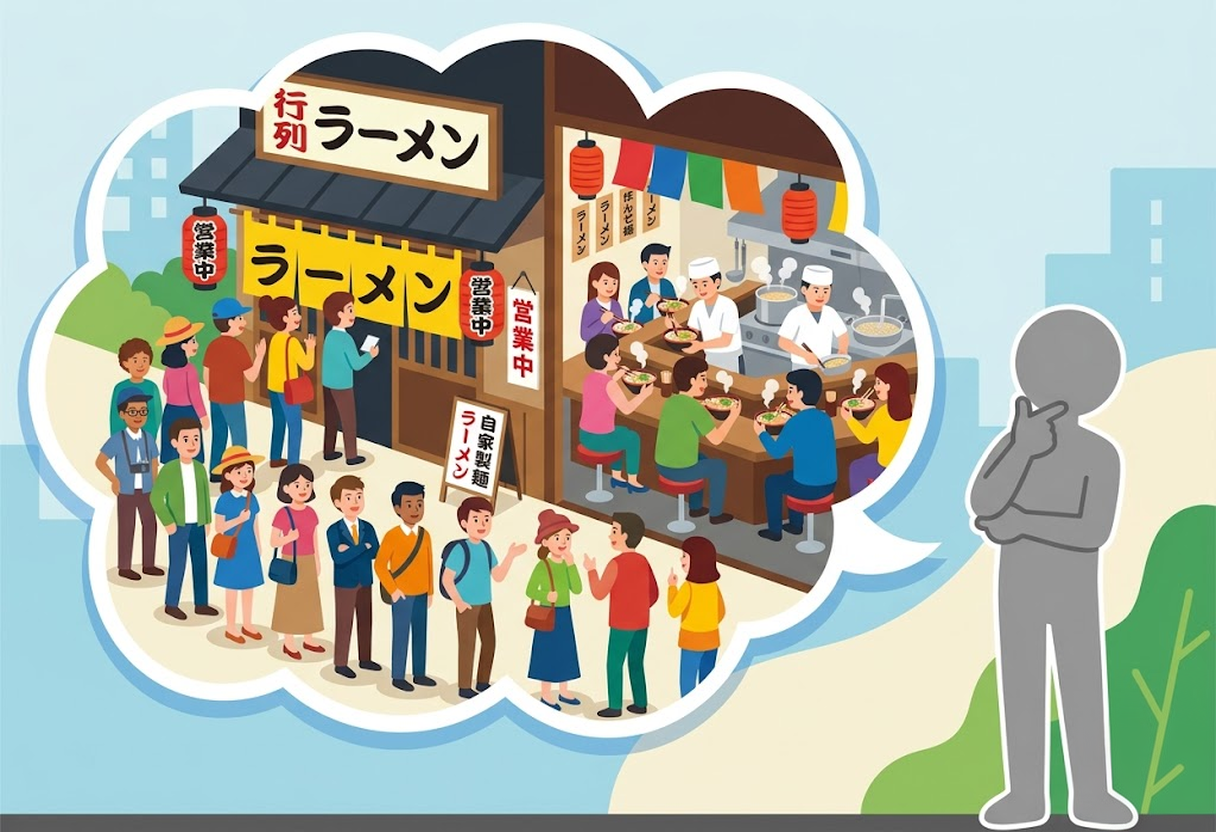
Photos of Japanese ramen shops on social media often show long lines. Many people might have the image that 'you need to be prepared to wait an hour to eat ramen in Japan.'
But that's not the whole picture.
Upon analyzing the Ramen Gateway listed shop database, the following trends emerged: roughly 10% of shops open before 10 AM, and about 25% stay open past 11 PM. While small shops with 10 seats or fewer make up about 30% of the total, approximately 44% of shops have a "*nakayasumi*" (mid-day break), closing in the early afternoon. (The following figures are also trends based on the same database.)
This means that by simply choosing your time wisely, you could walk into a famous shop without a wait, or conversely, be left distraught because 'I went, but it was closed.'
In this guide, we'll share the ramen shop time patterns travelers should know, how to incorporate ramen into your sightseeing route, and strategies for when you encounter a queue. If you're not yet familiar with the full spectrum of Japanese ramen, reading the World Map of Ramen (11 Style Guide) first will broaden your shop-choosing horizons.

Ren's Note
The moment you find a 'delicious shop that isn't crowded,' your travel satisfaction will instantly skyrocket. This guide will specifically teach you how to find them.
🕐Understand a Ramen Shop's Day — Time Zone Map
Once you understand the operating patterns of ramen shops, it'll naturally become clear 'when to go.' Let's look at a ramen shop's day, hour by hour, as revealed by our listed shop data.
Morning (Until 10 AM) — The Bonus Stage
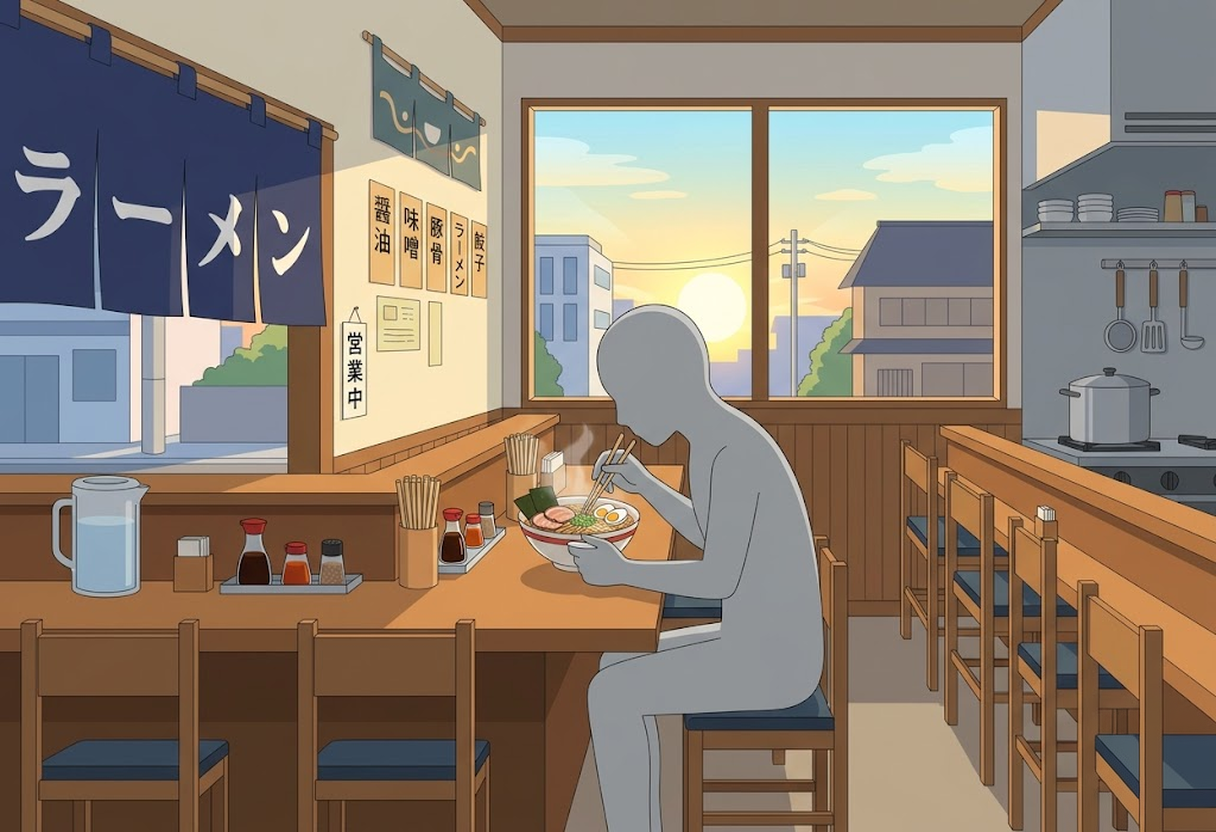
About 10% of ramen shops open before 10 AM. While their numbers are small, *asa-ramen* (morning ramen) is a valuable bonus stage before sightseeing. Shops are often significantly less crowded compared to the lunch peak, allowing you to enjoy a bowl before tourist spots get busy and start your day early.
| Shop Name | Area | Opening Time | Feature |
|---|---|---|---|
| Honke Daiichi Asahi Honten | Kyoto Station | 5:00 AM – 6:00 AM (varies by season) | Synonymous with morning ramen in Kyoto. Popular even in the early morning, so expect a slight wait. Confirm opening hours in advance. |
| Kaidashimen Kitada | Kyoto Station | 7:00 AM | Clear broth with clam dashi. A light ramen perfect for the morning. |
| Ramen Benkei Asakusa Honten | Asakusa | 7:00 AM | A robust bowl of tonkotsu-shoyu (pork bone and soy sauce) ramen. Special operation only from 7-10 AM. |
| Sarusuberi | Shinjuku | 7:00 AM | A valuable option for ramen from 7 AM in Shinjuku. |
| Torisoba 223 | Takaragaike (Kyoto) | 8:00 AM | Additive-free chicken salt ramen. Enjoy a morning bowl in a stylish setting. |

Mei's Note
*Asa-ramen* is 'a reward just for early risers.' In Kyoto, you can eat at Daiichi Asahi from 6 AM, and in Tokyo, at Benkei from 7 AM. Incorporating it into your travel schedule makes your day incredibly fulfilling.
Lunch Peak (11:30 AM – 1:00 PM) — The Busiest Time
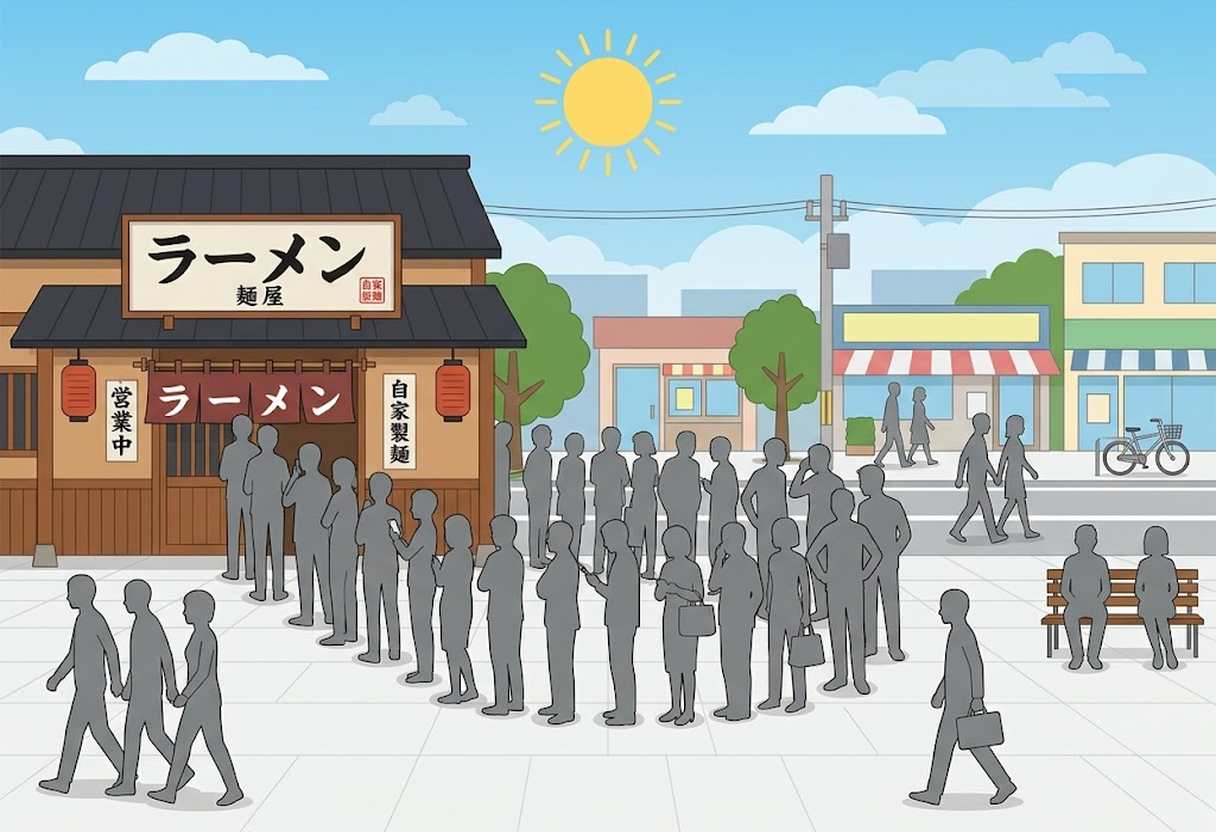
Needless to say, 11:30 AM – 1:00 PM is the busiest time for ramen shops. Especially at popular shops in tourist areas like Shibuya, Asakusa, and Shinjuku, it's not uncommon to find queues lasting 30 minutes to an hour during this period.
The easiest way to avoid the peak is to arrive 'just before opening.' If a shop opens at 11 AM, arriving at 10:50 AM almost guarantees you'll get in without a wait. Alternatively, aiming for 1:30 PM – 2:00 PM after the peak can also be effective, but be wary of the upcoming 'Nakayasumi Trap.'
The Nakayasumi Trap (2 PM – 5 PM) — About Half of Shops Close
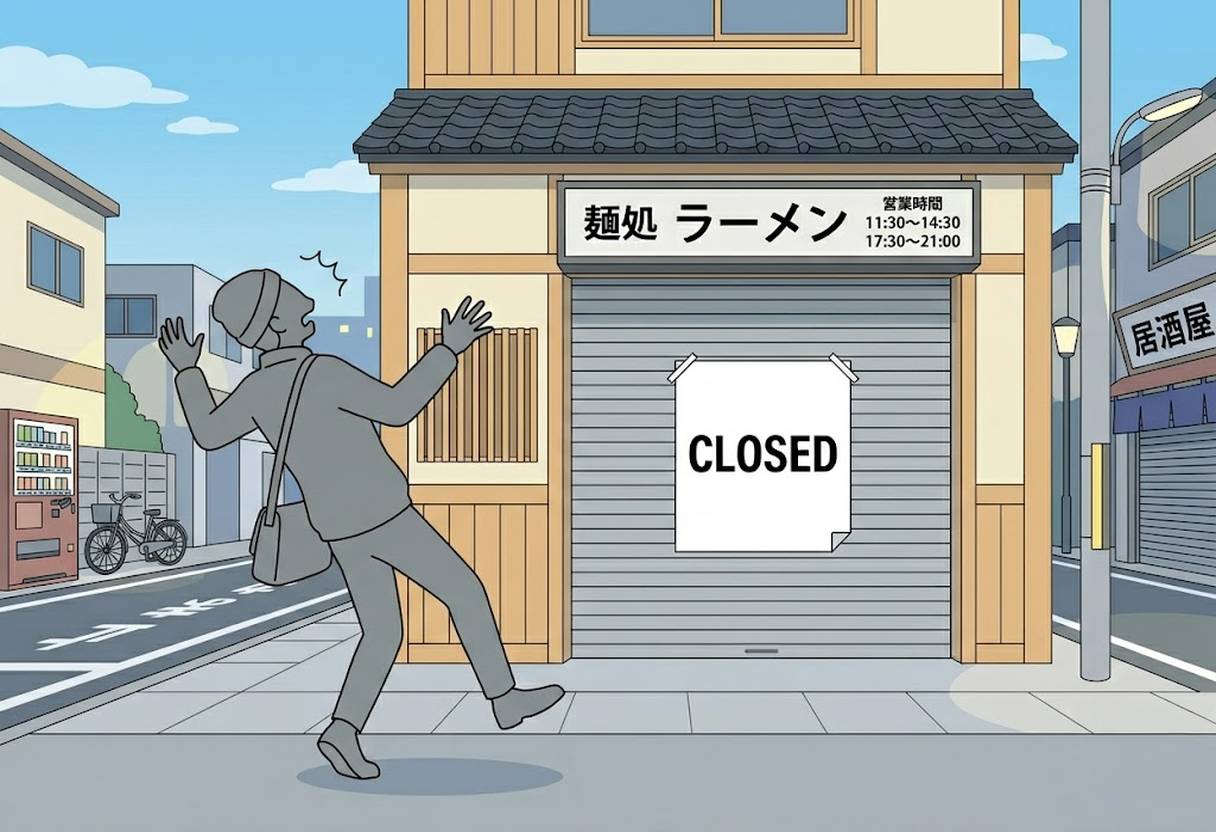
This is the fact that travelers absolutely need to know.
About 44% of the shops listed on Ramen Gateway take a "*nakayasumi*" (mid-day break) between lunch and dinner. This means that if you crave ramen in the early afternoon, there's almost a 50% chance your target shop will be closed.
*Nakayasumi* typically begins around 2:00 PM – 2:30 PM and evening service starts around 5:00 PM – 6:00 PM. This 2-3 hour gap is a significant pitfall, especially for travelers trying to grab ramen between sightseeing activities.
Tips to Avoid Nakayasumi
Always check the business hours on each shop's page in advance. Listing 1-2 shops that offer *tooshi-eigyou* (continuous operation, meaning no break between lunch and dinner) will provide a safe option for the afternoon.

Dr. Hiro's Note
That 44% figure can't be ignored. Kyoto, in particular, tends to have many shops with *nakayasumi*. If you're planning 'ramen in Kyoto in the afternoon,' checking in advance is a must.
Two Dinner Waves (Around 6 PM vs. Around 8 PM)
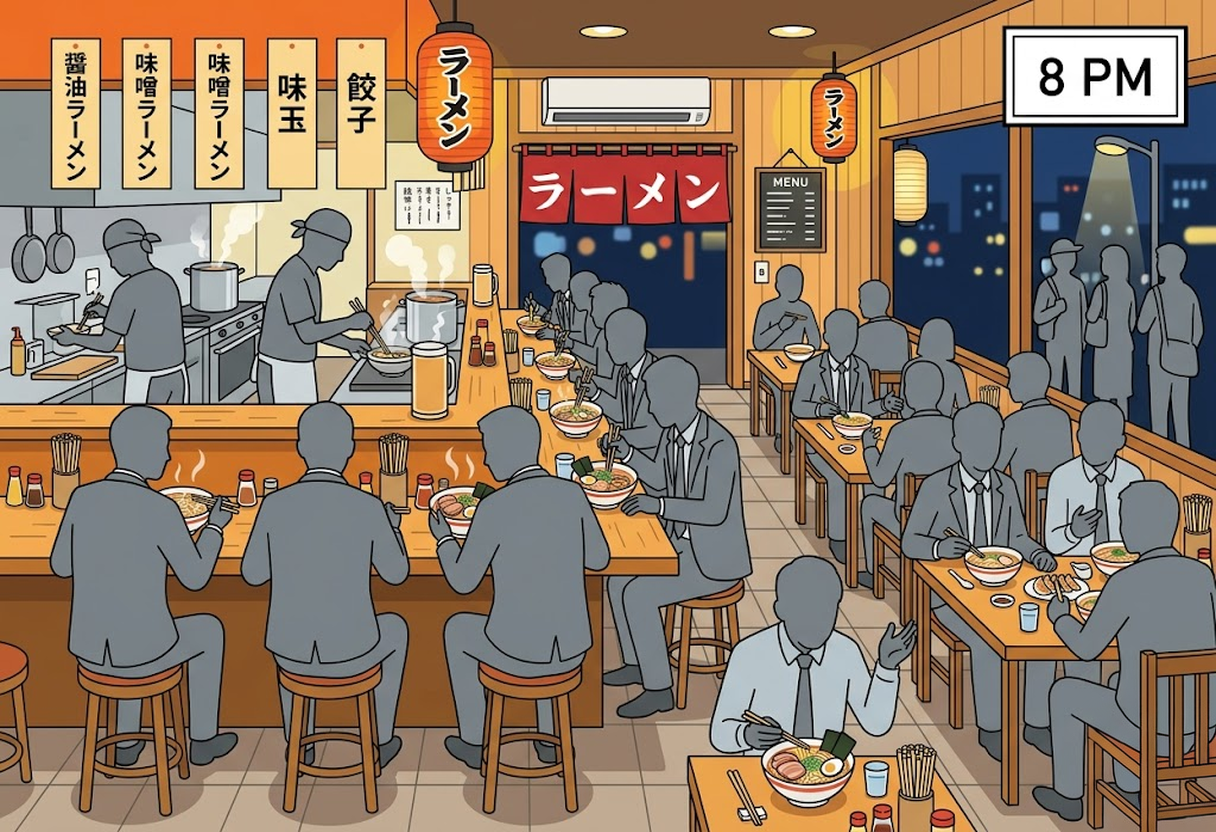
The dinner rush isn't just one wave. Around 6 PM, tourists and early diners arrive, followed by local office workers finishing their jobs around 8 PM, creating two distinct peaks.
For travelers, the prime target is right after evening service begins, from 5:30 PM – 6:00 PM. If you go just as they reopen after *nakayasumi*, you can secure a seat before the local rush. Conversely, if you plan to go around 8 PM, be prepared for a bit of a wait.
Late Night (From 11 PM) — The Culture of Shime-Ramen
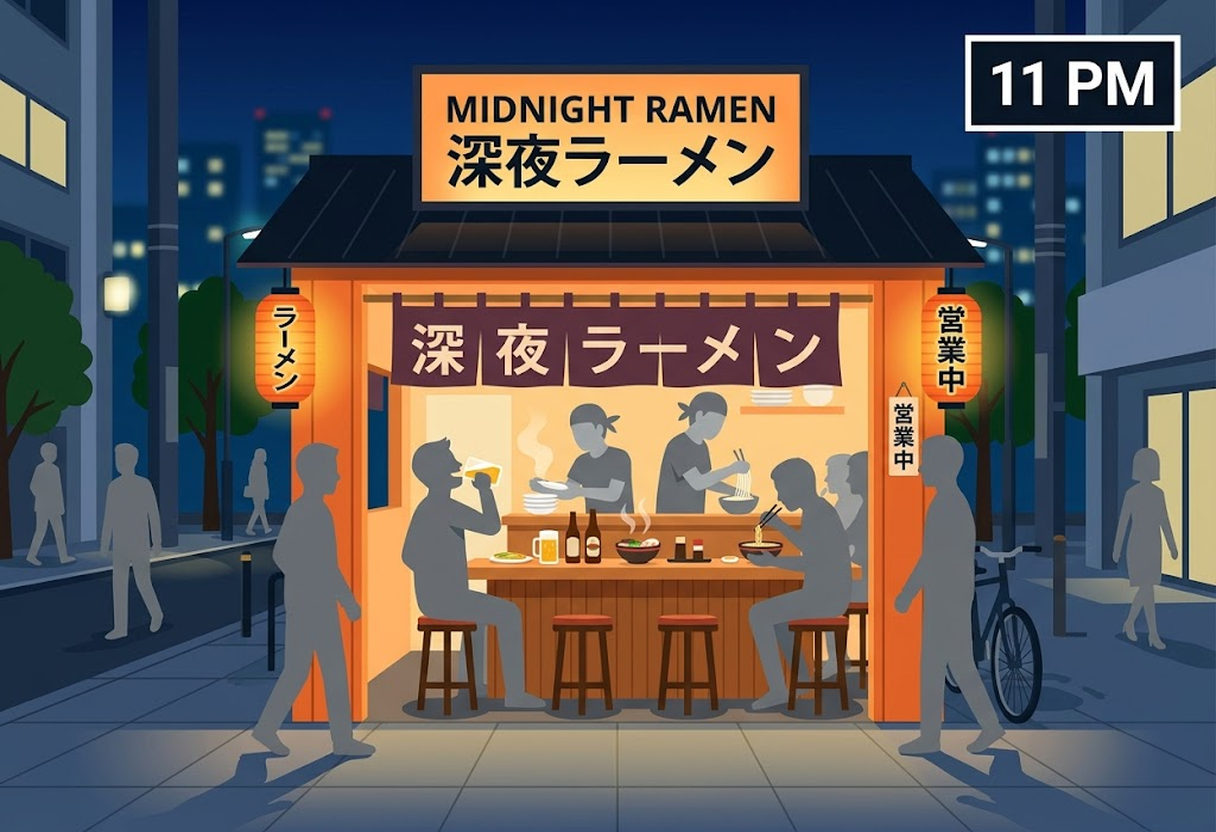
Japan has a culture called "*shime-ramen*" (finishing ramen). It refers to ramen eaten after a drinking party, and late-night shops thrive on this demand. Approximately 25% of our listed shops operate past 11 PM, making them a viable 'late-night option' for travelers.
Shibuya, Shinjuku, and Kamata are areas with a particularly high number of late-night ramen shops. Stopping by after enjoying night views or after visiting bars and clubs is one way to experience Japan's nightlife. Queues also tend to be shorter late at night.
🗺️Integrating Ramen into Your Sightseeing Route
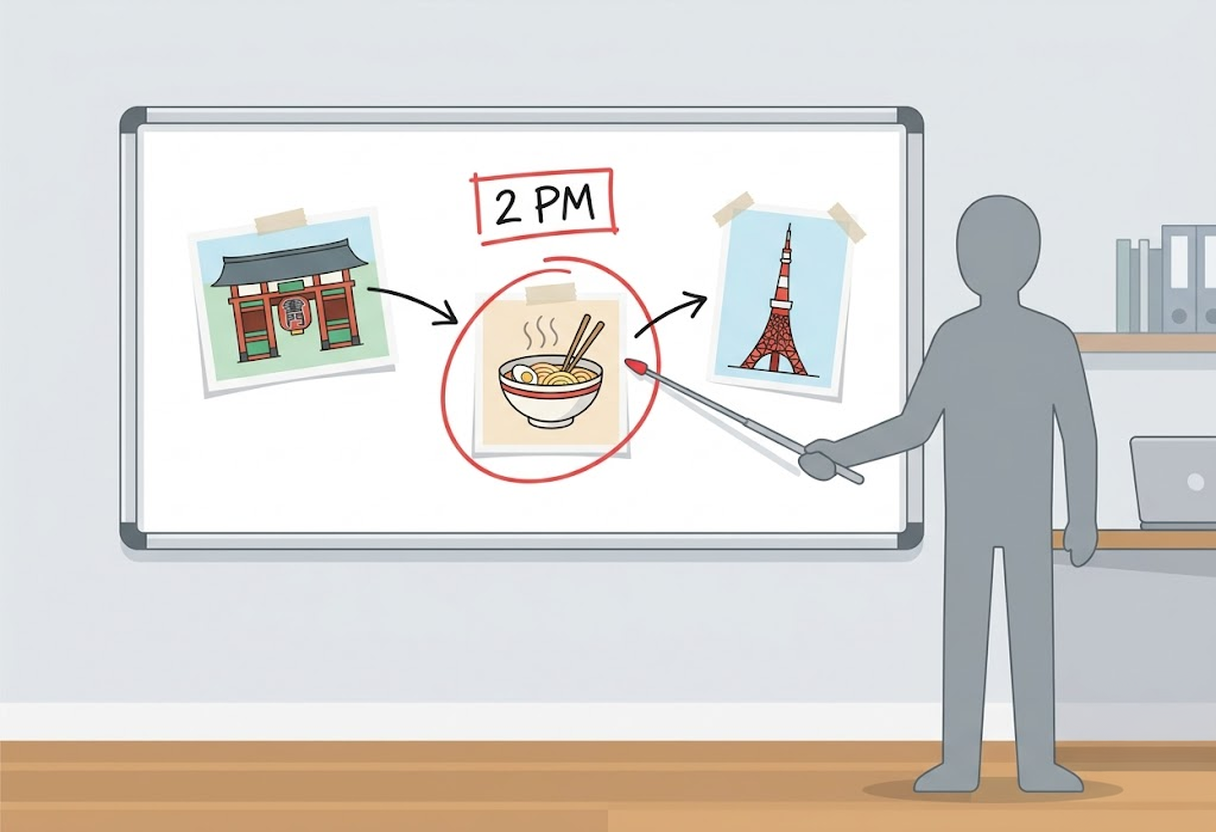
Instead of traveling solely for ramen, it's more efficient to fit ramen stops into your existing sightseeing route. Consider the following patterns:
Pattern ①: Morning Ramen → Tourist Spot
Example: Torisoba 223 (opens 8:00 AM) → Kyoto Botanical Garden (from 9:00 AM) → Shimogamo Shrine. This is the most efficient pattern, utilizing quiet morning hours and aligning with tourist spot opening times.
Pattern ②: Sightseeing → Late Lunch (Around 2 PM)
Finish your sightseeing in the morning, then head for ramen around 2 PM when the lunch peak has subsided. Example: Explore Senso-ji Temple and Nakamise-dori in the morning → Head to a ramen shop in the Asakusa area at 2 PM. However, since many shops have *nakayasumi*, it's crucial to check for *tooshi-eigyou* (continuously open) shops in advance.
Pattern ③: Early Dinner (5:30 PM – 6:00 PM)
Immediately after the evening service begins, right after *nakayasumi*, is a golden time that avoids both the lunch and dinner peaks. Example: Shopping in Shibuya → Ramen shop in the Shibuya area at 5:30 PM → Enjoy Shibuya Scramble Crossing at night. This allows you to plan your subsequent activities with plenty of time.
The 'Shift One Station' Strategy
Ramen shops right in the heart of tourist areas are inevitably crowded. It's often the case that simply moving one station away can dramatically cut down waiting times. If you're queuing for 40 minutes in central Shinjuku, it's not uncommon to find a shop of the same caliber in Nakano, just a 5-minute train ride away, with no wait.
Shops inside or directly connected to stations are convenient on rainy or scorching hot days, but their easy access directly translates to crowds. The courage to walk a little can significantly enhance your travel satisfaction.

Zack's Note
Shops an 8-12 minute walk from the station often have significantly shorter queues just because of that distance. With Google Maps, you won't get lost, and you'll often find a 'delicious shop that isn't crowded' waiting at the end of your walk. You don't always have to choose shops right near the station—walking a bit is a perfectly valid option.
⏱️The Art of Waiting in the Land of Small Shops — The 1-Batch Rule
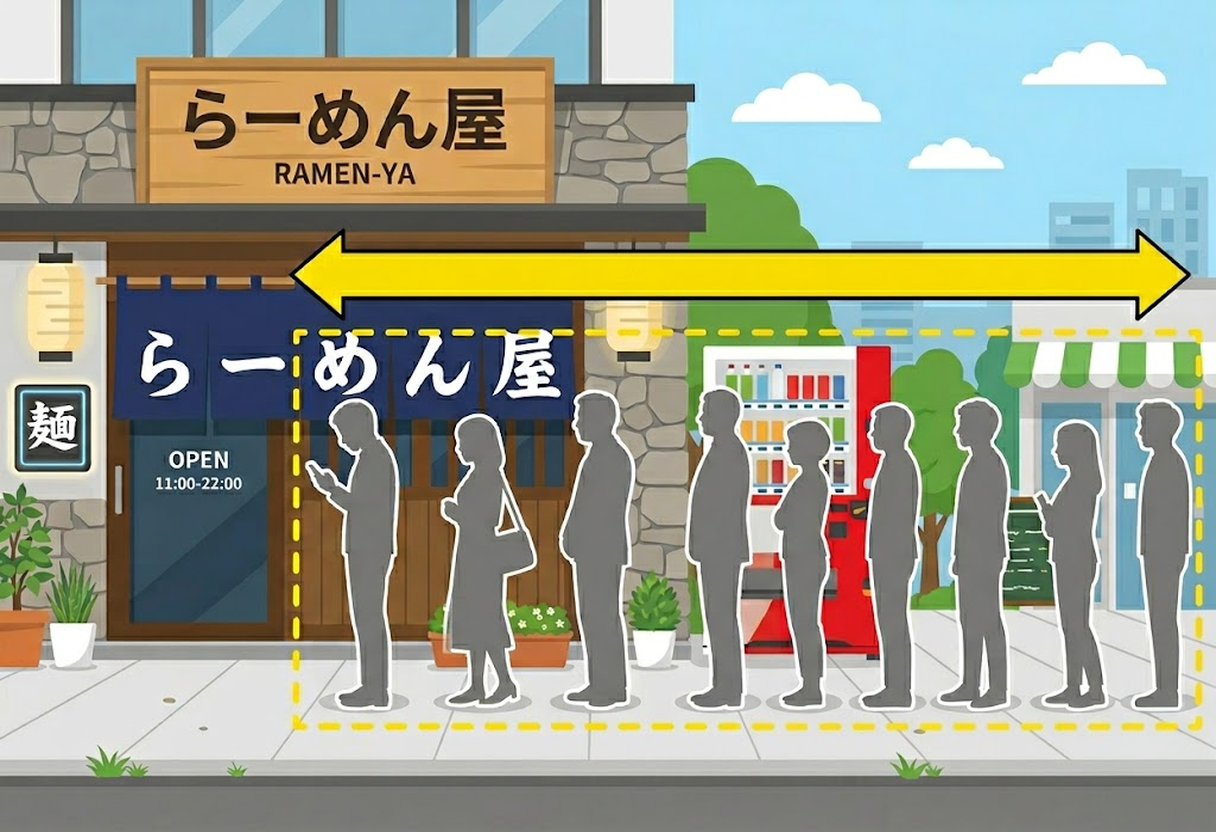
Japanese ramen shops are notably small compared to eateries worldwide. The average seating capacity for shops listed on Ramen Gateway is just about 16 seats. Shops with 10 seats or fewer make up approximately 30% of the total, and those with 15 seats or fewer account for about 60%.
This small size is the root cause of queues. Even the most popular 10-seat shop can only serve 40-50 people per hour at most. However, conversely, if you understand the queue structure, you can predict waiting times quite accurately.
Ramen Shop Queues Move in 'Batches'
Ramen shop queues don't move one person at a time like fast-food lines; they move in blocks, or 'batches.' In a shop with 10 counter seats, 10 customers who sat down almost simultaneously will finish eating in 10-15 minutes, and then all 10 seats will turn over at once. So, 'the line hasn't moved in 5 minutes' isn't unusual; it often just means you're waiting for the next batch turnover.
The 1-Batch Rule — Predicting Waiting Times
Let's call the cycle where a group of customers in a shop turns over '1 batch.' From the moment a ramen bowl is served to when it's finished, it takes an average of 10-15 minutes. Including seating and departure turnover time, 1 batch is approximately 20 minutes (this can vary depending on the shop's speed).
First, count how many people are in line ahead of you. Next, check the shop's seating capacity (listed on each shop's page on Ramen Gateway). If the number of people ahead is less than or equal to the seating capacity, you'll get in with the next 1 batch. If it exceeds the seating capacity, you'll have to wait for 2 or more batches.
🧮The 1-Batch Rule — Specific Examples
- At a 10-seat shop, 8 people ahead → You'll get in with the next turnover (approx. 20 minutes)
- At a 10-seat shop, 12 people ahead → 2 turnovers needed → approx. 40 minutes
- At an 8-seat shop, 20 people ahead → 3 turnovers needed → approx. 60 minutes
You can quickly decide: if it's 1 batch, you'll wait; if 2 batches or more seem too long, you'll head to another shop. Note that this is an estimate for 'waiting time.' Eating also takes 10-15 minutes, so factor in mealtime when considering the time until your next plan.
'Crowd Signs' That Lengthen Batch Times
1 batch = approximately 20 minutes is a guideline, but batch times can extend to 25-30 minutes under the following circumstances. Observe the composition of the queue:
- 👨👩👧👦 Many families with children — Tend to eat at a slower pace
- 🧳 Many customers with suitcases — Entry takes longer due to luggage storage
- 👥 Many large groups — May linger at their seats for a while after eating
Conversely, 'Fast' Signs
- 🧑 Many solo diners — Turnover is quicker as seats open one by one
- 🎫 Shop has a ticket machine (*kukenki*) — No time lost on ordering; cooking starts immediately after seating (approx. 60% of listed shops have ticket machines)
- 🍜 Customers inside are lifting their bowls to drink soup — A sign they're almost finished eating
Dr. Hiro's Note
Tip for increasing the accuracy of the 1-batch rule: As soon as you start queuing, note down on your smartphone the time the previous batch entered. If you know the actual time until the next batch, you can predict your own waiting time almost precisely.
Have Two Alternative Options
In case of a long queue, bookmark two alternative options in the same area. It's common for your first choice to have a 3-batch wait, while a second option 200m away might be empty. Ramen Gateway's bookmark feature allows you to quickly check your list even while traveling.
👀Don't Be Fooled by Apparent Queues
Even if there's no one queuing outside the shop, don't let your guard down. Some Japanese ramen shops have 'invisible queue systems.'
*Kichou-sei* / *Seiriken-sei* (Sign-up/Numbered Ticket Systems)
At some shops, you write your name on a board at the storefront and wait at a designated remote location. Even if there are no people outside the shop, it's possible there's actually a 20-minute wait.
For example, Tokyo Style Noodle Hotate Biyori in Akihabara uses a *seiriken-sei* (numbered ticket system). You receive a numbered ticket at the storefront and return at the indicated time for entry. Just because there's no queue in front of the shop doesn't mean you can get in immediately.
While a *seiriken-sei* system means you 'don't have to queue,' it requires you to spend time in the surrounding area until your designated time. For travelers, this can be less flexible, but it also presents an opportunity to visit nearby tourist spots or do some shopping while you wait. In a place like Akihabara, you'll certainly have no trouble finding ways to pass the time.
Pre-purchase Meal Tickets — The Queue Starts at the Ticket Machine
At shops with a ticket machine (*kukenki*), there's often a rule to purchase meal tickets before entering. Even if there's no queue outside, if 3-4 people are lined up at the ticket machine, that's effectively where the wait begins. Operating a ticket machine can take time, especially if there's no foreign language menu.
Related Guides
How to queue at a ramen shop is explained in detail in our Queue Etiquette Guide, behavior after entering in the Counter Etiquette Guide, and how to use a ticket machine in the Master the Ticket Machine Guide.
Don't Be Complacent Even If It Says 'Open'
Shops that operate on a 'closing once soup runs out' basis may shut down even within their stated business hours. It's not uncommon for popular small shops to sell out before 2 PM. If you're aiming for a limited-time menu item, acting even earlier is crucial. Don't miss any notes in the business hours section on each shop's page.
🤔Queue for a Famous Shop, or Find a Less Crowded Gem?
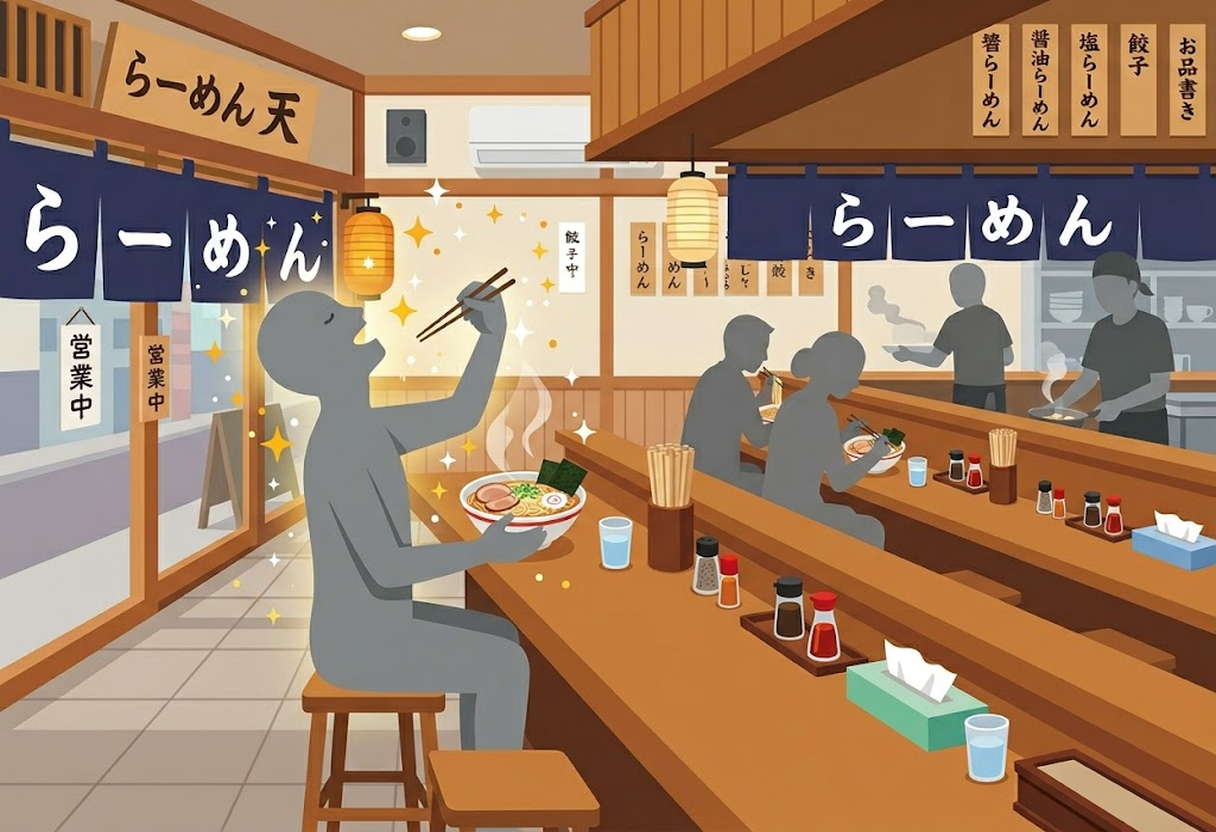
Walking past Japanese ramen shops, you might be surprised by the difference between shops with long queues and those that are empty. So, are the shops with longer queues necessarily more delicious?
Crowded ≠ Always Best
Shops with long queues are often delicious. However, the psychological phenomenon of 'queuing because there's a queue' (the bandwagon effect) is definitely at play. The phenomenon of queues attracting more queues is especially pronounced in tourist areas.
On the other hand, empty shops aren't necessarily less delicious. They are often less crowded simply due to the time of day, location, or day of the week. Many hidden gems are just a 10-minute walk from the station, where queues disappear.
'One Bowl You Can Only Get Now' vs. 'One Bowl You Can Get Again'
Travel time is limited. You can't visit every shop. So, what you want to consider is how to prioritize.
- 🥷 Shops with short operating hours or irregular holidays (referred to as 'Ninja shops') — 'You might not be able to eat there if you don't go now' → Prioritize them
- 🏪 Shops with long operating hours or chain locations — 'You can go again when you return' → If you have spare time
- ⏰ Shops that close when soup runs out — Incorporate into morning/lunch plans. Evening might be too late.
'Limited hours, far from the station, irregular holidays' — these shops are challenging, but the sense of accomplishment and the memory of the taste when you finally get there are exceptional.
Mei's Note
Shops you 'can go to again' offer reassurance, but what truly stays in your travel memories is 'that one bowl I'm glad I tried when I had the chance.' If you find a Ninja shop, try to fit it into your schedule, even if it's a bit of a stretch.
The Value of an 8-12 Minute Walk
A shop right in front of the station, or a shop in a residential area a 10-minute walk from the station. Which would you choose?
Most travelers choose 'near the station.' However, shops a short walk from the station tend to have shorter queues just because of the distance. With Google Maps, you don't have to worry about getting lost. Considering a 10-minute walk as an investment to avoid a 30-minute queue, it's overwhelmingly advantageous.

Sophia's Note
For travelers, a '30-minute wait' is also an opportunity cost for sights and experiences they could have had. I think avoiding crowds to save time is an important decision that enhances the quality of your trip.
🎮Level-Based Strategies — Crowd Avoidance is an 'Advanced Move'
Avoiding crowds isn't 'fleeing.' Rather, it's an advanced travel move to read the time zones, plan your route, and eat at the optimal moment. Drawing an analogy to Ramen Gateway's Rank System, we propose level-based strategies.
Newbie ~ Seeker: Avoid the Peak
- First, arrive just before opening (the most reliable way to avoid crowds)
- Choose shops near stations, with ticket machines (*kukenki*), and English menus
- Bookmark two alternative options
- Be aware of *nakayasumi* — always check business hours for the afternoon
Pathfinder ~ Warrior: Master the Time Zones
- Aim for 5:30 PM – 6:00 PM right after *nakayasumi* (the evening's golden time)
- Avoid tourist area crowds with the 'shift one station' strategy
- Incorporate *asa-ramen* into your itinerary
- Calculate queues with the 1-batch rule and quickly decide whether to stay or move on
Elite ~ Legend: Read the Peak and Act
- Eat the shortest route even during peak hours — 1-batch rule + discerning crowd signs
- Center your itinerary around Ninja shops (short operating hours, hidden gems)
- Find 'delicious shops that aren't crowded' yourself
- Utilize late-night ramen and explore new bowls until the last day of your trip
Zack's Note
Beginners avoid the peak. Advanced travelers 'read' the peak and act. Both are valid strategies. The important thing is to move based on your own judgment, rather than 'just queuing.' That alone will double your satisfaction on a ramen journey.
❓Frequently Asked Questions
QWhen are Japanese ramen shops least crowded?
For shops open in the morning, 7-9 AM is the least crowded. For lunch operations, arriving just before opening is safest. Around 2 PM is also less crowded after the lunch peak, but many shops close for *nakayasumi*, so confirm in advance. In the evening, right after *nakayasumi* ends, from 5:30 PM – 6:00 PM, is the target time.
QWhat's a reasonable waiting time for a ramen queue?
You can decide using the 1-batch rule. If the number of people ahead is less than or equal to the shop's seating capacity, it's about 20 minutes. If it's double, about 40 minutes. Judge based on your itinerary's flexibility and whether you can only eat that particular ramen at that specific shop. If there are alternative options in the same area, switching to another shop is a choice if the wait is 2 batches (40 minutes) or more.
QAre ramen shops less crowded on rainy days?
On rainy days, more people tend to stay indoors, so shops are often less crowded than usual. However, shops inside or directly connected to stations are 'easy to access even in the rain,' so they might become more crowded. Shops a short walk away tend to be hidden gems on such days.
QWhat are the best times for ramen shops with children?
Choose shops with table seating, and aim for right after opening at 11 AM or early in the evening around 5:30 PM. Peak hours (around 12 PM, around 8 PM) are often full with longer waits and a bustling atmosphere, so it's better to avoid them for a more relaxed meal. Checking the seating types on each shop's page in advance will give you peace of mind.
QCan you make reservations at ramen shops?
Most ramen shops do not accept reservations. They typically operate on a first-come, first-served basis (queueing order). In some *seiriken-sei* (numbered ticket) shops, time slots might be assigned based on arrival order.
✅Summary — Ramen Checklist for Travelers
Finally, here's a checklist for your ramen strategy during your trip.
Before Departure
- Bookmark 3 shops in the same area (first choice + 2 alternatives)
- Check each shop's business hours and if they have *nakayasumi*
- Prioritize 'Ninja shops' (short operating hours, irregular holidays) in your schedule
On the Morning of Your Visit
- Double-check the business hours of the shops you plan to visit today (possibility of temporary closure)
- If *asa-ramen* can be incorporated, do so — it's a much less crowded time than lunch
Upon Arrival at the Location
- Spot a queue → Immediately assess with the 1-batch rule (people ahead ÷ seating capacity × 20 minutes)
- If there are 'crowd signs' (families, heavy luggage, large groups), adjust by +5-10 minutes
- If it looks tough, head to an alternative. Wasting time hesitating is not worth it.
Things to Watch Out For
- Possibility of *nakayasumi* between 2 PM and 5 PM (applies to 44% of shops)
- Even if it says 'Open,' beware of soup running out or early closing
- Shops with *kichou-sei* or *seiriken-sei* may have a wait even if no one is outside
While this guide has shared many ways to use your time efficiently, ramen isn't a 'task to be completed.' When a steaming bowl is in front of you, put your phone down and slowly savor that first sip of soup. That very moment is why it's worth making an effort to manage your time.
Queuing isn't the goal of your trip. Meeting a delicious bowl is the goal.
The moment you find a 'delicious shop that isn't crowded,' your trip will transform. We hope this guide helps make your ramen journey even richer.
🔍Now that you've read this guide, it's time to find a shop!
Once you understand the time slots and strategies, all that's left is to decide which shops to actually visit. Try searching from the Shop List page by narrowing down by area or tag.
Each shop's page includes business hours, seating capacity, and ordering method, so you can immediately apply the 1-batch rule and *nakayasumi* checks introduced in this guide. Just bookmarking 3 shops before you go will make your decisions on the day significantly smoother.
Shop Finding Tips
On the Shop List page, you can filter by area. Conditions like morning operations, late-night operations, and 'Ninja shops' can be checked in each shop's business hours and icons on their respective pages.
✍️Verified by Real Humans
The data in this article is calculated by aggregating the business hours, seating capacity, and ordering methods of shops listed on Ramen Gateway. The listed shop data is curated by our editorial team based on official information, social media, review sites, and some details are verified on-site. As the number of shops increases, the data will be updated periodically. Actual operating conditions may change, so please check the latest information on each shop's page before visiting.
"We don't let AI eat ramen. We use AI to draw the coolest map so adventurers worldwide can find the real treasure hidden in Japan's back alleys."
Made in Japan — with local knowledge & AI assistance