Asakusa Ramen Guide: 20 Bowls to Fit into Your Sightseeing Schedule — From a Light Bowl After Nakamise to a Shime Ramen on Hoppy Street
Find the perfect bowl for your journey in the birthplace of Japanese ramen.


📖What You'll Find in This Guide
- What's a light ramen I can enjoy even after eating my way through Nakamise?
- What's a good shime ramen (ramen to finish the night after drinks) after drinks on Hoppy Street?
- Are there any 'Asa-Ra' (morning ramen) spots open from 7 AM?
- Which shops offer English menus and cashless payment for peace of mind?
- Which shops have table seating for families or groups?
- Are there any vegan-friendly ramen options?
⚡Lost? Start Here — Asakusa Ramen Quick Guide
| Scene | Shop | Difficulty | Highlight |
|---|---|---|---|
| Light meal after Nakamise | Umikaze | ★1 | Clear clam-broth shio ramen |
| A bowl to finish the night | Yukikage | ★1 | Tori paitan, open until 11:30 PM, cashless available |
| Ramen at 7 AM | Benkei | ★2 | Limited morning hours, hearty seabura shoyu asa-ra |
| Safe for first-timers | Hayashida | ★1 | English menu, cashless, open until 11 PM |
| Vegan-friendly | Yoroiya | ★1 | Animal-product-free menu available |
| Asakusa's top-tier shop | Mitsui | ★2 | Tabelog highly rated, a gem of the tanrei style |
About Our Information Sources
Information in this article is curated from official websites, social media, review sites, and some on-site verification. While we strive for accuracy, please check each shop's page for the latest information before visiting.
🍜The Birthplace of Japanese Ramen — Yet Few Come Here Just for Ramen
In 1910 (Meiji 43), a shop called 'Rairaiken' opened in Asakusa. It invited chefs from Guangdong Province via Yokohama Chinatown and served 'raumen' (an early term for ramen) tailored to Japanese tastes. This is considered Japan's first ramen specialty shop, meaning the origin of Japanese ramen culture lies right here in Asakusa.
However, nowadays, few people visit Asakusa solely for ramen. Taking photos at Kaminarimon, snacking on ningyo-yaki (doll-shaped cakes) and agemanju (fried manju, steamed buns with filling) on Nakamise Dori (the shopping street leading to Senso-ji Temple), and drawing omikuji (fortunes) at Senso-ji Temple are typical activities. With so many 'specialties' like Tendon (tempura rice bowl), Monja (savory pancake), and Sukiyaki (hot pot dish), ramen often struggles to fit into visitors' schedules.
That's why this guide proposes not 'making a special trip for ramen,' but rather 'slipping ramen into the gaps of your Asakusa day.' A light bowl that's just right after exploring Nakamise. A shime ramen (finishing ramen) to finish off your evening after drinks on Hoppy Street. A bowl to enjoy at 7 AM before Nakamise even opens. Asakusa has 20 ramen options that perfectly fit into your travel schedule.
And one more thing: Asakusa is one of Tokyo's most foreigner-friendly ramen areas. With 8 shops rated ★1 (beginner-friendly), that's two to three times more than other areas. You'll find English menus, cashless payment options, and even vegan menus. It's a traveler-friendly ramen environment that has evolved precisely because it's a major tourist destination.

Ren
It's the birthplace of Japanese ramen, yet few people come specifically for ramen. That unexpectedness is interesting. But those in the know understand — Asakusa has many hidden gems.
⏰Asakusa in a Day with Ramen — When and Where to Eat
We've organized how ramen can fit into a typical Asakusa sightseeing day, broken down by time.
🌅Morning Asakusa (7:00 AM – 10:00 AM) — The Secret 'Asa-Ra' (Morning Ramen)
Most shops on Nakamise Dori open between 9 AM and 10 AM. Senso-ji Temple opens at 6 AM, but tourists are sparse at this time. In the morning quiet of Asakusa, where you can have Kaminarimon (Thunder Gate) all to yourself, starting your day with ramen is a unique option.
Ramen Benkei (Benkei) operates with a unique morning-specialized style, opening at 7 AM and closing at 10 AM. Its seabura shoyu (soy sauce ramen with a generous amount of pork back fat) is perfect for a hearty energy boost to start your day. Yoroiya also opens from 8:30 AM and is a calm shop offering vegan options. Both are located a little away from Asakusa's main tourist core, and enjoying ramen in the quiet, old-town atmosphere of the morning is truly special.
If you visit, we'd love to hear your review!
If you visit, we'd love to hear your review!
🏮Lunch After Nakamise (11:00 AM – 3:00 PM) — Slip in a Light Bowl
After munching on ningyo-yaki, agemanju, melon bread... on Nakamise, you might find yourself fairly full. But you haven't had a 'proper meal' yet. In such cases, tendon or sukiyaki can be too heavy. Ramen, on the other hand, a light bowl is just right.
After exploring Nakamise, we recommend light, *assari*-style (light, refreshing) ramen. Kaidashi Ramen Umikaze (Umikaze)'s clear *shio* (salt) broth is a gentle, comforting bowl for a stomach that's already had some snacks. Ramen Hayashida (Hayashida)'s *tori chintan shoyu* (clear chicken broth soy sauce ramen) also offers a refreshing taste, perfect for a quick bite between sightseeing. Both shops offer English menus and cashless payment.
For vegans, Yoroiya is highly recommended. A shop offering ramen without animal products in the Nakamise area is a rarity. Asakusa attracts 600,000 foreign visitors annually, and Taito City is actively promoting food diversity, including developing vegan and halal-friendly maps. However, shops offering vegan ramen are still uncommon, making Yoroiya's presence particularly noteworthy.
If you want something a bit more substantial, Jikaseimen Uruchi (Uruchi)'s *tanrei shoyu* (clear-broth soy sauce ramen) or Kibi Taro (Kibi Taro)'s *shoyu ramen* (soy sauce ramen) are also great choices. Mitsui, highly rated on Tabelog (Japanese restaurant review site), might require a wait, but it's well worth it.
If you visit, we'd love to hear your review!
If you visit, we'd love to hear your review!
If you visit, we'd love to hear your review!
🌙Evening Asakusa (5:00 PM – Late Night) — The 'Shime Ramen' After Drinks
In Japan, there's a food culture of 'finishing a night of drinking with ramen.' After enjoying beer or sake at an *izakaya* (Japanese pub), you have one last bowl of ramen before heading home. This is called 'shime ramen' (finishing ramen). The warm soup and noodles, gently comforting a tipsy body, are a staple of Japanese nightlife.
Hoppy Street, located west of Senso-ji Temple, is the heart of Asakusa's nightlife, lined with old-fashioned *taishu izakaya* (casual pubs). The classic way to enjoy it is by snacking on *gyusuji nikomi* (stewed beef tendon) and *yakitori* (grilled chicken skewers) while drinking 'Hoppy' (a beer-flavored, low-alcohol beverage mixed with shochu, Japanese distilled liquor). The lanterns and open-terrace atmosphere are increasingly popular with foreign tourists.
For *shime ramen* after drinks on Hoppy Street, shops open late are recommended. Umikaze is open until midnight, and its light clam broth is just right for a tired stomach. Yukikage offers rich *tori paitan* (creamy chicken broth) and is open until 11:30 PM for a substantial finish. Hayashida also has continuous service until 11 PM.
If you venture a little further, Uruchi (towards Tawaramachi, until 11 PM) and Noriaki・Bibi (towards Komagata, until 11 PM) are also open in the evening. Noriaki・Bibi's *jukusei miso ramen* (aged miso ramen), in particular, is highly praised as exceptional after a drink.
If you visit, we'd love to hear your review!
If you visit, we'd love to hear your review!

Mei
Senso-ji Temple, lit up at night, is truly beautiful. After 5 PM, the crowds significantly thin out. Seeing the quiet Senso-ji at night, then having drinks on Hoppy Street, and finishing with ramen — I think this is the golden route for an Asakusa evening.
🗺️How to Navigate Asakusa — Ramen Map by Zone
Asakusa Station is served by four lines: Tokyo Metro Ginza Line, Toei Asakusa Line, Tobu Skytree Line, and Tsukuba Express. It boasts excellent access, just 5 minutes from Ueno via the Ginza Line, 5 minutes from Akihabara via Tsukuba Express, and a direct 30-minute ride from Shibuya via the Ginza Line. Tokyo Skytree is a 20-minute walk away (via Sumida River Walk), making the Asakusa → Skytree 'East Tokyo Golden Route' a classic tourist itinerary.
⛩️Zone A: Kaminarimon・Nakamise Area — 7 Shops in the Heart of Sightseeing
Kaminarimon, Nakamise Dori, and Senso-ji Temple form the core of Asakusa tourism. Centered around Asakusa 1-chome and Kaminarimon 2-chome, seven ramen shops are clustered here. Their excellent locations make them easy to visit naturally within your sightseeing flow.
Ramen in this zone: Tanaka Soba-ten (★1), Yukikage (★1), Hayashida (★1), Yoroiya (★1), Fuji Ramen (★1), Billiken (★3), Bazoku (★3). With five ★1 shops, this is the most foreigner-friendly zone.
🏮Zone B: West of Senso-ji Temple・Oku-Asakusa — Hoppy Street and Shime Ramen
The area west of Senso-ji Temple, Asakusa 2-chome. It's home to Hoppy Street and Hanayashiki Amusement Park, bustling in the evenings. Tsukuba Express Asakusa Station is the nearest.
Ramen in this zone: Umikaze (★1, until midnight), Kibi Taro (★2), Menmaru (★2), NO11 (★3 Wizard, Jiro-kei, a rich, hearty ramen style with large portions of toppings). Umikaze, open late, is a top contender for shime ramen.
🌊Zone C: Hanakawado・Sumida River Side — On the Way to Skytree
The area north of Asakusa Station, close to the Sumida River. It's also the starting point for the Sumida River Walk towards Tokyo Skytree. While slightly outside the main tourist hub, it hides some top-tier shops.
Ramen in this zone: Ikutaan (★1), Benkei (★2 Wizard, 7 AM – 10 AM only), Urinbo (★4, famous Tonkotsu (pork bone broth ramen) shop). Benkei's morning ramen is a unique Asakusa experience.
🧭Zone D: Tawaramachi・Nishi-Asakusa — Beloved by Locals, Top Performers
The area around Ginza Line Tawaramachi Station and Nishi-Asakusa. It's a calm district, removed from the tourist hustle, where renowned local shops are gathered. It's also close to Kappabashi Kitchenware Street (a specialty street for tableware and cooking utensils).
Ramen in this zone: Aun (★1, Sichuan Tantanmen), Mitsui (★2 Dojo, Tabelog Hyakumeiten, Tabelog's 'Top 100 Shops' list), Uruchi (★2, Tabelog highly rated tanrei style), Tokichiro (★3, Tantanmen), Raishuken (★5 Dojo, old-school Showa-era Chuka). Both Mitsui and Uruchi are within a 1-minute walk from Tawaramachi Station, concentrating some of Asakusa's top-tier shops.
📍Zone E: Komagata・Kuramae Area — Intersection with a Stylish Neighborhood
The south side of Asakusa, the Komagata area. Kuramae has recently become known as 'Tokyo's Brooklyn,' a neighborhood filled with stylish cafes and galleries, attracting more people to combine it with Asakusa sightseeing. Toei Asakusa Line's Asakusa Station is the nearest.
Ramen in this zone: Noriaki・Bibi (★2 Wizard, Jukusei Miso). It's open until 11 PM for dinner, making it suitable for shime ramen.

Dr. Hiro
With 7 shops in Zone A and 4 in Zone B, there are 11 shops just around Senso-ji Temple. An area with so many options directly on the tourist route is rare in Tokyo. On the other hand, the 9 shops in Zones C-E tend to have shorter wait times due to fewer tourists.
📊Map of All 20 Shops
Payment methods may change. Please check each shop's page for the latest information.
Tap/Click Shop Name
Each shop name is a link. Tap or click to jump to the shop's detailed page (business hours, ordering guide, reviews, etc.).
About Special Classes
🧙 Wizard = Shops with quirks in their ticket machines or ordering methods. 🥷 Ninja = Hidden gems with hard-to-find entrances. 🥋 Dojo = Renowned shops with unique rules or etiquette. These indicate special 'adventure elements' unique to each shop, separate from the difficulty rating ★. There are no Ninja-attributed shops among Asakusa's 20.
🗾 Asakusa Ramen Map
| Shop Name | Difficulty | Style | Payment |
|---|---|---|---|
| Umikaze | ★1 | Clam Broth Shio | Cashless available |
| Yukikage | ★1 | Tori Paitan | Cashless available |
| Hayashida | ★1 | Tori Chintan Shoyu | Cashless available |
| Yoroiya | ★1 | Shoyu (Vegan available) | Cash only |
| Tanaka Soba-ten | ★1 | Seabura Niboshi Shoyu | Cash only |
| Aun | ★1 | Sichuan Tantanmen | Cash only |
| Ikutaan | ★1 | Balanced Style | See shop page |
| Fuji Ramen | ★1 | Hakata Tonkotsu | See shop page |
| Uruchi | ★2 | Tanrei Shoyu/Shio | Cash only |
| Benkei | ★2 | Seabura Shoyu | Cash only |
| Noriaki・Bibi | ★2 | Jukusei Miso | See shop page |
| Kibi Taro | ★2 | Shoyu | Cashless available |
| Menmaru | ★2 | Tanrei Shoyu | Cash only |
| Mitsui | ★2 | Tanrei Shoyu/Shio | See shop page |
| Billiken | ★3 | Kamo Shoyu | Cash only |
| Bazoku | ★3 | Tantanmen (Hand-pulled Noodles) | Cash only |
| NO11 | ★3 | Jiro-kei | Cash only |
| Tokichiro | ★3 | Tantanmen | Cash only |
| Urinbo | ★4 | Hakata Tonkotsu | Cash only |
| Raishuken | ★5 | Showa Chuka | Cash only |
Dr. Hiro
Difficulty distribution for 20 shops: 8 shops are ★1, 6 shops are ★2, 4 shops are ★3, 1 shop is ★4, and 1 shop is ★5. The 40% ratio of ★1 shops is among the highest in Tokyo's main areas. 3 Wizard shops, 2 Dojo shops.
🟢The 8 ★1 Shops Nurtured by Tourism — One of Tokyo's Most Foreigner-Friendly Areas
40% of ramen shops in Asakusa are ★1 — they have English menus, allow ordering from a ticket machine while looking at pictures, and many accept credit cards and IC cards. It's an area visited by 600,000 foreign tourists annually, which naturally lowers the barriers.
Kaidashi Ramen Umikaze (Umikaze) — The Best Choice After Nakamise
Located in the Oku-Asakusa area (Zone B), a 3-minute walk from Senso-ji Temple and close to Hoppy Street. It offers clear *shio ramen* (salt ramen) with a broth based on clam *dashi* (broth), such as Japanese littleneck clams and Manila clams. Its light flavor is appealing, easily enjoyed even after having snacks. English menu available, cashless payment accepted. Open until midnight, making it suitable for *shime ramen*.
If you visit, we'd love to hear your review!
Ramen Hayashida (Hayashida) — English, Cashless, Until 11 PM
In the Nakamise area (Zone A). This Asakusa branch of a popular nationwide chain serves *chintan shoyu ramen* (clear-broth soy sauce ramen) with concentrated chicken *umami* (savory taste). With an English-enabled touch-panel ticket machine, credit card, and e-money support, the barrier for foreign travelers is extremely low. It also has table seating, making it easy to accommodate groups. With continuous operation from 10 AM to 11 PM, it can be visited at any time of day.
If you visit, we'd love to hear your review!
Yukikage — A Rich Tori Paitan for Your Shime Ramen
A 1-minute walk from Kaminarimon, right by Asakusa Station Exit 1 (Zone A). Its thick, milky *tori paitan* (creamy chicken broth) has a strong initial impact of richness and *umami*, providing a satisfying meal. With 5 counter seats and 6 tables, it has ample seating and can easily accommodate families. Cashless payment available. Open until 11:30 PM, making it perfect for a *shime ramen*.
If you visit, we'd love to hear your review!
Yoroiya — If You're Looking for Vegan Ramen in Asakusa
A 2-minute walk from Senso-ji Temple, near the north end of Nakamise (Zone A). This famous Asakusa shop, featured in many TV shows and magazines, offers a vegan menu that uses no animal products. Japanese ramen typically uses animal-based broths like *tonkotsu* (pork bone) or *torikotsu* (chicken bone), so vegan-friendly shops are extremely rare. The presence of a vegan ramen shop in the heart of Asakusa's Nakamise area is a huge relief for travelers with dietary restrictions. With 6 spacious tables, it's easy for families to enter, and it's open from 8:30 AM, making it an option for morning ramen. An English menu is available, but it's cash only.
If you visit, we'd love to hear your review!
Aun — Numbingly Spicy Sichuan Tantanmen
Right by Tawaramachi Station (Zone D). A renowned shop for authentic Sichuan *tantanmen* (Sichuan-style dandan noodles), characterized by the numbing sensation of *sansho* (Sichuan peppercorn) and the spiciness of *rayu* (chili oil). You can choose your preferred level of spiciness and numbness, so even those who don't like spicy food can enjoy it. An English menu is available. It's featured in various media as one of Tokyo's top *tantanmen*.
If you visit, we'd love to hear your review!
Chuka Soba Billiken — Duck-and-chicken chintan shoyu, sister shop of Ramen Kai
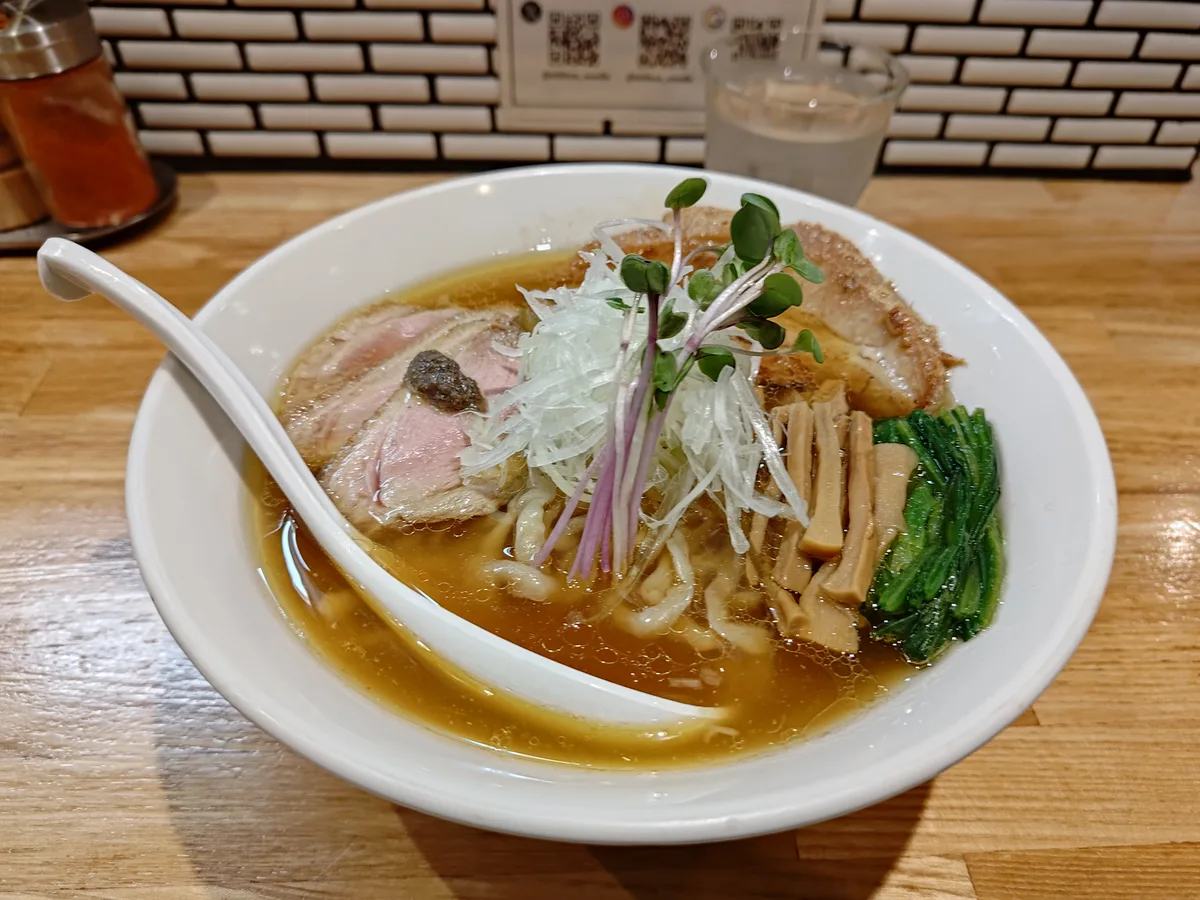
Located a 4-minute walk from Kaminarimon, towards Komagata Bridge (Zone A). This shop is a sister establishment to the renowned Ramen Kai in Akihabara, and was selected for the 2021 Tabelog Top 100 Ramen list for its duck-and-chicken chintan shoyu ramen. Its signature Hand-Crumpled Chuka Soba is an elegant dish featuring low-hydration wavy noodles and roasted duck topped with black truffle. With a smooder-made multilingual touch-panel ticket machine (Japanese, English, Chinese, Korean) and a photo menu, plus self-seating, first-time visitors will find it easy to navigate. A popular way to enjoy the meal is to add the "Ae-soba" (280 yen, added from the toppings section), a hidden specialty, and dip it into the main ramen soup for a two-stage flavor experience. There is another ramen shop next door, and Billiken itself has a small storefront, so it's recommended to confirm the "Chuka Soba Billiken" sign before entering for peace of mind. While the peak crowded hours are weekday lunch (around 12:00 PM), the evening between 6:30 PM and 7:00 PM is a relatively easy time to visit.
If you visit, we'd love to hear your review!
Visited & Verified by Our Team
Our editorial team actually visited the shop on May 1, 2026, and experienced everything from operating the multilingual touch-panel ticket machine to the tasting itself.
Other ★1 Shops
Tanaka Soba-ten (Zone A) offers a rich *shoyu* (soy sauce) broth infused with *seabura* (pork back fat) and *niboshi* (dried sardines). You can customize noodle quantity and toppings, and an English menu is available. Fuji Ramen (Zone A) serves Hakata *Tonkotsu* (pork bone) in the Nakamise area. Ikutaan (Zone C) offers a mild, comforting bowl in the Hanakawado area.
If you visit, we'd love to hear your review!

Sophia
Yoroiya for vegans, Aun for customizable spice levels, and Umikaze, Hayashida, and Yukikage for cashless payment. Whether you have dietary restrictions or are concerned about cash, you're sure to find a suitable shop among these 8.
🟡Take a Step Further with 6 ★2 Shops — Local Favorites with Real Skill
Ticket machines are mainly in Japanese but have pictures for selection; many shops are cash-only. While the hurdle is slightly higher, this zone offers a significant boost in taste satisfaction.
Jikaseimen Uruchi (Uruchi) — One of Asakusa's Foremost Tanrei Styles
Right by Tawaramachi Station (Zone D). A highly-rated shop on Tabelog, specializing in both *shoyu* (soy sauce) and *shio* (salt) ramen. Its clear broth, made from chicken and seafood, pairs perfectly with its smooth, homemade noodles. It's a small shop with 5 counter seats and 2 tables, but it's open until 11 PM for dinner, making it suitable for *shime ramen*. Cash only.
If you visit, we'd love to hear your review!
Ramen Benkei (Benkei) — Seabura Ramen at 7 AM
In the Hanakawado area (Zone C). It has a unique operating style, opening at 7 AM and closing at 10 AM, and is generally open daily (we recommend checking the shop page before visiting, as temporary closures may occur). Its *shoyu ramen* (soy sauce ramen) with abundant *seabura* (pork back fat) is perfect for an energy boost first thing in the morning. It's spacious with 23 seats, mainly counter seating. While it's a Wizard class (a system for adjusting oil quantity and flavor intensity), you can manage by pointing. Cash only.
If you visit, we'd love to hear your review!
Noriaki・Bibi — Late-Night Jukusei Miso
In the Komagata area (Zone E). A highly-rated Tabelog specialist in *miso ramen* (ramen flavored with fermented soybean paste). It features a rich broth made from a blend of aged *miso*. It's a Wizard class (a system for choosing spice levels, etc.). Open until 11 PM for dinner, so if you crave *jukusei miso ramen* (aged miso ramen) after drinks, this is the place to go.
If you visit, we'd love to hear your review!
Men Mitsui (Mitsui) — The Power of a Tabelog Hyakumeiten Shop
Right by Tawaramachi Station (Zone D). A renowned shop selected for Tabelog's Hyakumeiten list, featuring both *shoyu* (soy sauce) and *shio* (salt) as its main offerings. The clear broth offers a multi-layered *umami* that, from the first sip, tells you 'this is special.' It's a Dojo class (meaning there are rules for waiting in line and it closes when sold out). 11 counter seats. Closed Mondays and Sundays. Many locals recommend this as the single best choice for ramen in Asakusa.
If you visit, we'd love to hear your review!
Other ★2 Shops
Kibi Taro (Zone B) offers *shoyu ramen* with cashless payment. An English menu is also available, making it almost as convenient as a ★1 shop. Menmaru (Zone B) serves *tanrei shoyu* from 9 AM and is well-regarded for its cost-performance.

Zack
Mitsui often has a line even before opening. It's generally easier to get in right after opening at 11 AM on weekdays, or during the evening hours (from 6 PM). Since they close once sold out, it's best to avoid visiting late in the afternoon.
🔴For the Advanced Traveler: ★3 to ★5 Shops — Be Prepared
Japanese menus only, cash only, unique rules. The hurdles are high, but that's precisely why there's a sense of accomplishment and flavor excitement when you reach them. These 6 shops are for those who have experienced Asakusa sightseeing multiple times and are ready to challenge the next level.
Bazoku (★3) — Hand-Pulled Noodle Performance Right Before Your Eyes
A 3-minute walk from Kaminarimon (Zone A). Its specialty is the performance of artisans hand-pulling noodles right in front of the shop. The thick, chewy hand-pulled noodles are perfectly coated by the spicy *tantanmen* (dandan noodles) broth. The experience of watching the noodle-making artistry while you eat is a unique Asakusa sightseeing element that can be enjoyed as an extension of your Nakamise stroll. Cash only. Closed Mondays.
If you visit, we'd love to hear your review!
Mei
Bazoku's hand-pulled noodle performance is very photogenic, so filming is OK. If you follow the route Nakamise → Senso-ji Temple → Bazoku, it's easy to combine your Asakusa sightseeing and meal into one video. It's also close to Kaminarimon, so access is easy.
Jikaseimen NO11 (★3 Wizard) — Asakusa's Jiro-Inspired Ramen
In the Oku-Asakusa area (Zone B). This Jiro-inspired ramen features generous piles of vegetables, garlic, and *seabura* (pork back fat). The Wizard-class ordering method (using 'calls' to specify amounts of vegetables, garlic, *seabura*, and spice) is challenging, but you'll be fine if you study the details on the shop page beforehand. Open until 10 PM for dinner. Cash only.
If you visit, we'd love to hear your review!
Tantanmen Tokichiro (★3) — Authentic Tantanmen
In the Tawaramachi area (Zone D). Authentic *tantanmen* with a balanced blend of spiciness and numbness. You can customize the spice level. It's a small shop with only 6 seats, but its carefully crafted bowls are highly regarded. Cash only. Closed Thursdays.
If you visit, we'd love to hear your review!
Urinbo (★4) — Encounter Authentic Hakata Tonkotsu in Asakusa
In the Hanakawado area (Zone C), close to the Sumida River and Skytree. This renowned shop for Hakata *Tonkotsu ramen* (pork bone broth ramen) is considered one of Tokyo's best. Its cloudy broth is rich yet lacks any strong odor, and it pairs perfectly with the thin noodles. There are 4 tables available. However, it's open for lunch only (11:30 AM – 2:30 PM) and closes once sold out. Cash only. Many say it's worth visiting Asakusa solely for this one bowl.
If you visit, we'd love to hear your review!
Raishuken (★5 Dojo) — 'Machi-Chuka' Where Showa Lives On
In the Nishi-Asakusa area (Zone D). Raishuken is not a ramen specialty shop but a *Machi-Chuka* (neighborhood Chinese diner), a casual Chinese restaurant that has been around since the Showa era (1926-1989). *Machi-Chuka* refers to family-run Chinese restaurants rooted in Japanese residential areas and *shitamachi* (old downtown districts). They serve ramen alongside set meals like *chahan* (fried rice), *gyoza* (dumplings), and *rebanira itame* (stir-fried liver and chives), representing a unique Japanese food culture.
Raishuken perfectly preserves that *Machi-Chuka* atmosphere, even in the Reiwa era. The menu is Japanese only, it's cash only, and there's little consideration for tourists. However, for travelers who love retro Japanese culture and nostalgic spaces, this is 'authentic Showa' that can't be experienced in a theme park. Recommended for advanced visitors who want to feel the history of Asakusa and the roots of Japanese ramen culture firsthand.
If you visit, we'd love to hear your review!
Zack
Urinbo is only open for lunch for 3 hours. The rule is to go right at opening at 11:30 AM. Raishuken isn't a shop to 'conquer' but to 'experience.' Even if you don't speak Japanese, pointing and a smile will get you by.
🧭So, Where Should You Go? — Recommendations by Type
We've introduced 20 shops so far, but for those who might feel overwhelmed by the information, we've re-organized the recommendations to suit your situation.
| Your Situation | Recommendation | Summary |
|---|---|---|
| Want a light meal after Nakamise | Umikaze(★1) | Clam broth *shio*. Gentle on the stomach after snacking. |
| No cash / Want to pay by card | Hayashida(★1) | English menu, cashless, open until 11 PM |
| Want to finish with *shime ramen* after drinks | Yukikage(★1) | Rich *tori paitan*, open until 11:30 PM, cashless available |
| Want to eat late at night | Umikaze(★1) | Open until midnight. Asakusa's top choice for late-night ramen. |
| Want to eat first thing in the morning | Benkei(★2) | Opens at 7 AM. Before Nakamise opens. |
| Want a vegan menu | Yoroiya(★1) | Animal-product-free menu available |
| Want to go with family/group | Yukikage(★1) | 6 tables, cashless available |
| Want something spicy | Aun(★1) | Sichuan *tantanmen*. Spice level customizable. |
| Want to go to the best shop in Asakusa | Mitsui(★2) | Tabelog Hyakumeiten. Be prepared for a line. |
| Want to challenge as an advanced ramen eater | Urinbo(★4) | Famous *tonkotsu* shop. Lunch only for 3 hours. |
Ren
If you're unsure, start with Umikaze or Hayashida. Both of these shops are ★1, have English menus, and accept cashless payments, making them the easiest to fit into your Asakusa sightseeing.
👨👩👧👦Shops with Table Seating — For Families and Groups
Asakusa is an area with many foreign tourists, including families. While many ramen shops primarily have counter seating, several also offer table seating.
| Shop Name | Difficulty | Tables | Counters | Payment |
|---|---|---|---|---|
| Yukikage | ★1 | 6 Tables | 5 Seats | Cashless available |
| Yoroiya | ★1 | 6 Tables | 7 Seats | Cash only |
| Urinbo | ★4 | 4 Tables | 7 Seats | Cash only |
| Hayashida | ★1 | 2 Tables | — | Cashless available |
| Kibi Taro | ★2 | 2 Tables | 10 Seats | Cashless available |
| Menmaru | ★2 | 2 Tables | 7 Seats | Cash only |
| Benkei | ★2 | 2 Tables | 23 Seats | Cash only |
| Uruchi | ★2 | 2 Tables | 5 Seats | Cash only |
| Noriaki・Bibi | ★2 | 1 Table | 6 Seats | See shop page |
Sophia
Yukikage (6 tables) and Yoroiya (6 tables) have the most table seating. Yukikage, in particular, with its cashless payment option, is the easiest to recommend for families with children.
❓FAQ — Frequently Asked Questions
QDo I need cash?
11 out of 20 shops are cash-only. It's safe to have a few 1,000-yen bills ready. Cashless payment is reliably available at Umikaze, Yukikage, Hayashida, and Kibi Taro (all ★1 to ★2).
QAre there vegan-friendly ramen options?
Yoroiya (★1) has a vegan menu that uses no animal products. An English menu is also available, making ordering easy. The Asakusa area benefits from Taito City's vegan and halal-friendly map, making it relatively easy to find options beyond ramen as well.
QWhat is Hoppy Street?
Located west of Senso-ji Temple, it's a short street (approx. 80m) lined with old-fashioned *taishu izakaya* (casual pubs). The classic way to enjoy it is by eating *gyusuji nikomi* (stewed beef tendon) and *yakitori* (grilled chicken skewers) while drinking 'Hoppy.' It's busiest from evening onwards. Finishing your night with ramen at a nearby ramen shop after drinks is a typical way to enjoy Asakusa's nightlife.
QCan I eat while walking on Nakamise Dori?
Eating while walking is prohibited on Nakamise Dori. The rule is to stop in front of the shop where you made your purchase to eat. There are almost no public trash cans, so please return containers and skewers to the shop where you bought them.
QWhich shops are easy for families to enter?
Yukikage (6 tables, cashless available) and Yoroiya (6 tables, vegan options available) are recommended. Both are in the Nakamise area, making them easy to visit naturally within your sightseeing flow.
QIs a reservation required?
All 20 shops do not require reservations and you can walk right in. However, popular shops like Mitsui, Billiken, and Urinbo may have lines during peak hours. To avoid crowds, we recommend visiting right after opening or after 2 PM.
💡Practical Information
Access to Nearby Areas
Asakusa → Tokyo Skytree: 20-minute walk (via Sumida River Walk) / Asakusa → Ueno: 5 minutes via Ginza Line / Asakusa → Akihabara: 5 minutes via Tsukuba EX. It's an ideal base for exploring East Tokyo's tourist attractions efficiently.
Tips for Avoiding Crowds
Nakamise Dori and Senso-ji Temple are busiest between 11:00 AM and 3:00 PM. As this overlaps with ramen shops' lunch times, it's smoother to visit slightly outside these hours, between 10:00 AM and 11:00 AM, or 2:00 PM and 3:00 PM.
Shops You Can Visit on Rainy Days
Nakamise Dori is a covered arcade, so you can walk there even in the rain. Shops in Zone A are close to Nakamise, making them relatively easy to access on rainy days.
About Business Hours and Holidays
Business hours and regular holidays may change. Smaller shops, in particular, may have temporary closures, so please check each shop's page or social media for the latest information before visiting.
✅Verified by Real Humans
This article is not automatically generated. The Ramen Gateway editorial team researched local information and compiled this guide by cross-referencing official shop information, reviews, and actual visit records. Our AI editor handled the structure and drafting, while a human team performed fact-checking and final review.
🎯Summary — A Bowl for Your Asakusa Journey
Asakusa might not be a city you visit 'just for ramen.' However, whether it's a light bowl after tiring from walking Nakamise, a *shime* after drinks on Hoppy Street, or a morning bowl at 7 AM before sightseeing begins — there's a perfect ramen-sized slot somewhere in your Asakusa day.
In one of Tokyo's most foreigner-friendly areas, boasting eight ★1 shops, you'll find everything from vegan options to Tabelog Hyakumeiten selections. Discover the perfect bowl for your journey in the birthplace of Japanese ramen.
Details for all 20 shops (business hours, ordering methods, reviews) can be found on the Asakusa Shop List Page.
Ren
While there are light bowls to fit into sightseeing, there are also shops like Mitsui and Urinbo that are worth visiting just for that one bowl. Asakusa's ramen has a depth that goes beyond just 'filling a gap.' We hope you find a bowl for your journey.
"We don't let AI eat ramen. We use AI to draw the coolest map so adventurers worldwide can find the real treasure hidden in Japan's back alleys."
Made in Japan — with local knowledge & AI assistance