Shoyu Ramen Complete Guide: Discover the Origin of Japanese Ramen
The Difference Between 'Tare' and 'Soup', How to Find it at a Ticket Machine, and Recommended Shops by Difficulty Level.


📖What You'll Learn in This Guide
- What is Shoyu Ramen? — The Origin of Japanese Ramen and its Position
- The Difference Between Tare and Soup — The True Structure of Ramen that English Sites Don't Tell You
- Aromatic Oils (Koumi-Abura) — Chicken oil (Chiyu), pork back fat (Se-abura), lard... The Third Main Player that Determines the Taste
- How to Find it at a Ticket Machine — 'Chuka Soba', 'Seiyu'... These are all Shoyu Ramen
- Classic Toppings and Ajihen — The Role of Ingredients and the Japanese Way of Enjoying Changing the Taste Mid-Meal
- Regional Styles — Tokyo Shoyu, Asahikawa, Tsubame-Sanjo, Kyoto... So Different, Even With the Same Shoyu Base
- Recommended Shop List — From Safe ★1 Shops to ★4 Ninja Hideouts, a List of Featured Shops
⚡Start Here if You're Lost — 4 Recommended Shoyu Ramen
| Purpose | Shop | Area | Difficulty | Highlights |
|---|---|---|---|---|
| First Shoyu | Chuka Soba Kikutani | Kamata | ★1 | English menu available・Ticket machine・Classic bowl |
| Experience a Masterpiece | Mendokoro Honda | Akihabara | ★3 Dojo | Tabelog Hyakumeiten・Peak of clear chicken broth |
| Regional Taste in Tokyo | Aoshima Shokudo | Akihabara | ★3 | Niigata Nagaoka's Ginger Shoyu in Tokyo |
| Vegan Options | Soranoiro NIPPON | Tokyo Station | ★1 | Offers animal-free Shoyu Ramen |
About Information Sources
This article is based on information from Ramen Gateway featured shops, publicly available shop information, editorial research, and some on-site verification. While we strive for accuracy, please check each shop's page for the latest information before visiting.
🍜Shoyu Ramen — The Origin of Japanese Ramen
The bowl served at 'Rairai-ken' in Asakusa, Tokyo, in 1910, is considered the beginning of ramen history in Japan. That ramen, combining a soy sauce-based seasoning (tare) with soup made from chicken bones and pork bones, and Chinese-style noodles, eventually became known as 'Chuka Soba' and spread throughout Japan.
Overseas travelers often first encounter Tonkotsu Ramen, exemplified by Ichiran and Ippudo. However, if you ask a Japanese person, 'What comes to mind when you hear ramen?', many would think of a soy sauce-based bowl. It's also the most widely seen ramen style in shops across the country. Understanding Shoyu Ramen means touching the very roots of Japanese ramen culture.

Ren
Tonkotsu Ramen became famous overseas as a representative of 'Japanese Ramen,' but the truth is, the beginning of Japanese ramen was Shoyu. Learning its origin makes the world of ramen many times more interesting!
Shoyu Ramen Taste Profile
🟢🟢⚪️⚪️⚪️ Richness: Leaning Light — Many shoyu ramen have clear soups, making them lighter than tonkotsu or miso. However, back fat (se-abura) or Iekei styles are exceptionally rich.
🟢🟢🟢⚪️⚪️ Saltiness: Medium — Not as salty as the dark color of soy sauce might suggest. The amount of tare is adjusted by each shop.
🟢🟢⚪️⚪️⚪️ Noodles: Leaning Thin — Medium-thin to thin noodles are common, prioritized for compatibility with clear (chintan) soup. There are exceptions like Kitakata-style with thick noodles.
The basic flavor of Shoyu Ramen is 'delicate and profound.' The dashi (broth) of the soup, the soy sauce of the tare, and the aroma of the oil — their individual characteristics overlap to create a simple yet never-tiring taste. In contrast to the richness of Tonkotsu Ramen, it's a style where the flavors of the ingredients are directly conveyed.
🔬The Structure of Ramen — Tare and Soup are Separate Things
Many English ramen information websites describe 'shoyu ramen = soy sauce broth.' However, this isn't entirely accurate. The flavor of ramen is actually determined by a combination of four elements.
What is Tare?
Tare (タレ) is a concentrated seasoning liquid that determines the flavor of ramen. It's typically placed at the bottom of the bowl beforehand, and then the soup is poured over it to complete the ramen's flavor. The three main types are shoyu (soy sauce), miso, and shio (salt). Even with the same soup, changing the tare will result in a completely different ramen. Tare is the core of a ramen shop's flavor, and many shops keep their recipes secret.
| Element | Japanese | Role | Examples |
|---|---|---|---|
| Soup (Broth) | スープ / 出汁 | The base liquid. Animal-based, seafood-based, vegetable-based, etc. | Chicken bones, pork bones, dried sardines (niboshi), duck |
| Tare (Seasoning) | タレ | Seasoning. Placed at the bottom of the bowl, combines with the soup | Soy sauce, miso, salt |
| Oil (Aromatic) | 油 / 香味油 | Aroma and richness. Floats on the surface of the soup | Chicken oil (chiyu), pork back fat (se-abura), lard, niboshi oil |
| Noodles | 麺 | Texture changes with thickness, curliness, and water content | Thin noodles, thick noodles, flat noodles, hand-massaged noodles |
The 'shoyu' in Shoyu Ramen refers to this 'tare.' This means that soy sauce isn't the soup itself, but rather a seasoning that flavors the soup. That's why even within 'Shoyu Ramen,' a shop with chicken bone soup will taste completely different from one with niboshi soup.

Dr. Hiro
When you separate tare (seasoning) and soup (broth), the world of ramen expands dramatically. 'Shoyu Ramen' isn't just one genre, but a combination of shoyu tare × countless soups.
Shoyu Tare × Soup Combinations
The table below shows what kinds of soups are combined with shoyu tare. Examples of featured shops are also provided.
| Soup Base | Characteristics | Flavor Impression | Ramen Gateway Featured Shops Example |
|---|---|---|---|
| Chicken Bone Chintan (Clear) | Clear golden soup | Light, elegant, aromatic | Kikutani (Kamata), Honda (Akihabara) |
| Niboshi (Dried Sardines) | Broth made by simmering small fish | Deep seafood umami, slight bitterness | NIBOSHI MANIA (Kamata), Waka Seimen (Kamata) |
| Tonkotsu Paitan (Cloudy) | Cloudy soup made from long-simmered pork bones | Rich, creamy | Daiichi Asahi (Kyoto) — The origin of Tonkotsu Shoyu |
| Kamo Dashi (Duck Broth) | Broth made from duck bones and carcasses | Elegant sweetness from duck fat | Billiken (Asakusa) — Duck and Chicken Chintan |
| Rich Tonkotsu Shoyu (Iekei) | Tonkotsu soup with rich shoyu tare + chicken oil. Almost a standalone genre. | Powerful and impactful. You might be surprised if you eat it expecting regular Shoyu Ramen. | Hiiki (Kamata) — Iekei at difficulty ★2 |
Keeping this table in mind will help you understand 'what type of shop this is' when you enter. You can gather a lot of information just by looking at the soup's color and clarity.
✨Koumi-Abura (Aromatic Oils) — The Third Main Player
In addition to the combination of tare and soup, 'oil' plays a crucial role in defining the ramen's character. The layer of oil floating on the surface of the soup not only adds to its visual appeal but also significantly influences its aroma, richness, and temperature retention.
| Type of Oil | Japanese | Appearance | Effect |
|---|---|---|---|
| Chicken oil | 鶏油(チーユ) | Clear, golden oil | Elegant aroma, adds depth to the soup. A staple for Tokyo Shoyu. |
| Pork back fat | 背脂(せあぶら) | White globules of fat float on the soup | Adds a rich, heavy feeling. Characteristic of Se-abura Chatcha style. |
| Lard | ラード | Forms a thin film on the surface | Insulating effect. Asahikawa Ramen uses a lard film to protect against the cold. |
| Niboshi oil | 煮干し油 | Brownish oil | Emphasizes the aroma of dried sardines (niboshi). Used in niboshi-based shops. |
Even between two 'Shoyu × Chicken bone' shops, one using chicken oil and another using back fat will result in completely different bowls, both in appearance and taste. Try observing the surface of the soup!
🎰Finding Shoyu Ramen at the Ticket Machine — A Guide to Labels
Many ramen shops in Japan use ticket vending machines (kiosk system). The buttons on these machines often only have Japanese, making it difficult to know 'which one is Shoyu Ramen.' By remembering the following terms, you won't get lost in front of the ticket machine.
| Notation | Reading | Meaning | Note |
|---|---|---|---|
| 醤油 | しょうゆ / shoyu | Shoyu Ramen | Most common notation |
| しょうゆ | しょうゆ / shoyu | Shoyu Ramen | Hiragana notation. Same thing. |
| 正油 | しょうゆ / shoyu | Shoyu Ramen | Different Kanji notation. Same thing. |
| 中華そば | ちゅうかそば / chuka soba | Chuka Soba (≒ Shoyu Ramen) | If it says 'Chuka Soba,' it's almost certainly Shoyu. |
| 支那そば | しなそば / shina soba | Shina Soba (≒ Shoyu Ramen) | An older term, rarely used today. Some long-established shops retain it in their name. |
| ラーメン / らーめん (No flavor type specified) | らーめん / ramen | Default ramen | If no flavor type is written, it's often Shoyu. |
Ren
If the ticket machine has 'Miso,' 'Shio,' and 'Tonkotsu' listed, and there's another button just saying 'Ramen' or 'Chuka Soba' — that's almost always Shoyu Ramen. Shoyu is often the 'default,' so many shops don't bother writing 'Shoyu.' Look at the picture below. The button within the red box, simply labeled 'Ramen' — that's Shoyu Ramen!
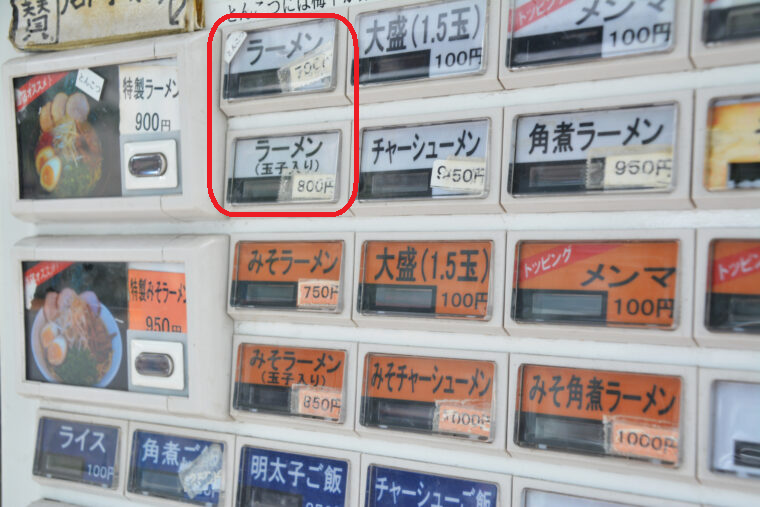
If Lost, Go Top-Left
The button in the upper-left corner of the ticket machine is often the shop's most popular item. If it's your first time, try pressing the upper-left button.
🥚Classic Toppings — The Unsung Heroes of Shoyu Ramen
Essential ingredients for Shoyu Ramen. If you press the 'Tokusei' (Special) or 'Zenbu-iri' (All Toppings) button on the ticket machine, you'll get a bowl with all of these!
- 🎋 Menma (メンマ) — Fermented bamboo shoots. Their crunchy texture and unique sweetness complement the saltiness of the shoyu soup. They pair perfectly with Shoyu Ramen and are found in almost all shops.
- 🥚 Ajitama (味玉) — A soft-boiled egg marinated in shoyu tare. The rich, runny yolk adds a great accent to the light shoyu soup. Many shops allow you to add it as an extra topping.
- 🍥 Naruto (ナルト) — A fish cake with a spiral pattern. While its flavor is subtle, it's a classic and essential ingredient for Tokyo-style Chuka Soba. Its visual appeal also plays an important role.
- 🌿 Nori (海苔) — Seaweed. When dipped in the soup and wrapped around the noodles, the aroma of the ocean spreads. The combination of shoyu flavor and nori aroma is particularly good, and it's standard for Iekei Ramen to have 3 or more sheets.

Mei
If you're unsure at the ticket machine, look for 'Tokusei' (Special) or 'Zenbu-iri' (All Toppings) buttons. You'll get ajitama, chashu, and nori all at once, making it look great for photos too! It's often cheaper than adding them individually.
🧂Ajihen (味変) — The Joy of Changing the Taste Mid-Meal
Japanese ramen culture has a custom called 'ajihen' (味変). It's a way of enjoying ramen by adding condiments from the table to change the taste as you eat. Shoyu Ramen, with its simpler flavor, is a style where the effects of ajihen are particularly noticeable.
- 🫙 Koshō (コショウ) (Black / White Pepper) — The most classic ajihen. Sprinkle a small amount after eating about half to add a spicy aroma to the soup, making the latter half of the meal more invigorating. White pepper is a staple for Shoyu Ramen, while black pepper adds more punch.
- 🍶 Osu (お酢) (Vinegar) — The acidity makes the soup refreshing. Particularly effective with back fat (se-abura) or rich (kotteri) styles. Be careful not to add too much, as it can ruin the soup's flavor; the trick is to add small amounts to your spoon and try it.
- 🌶️ Rayu (ラー油) (Chili Oil / La-yu) — Adds spiciness and aroma. Often found on tables in Tokyo Shoyu or Chuka Soba-style shops, just a few drops can dramatically change the flavor's impression.

Zack
Enjoying ajihen is great, but there's one golden rule. For the first few sips, taste the soup as is, without adding anything. Receiving the balance calculated by the chef as it is, that's the Japanese ramen etiquette.
🗾Shoyu Ramen Varies by Region — Taste the Differences While in Tokyo
As Shoyu Ramen spread across Japan, it evolved uniquely to suit local food cultures and climates. And in Tokyo, you can find famous regional shops or restaurants that recreate regional styles. The ability to compare multiple regional styles during your trip is a unique pleasure of being in Tokyo.
Tokyo Shoyu — Where It All Began
A clear (chintan) soup based on chicken and pork bones, with added depth from niboshi (dried sardines) and konbu (kelp). This is the prototype of Japanese ramen, continuing from Rairai-ken in 1910. Medium-thin wavy noodles, chashu (pork slices), menma (bamboo shoots), nori (seaweed), naruto (fish cake) — this style is likely close to what you imagine when you hear 'ramen.'
Among our featured shops, Chuka Soba Kikutani (Kamata, ★1) and Jikaseimen Uruchi (Asakusa, ★2) are classic examples of Tokyo Shoyu. Kiraku (Shibuya, ★1) is a long-established shop founded in 1952, famous for its Moyashi Wonton Shoyu (bean sprout wonton shoyu ramen).
Asahikawa Shoyu — W Soup Born from Extreme Cold
Asahikawa, Hokkaido's second-largest city, is a frigid region where winter temperatures can drop below -20 degrees Celsius. Asahikawa Ramen is characterized by its 'W Soup' (double soup), combining animal-based (pork bones, chicken bones) and seafood-based (niboshi, etc.) broths. A layer of lard (rādo) covers the surface of the soup to prevent it from cooling down while eating — wisdom born from a cold climate. The 'lard's insulating effect' mentioned in the aromatic oils section specifically refers to Asahikawa Ramen. Currently, Ramen Gateway does not feature any Asahikawa-style shops, but they will be added in the future.
Tsubame-Sanjo Se-abura — From Niigata's Metalworking Town
Tsubame City and Sanjo City in Niigata Prefecture are industrial towns known for metal processing. Tsubame-Sanjo style ramen originated as a salty ramen for factory workers after a hard day's sweat. It features a niboshi dashi-based shoyu soup, extra-thick noodles, and a generous amount of pork back fat (se-abura). It's a powerful bowl where the sweetness of the back fat and the umami of the niboshi combine. Ramen Jun (Kamata, ★1) is a Tokyo branch of a famous Tsubame-Sanjo shop and has an English menu.
Nagaoka Shoga Shoyu — Another Challenger from Niigata
Originating in Nagaoka City, Niigata Prefecture. This is an impactful bowl with a pork bone-based shoyu soup infused with plenty of ginger (shoga). Characterized by the pungent kick of ginger and the sharp taste of soy sauce, this style was born to warm the body during Niigata's winters. In Tokyo, you can experience it at Aoshima Shokudo Akihabara Branch (★3).
Zack
Aoshima Shokudo's ticket machine is Japanese-only and cash-only, but the menu is simple. Just press the 'Ramen' button, and you're good to go. The ginger-infused shoyu soup is a taste you won't find anywhere else.
Kyoto Shoyu Tonkotsu — Rich and Powerful
Contrary to Kyoto's image of elegant Japanese cuisine, rich Tonkotsu Shoyu (pork bone soy sauce) ramen is prevalent. It's a powerful flavor combining a cloudy soup made from thoroughly simmered pork bones with a rich shoyu tare. Honke Daiichi Asahi (Kyoto, ★1) has an English menu and opens from 5 AM, representing the origin of Kyoto Ramen.
Se-abura Chatcha Style — Tokyo's Rich Culture
A style where pork back fat (se-abura) is sprinkled 'chatcha' (onomatopoeia for sprinkling) over shoyu soup. While it looks rich, the soup itself is surprisingly light, with the back fat adding sweetness and richness. This style originated from Tokyo's downtown culture. You can experience it at Ramen Benkei (Asakusa, ★2 Wizard). Telling them the amount of back fat you want orally is the 'Wizard' element!
📊Shoyu Ramen Available on Ramen Gateway
Latest Featured Shops
This list is current as of the article's publication. New shops are added regularly. You can also check the latest Shoyu Ramen shops on the shop list page.
Tap/Click Shop Names
Each shop name is a link. Tap or click to jump to the shop's detail page (business hours, ordering guide, reviews, etc.).
| Shop Name | Area | Difficulty | Sub-style | Note |
|---|---|---|---|---|
| Kikutani | Kamata | ★1 | Tokyo Shoyu | English menu available. Classic introductory shop. |
| Jun Kamata Branch | Kamata | ★1 | Tsubame-Sanjo Se-abura | Tokyo branch of a famous Niigata Tsubame-Sanjo shop. English menu available. |
| Kiraku | Shibuya | ★1 | Tokyo - Long-established | Founded in 1952. Famous for Moyashi Wonton Shoyu. |
| Kacchan | Shibuya | ★1 | Tokyo Shoyu | A casual Shoyu shop in Shibuya. |
| Marusho | Akihabara | ★1 | Chuka Soba | Yodobashi 8F. Convenient for shopping. |
| Daiichi Asahi | Kyoto | ★1 | Kyoto Shoyu Tonkotsu | Opens from 5 AM. The origin of Kyoto Ramen. |
| Yamafuku | Kamata | ★2 Ninja | Tanrei Shoyu (Light Shoyu) | A hidden gem. An artistic clear soup. |
| Kokuu | Shibuya | ★2 | Niboshi Shoyu | Deep niboshi flavor. A strong contender in Shibuya. |
| Gottsu | Akihabara | ★2 | Se-abura Chatcha | The place to experience Se-abura in Akihabara. |
| Ito | Akihabara | ★2 | Tanrei Shoyu (Light Shoyu) | Elegant chintan shoyu. Akihabara's hidden gem. |
| Shinpuku Saikan | Akihabara | ★2 | Kyoto Black Shoyu | Shockingly black soup. A branch of a famous Kyoto shop. |
| Sakurazaka | Shibuya | ★3 | Shoyu Chintan | A carefully crafted bowl. |
| Honda | Akihabara | ★3 Dojo | Chicken Chintan | Tabelog Hyakumeiten (Top 100 Shops). The pinnacle in Akihabara. |
| Aoshima Shokudo | Akihabara | ★3 | Nagaoka Shoga Shoyu | A regional Niigata style in Tokyo. |
| NIBOSHI MANIA | Kamata | ★3 | Rich Niboshi | The ultimate niboshi. A rich bowl. |
| Tsumugi | Akihabara | ★4 Ninja | Shoyu Chintan | An underground hideout. Finding it is an adventure itself. |

Sophia
Shoyu Ramen is basically animal-based soup (chicken/pork). If you're looking for animal-free Shoyu Ramen, Soranoiro NIPPON (Tokyo Station, ★1) offers vegan shoyu ramen.
❓Frequently Asked Questions
QIs 'Chuka Soba' Different from 'Ramen'?
From a traveler's perspective, you can generally consider them the same. 'Chuka Soba' is an older term, widely used during the Showa era. Classical Shoyu Ramen shops tend to call themselves 'Chuka Soba.' While some shops might have specific preferences or aesthetics regarding the name, it doesn't imply a difference in taste when ordering.
QIs Shoyu Ramen High in Sodium?
The dark color of the soup might make it seem salty, but the actual sodium content varies by shop. Generally, the darkness of the soy sauce color does not directly correlate with saltiness. In some cases, 'Shio Ramen' (salt ramen) might even have higher sodium. However, we generally do not recommend drinking all the soup due to sodium intake.
QShould Beginners Try Shoyu or Miso First?
We recommend Shoyu. Miso Ramen often has a strong miso flavor, which can make it harder to discern the subtle differences in the soup base. Shoyu Ramen, on the other hand, directly conveys the individuality of the soup, making it a good first bowl for understanding the 'structure of ramen.' Of course, if you're curious about Miso or Tonkotsu, there's absolutely no problem starting there!
QWhat's the Recommended Way to Eat It?
First, take a sip of the soup without adding anything. This is the golden rule (see the 'Ajihen' section above for more details). First, taste the balance of dashi, tare, and oil as the shop intended. Slurping the noodles allows the soup's aroma to travel through your nose, enhancing the flavor. Slurping ramen is common in Japan, and making noise is perfectly acceptable. Of course, not slurping is also fine.
🏁Summary — Start Your Ramen Adventure from the Origin
Shoyu Ramen is the starting point of Japanese ramen and a deeply profound style. The combination of the four elements — 'tare,' 'soup,' 'oil,' and 'noodles' — creates infinite variations, and even with the same 'Shoyu Ramen,' you can encounter completely different bowls at each shop.
Learning the basics at a ★1 shop, then experiencing genuine craftsmanship at a ★3 or higher renowned shop. That step-by-step progression is the 'Ramen Adventure' that Ramen Gateway proposes.
Ren
Shoyu Ramen is so simple that there's no hiding anything. That's why each shop's individuality shines through the most. My recommendation is to start with Shoyu for your first bowl.
"We don't let AI eat ramen. We use AI to draw the coolest map so adventurers worldwide can find the real treasure hidden in Japan's back alleys."
Made in Japan — with local knowledge & AI assistance